
降息预期降温

Search documents
今日黄金价格多少?11月23日黄金价格一览
Sou Hu Cai Jing· 2025-11-23 14:55
Group 1 - The core viewpoint of the article indicates that gold prices experienced their first weekly decline of the month, with a drop of 0.46% from November 17 to 23, 2025, despite reaching a weekly high of $4,133 due to the strengthening of the US dollar and cooling interest rate cut expectations [1] Group 2 - As of the latest update, the London spot gold price is reported at $4,065 per ounce, while US gold stands at $4,102 per ounce, and domestic real-time gold prices are at 928 yuan per gram. Brand gold jewelry prices remain stable, with Chow Tai Fook and Chow Sang Sang at 1,295 yuan per gram, and Lao Feng Xiang and Lao Miao at 1,305 yuan per gram, while the gold recycling price is at 915 yuan per gram [3] Group 3 - Analysts suggest that gold prices need to stabilize above $4,200 to potentially challenge the October high, while a drop below $4,146 could signal the end of the current rebound. Investors looking to buy or liquidate should closely monitor these key price levels [5]


美联储降息预期降温引发全球市场震荡:黄金大跌、中概股承压,科技股泡沫隐忧加剧
Sou Hu Cai Jing· 2025-11-15 03:30
Market Overview - On November 14, 2025, global financial markets experienced significant turbulence, with international gold prices dropping over 2% and the COMEX gold futures closing at $4084.4 per ounce. The Nasdaq China Golden Dragon Index fell by 1.61%, with popular Chinese stocks like Futu Holdings and Xpeng Motors declining by over 5% [1] - The core trigger for this market shake-up was the Federal Reserve officials' hawkish signals, leading to a sharp decline in the market's expectation for a rate cut in December from nearly 70% at the beginning of the month to below 50% [1][3] Federal Reserve Policy Shift - The market had previously anticipated that the Federal Reserve would implement its third rate cut of the year in December due to weakening labor market conditions and slowing economic growth. However, multiple Fed officials expressed caution in mid-November, which became a key driver for market adjustments [3] - Consensus among officials emphasized "anti-inflation" and "preventing excessive easing." Kansas City Fed President Jeff Schmieding stated that further rate cuts could entrench high inflation, while Dallas Fed President Logan highlighted the need for clear evidence of inflation moving towards the 2% target before considering rate cuts [3][4] Economic Data Fragmentation - The U.S. government experienced its longest shutdown, leading to a disruption in the release of official employment and inflation data for October. Consequently, the Fed relied on private sector data, which indicated a mere 42,000 new jobs in October and a record high of 153,000 layoffs [4] - The Michigan Consumer Sentiment Index fell to 50.3, the lowest since 2022, creating a dilemma for policy decisions. Continuing rate cuts could risk a rebound in inflation, while maintaining rates could exacerbate economic downturns due to a cooling labor market and declining consumer confidence [4][5] Market Reactions Precious Metals - The decline in rate cut expectations led to a significant sell-off in gold, with spot gold prices dropping from a high of $4200 per ounce to below $4100, marking a single-day decline of over 2%. COMEX gold futures fell by 2.62%, the largest drop since October [6] - Analysts noted that the classic logic of "interest rates and gold" returned, as the cost of holding non-yielding assets like gold increased with high-rate expectations [6] Chinese Stocks - The Nasdaq China Golden Dragon Index fell by 1.61%, with major internet platform companies like JD.com, Baidu, and Alibaba seeing declines of nearly 4%. In contrast, the renewable energy sector showed resilience, with companies like Canadian Solar and JinkoSolar rising [7] - The adjustment in Chinese stocks was influenced by tightening Fed policies, increasing financing costs for companies reliant on U.S. dollar debt, and ongoing concerns about the regulatory environment between China and the U.S. [7] Technology Stocks - Concerns over AI stock valuations intensified, with Oracle's market value dropping by over $250 billion in the past month. Despite a slight rebound of 2.44% on one day, Oracle's stock had cumulatively fallen by 6.85% that week [8][9] - The high leverage associated with AI investments raised alarms, prompting a reassessment of tech stock valuations. Some funds shifted investments from high-valuation AI stocks to more stable sectors like semiconductors [9] Oil Prices - In contrast to the declines in gold and stocks, international oil prices rose, with U.S. crude oil futures increasing by 2.15% to $59.95 per barrel. This increase was attributed to geopolitical risks affecting oil supply, including attacks on key oil ports and tensions in the Middle East [10] - Despite OPEC's shift in outlook from supply shortages to oversupply, the ongoing production cuts by major oil-producing countries and declining U.S. oil inventories maintained a tight supply-demand balance [10] Future Outlook - The current market environment is characterized by high uncertainty due to ambiguous Fed policies, fragmented global economic data, and rising geopolitical risks. Investment strategies are shifting towards defensive positions and sectors with more predictable outcomes [11][12] - Recommendations include focusing on high-dividend defensive sectors and areas with strong earnings certainty, such as renewable energy and semiconductor equipment, while avoiding high-valuation AI tech stocks and those dependent on U.S. dollar financing [12][13]

美债收益率全线上扬 降息预期降温与债务供给放量成推手
Xin Hua Cai Jing· 2025-11-04 00:11
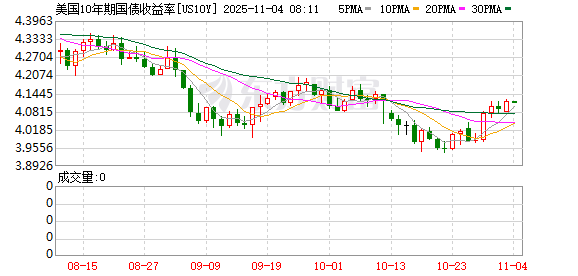
Core Viewpoint - The U.S. Treasury market is under pressure with rising yields, influenced by cautious statements from Federal Reserve officials regarding interest rate cuts and a surge in corporate debt supply [2][3] Group 1: Treasury Yield Movements - On November 3, U.S. Treasury yields rose across the board, with the 10-year yield increasing by 2.71 basis points to 4.1046%, the 2-year yield up by 2.47 basis points to 3.5984%, and the 30-year yield rising by 3.68 basis points to 4.6879% [2] - The yield curve has shifted upward, reflecting a pessimistic sentiment in the market, particularly with long-term bonds showing significant weakness [2] Group 2: Economic and Political Context - The ongoing U.S. government shutdown, which began on October 1, is on track to become the longest in history, disrupting the release of key economic data and increasing uncertainty for policymakers and investors regarding inflation and employment trends [2] - Federal Reserve Governor Cook indicated that the decision on potential rate cuts in December will depend on information available between now and then, highlighting the risks associated with maintaining high rates and the potential consequences of aggressive cuts [2][3] Group 3: Market Sentiment and Future Outlook - Market sentiment has been affected by the rapid decline in Treasury yields, with expectations for significant rate cuts being tempered by recent comments from Fed Chair Powell [2] - Cook emphasized the importance of not acting blindly, as the lack of recent official data on employment, inflation, and economic growth necessitates careful analysis of available administrative and private sector data [2]
英国国债收益率上升,美联储会后降息预期降温
Sou Hu Cai Jing· 2025-10-31 09:08
Core Viewpoint - UK government bond yields are rising, following the trends of similar bonds in the US and Eurozone, as investors lower expectations for interest rate cuts by major central banks in the coming months [1] Group 1: Interest Rate Expectations - The Federal Reserve recently cut rates but indicated that rates may not decrease again in December [1] - The European Central Bank maintained rates and noted the resilience of the economy [1] - As expectations for rate cuts in the US and Eurozone decline, the UK's rate cut expectations have also decreased [1] Group 2: Market Data - Current market data from the London Stock Exchange Group shows a 62% probability of the Bank of England cutting rates by the end of 2025, down from 72% a week ago [1] - According to Tradeweb, the yield on 10-year UK government bonds has increased by 2.2 basis points to 4.430% [1]
降息预期“降温”,英国最新通胀数据反弹
Sou Hu Cai Jing· 2025-08-20 07:40
Core Insights - The UK CPI data for July shows a year-on-year increase of 3.8%, exceeding market expectations and the previous value of 3.6% [1] - Core CPI also rose by 3.8%, surpassing both the forecast and prior value of 3.7% [1] - Following the data release, the British pound strengthened against the euro and experienced fluctuations against the US dollar [1] Economic Context - Prior to the data release, many market institutions anticipated a rebound in the UK CPI, and the actual results exceeded these expectations [1] - The Bank of England had previously predicted inflation would rise further, reaching a peak of 4% in September before gradually declining to the target rate of 2% [1] - Recent economic data indicates a 1.2% year-on-year GDP growth and a 0.3% quarter-on-quarter growth for the second quarter, both above market expectations [1] Monetary Policy Implications - Market institutions are now forecasting that the Bank of England may pause interest rate cuts in the upcoming September meeting to assess whether inflation is exerting sustained upward pressure [1]