美日货币政策分歧

Search documents
美联储降息VS日本加息?美国市场遭受冲击波,美债收益率再破4%
Hua Er Jie Jian Wen· 2025-12-02 08:25
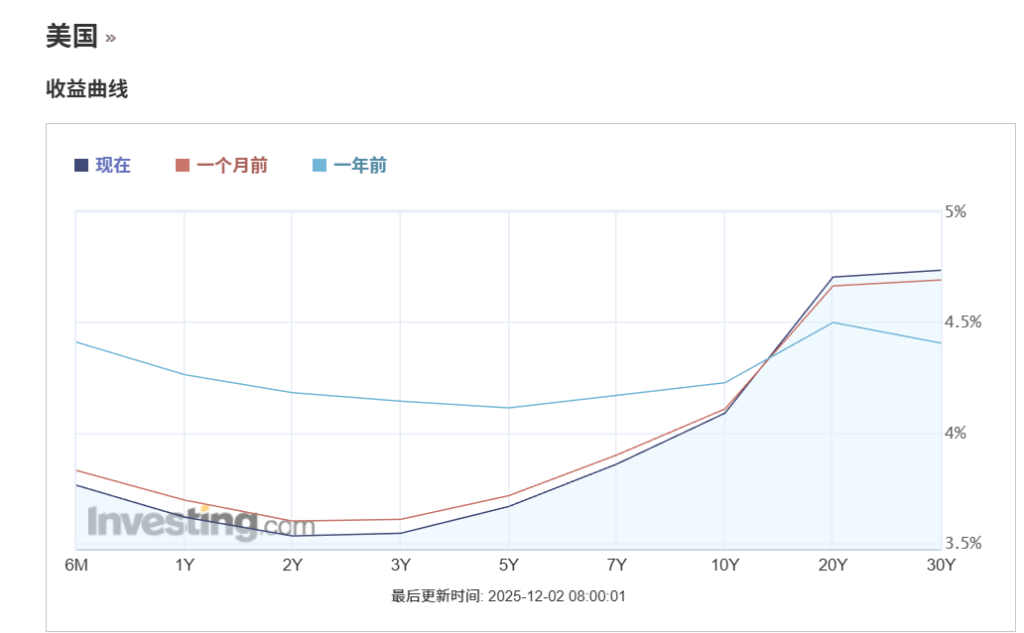
Core Viewpoint - The unexpected signal from the Bank of Japan regarding a potential interest rate hike has disrupted market expectations, leading to a rise in U.S. Treasury yields and prompting investors to reassess global capital flow risks [1]. Group 1: Market Reactions - The comments from Bank of Japan Governor Kazuo Ueda suggested a possible interest rate hike later this month, surprising investors who anticipated a more cautious approach due to economic stimulus pressures from the new Prime Minister [1]. - Following Ueda's remarks, global government bond markets experienced a sell-off, with Japan's 10-year bond yield rising to 1.879%, the highest closing level since June 2008 [1]. - The U.S. 10-year Treasury yield also increased, rebounding from below 4% to 4.095% [1]. Group 2: Implications for U.S. Markets - Concerns on Wall Street center around the rising Japanese bond yields potentially attracting funds away from U.S. investments, which could lead to increased U.S. Treasury yields [5]. - The U.S. Treasury market is particularly sensitive to changes in Japanese monetary policy due to Japan being the largest foreign holder of U.S. debt, with approximately $1.2 trillion in U.S. Treasury securities as of September [6]. - Analysts warn that a shift in Japanese bond yields could reduce demand for U.S. Treasuries, thereby pushing their yields higher [6]. Group 3: Diverging Monetary Policies - The divergence in monetary policies between the U.S. and Japan has become more pronounced this year, with the Federal Reserve adopting a more accommodative stance due to a cooling labor market, while the Bank of Japan is gradually tightening its policy in response to persistent inflation [7]. - The Bank of Japan's recent actions include raising interest rates from negative territory and increasing government bond issuance to fund economic stimulus, contributing to upward pressure on bond yields [7]. Group 4: Stock Market Impact - The potential for a rate hike in Japan has also affected U.S. stock markets, with the S&P 500 index falling by 0.5%, the Dow Jones Industrial Average dropping by 0.9% (approximately 427 points), and the Nasdaq Composite decreasing by 0.4% [8]. - Despite the recent pullback, some investors view this as a healthy correction after months of stable gains, with the S&P 500 still up 16% year-to-date [9].