美股贝塔收益

Search documents
高盛重磅预测:美股“躺赢”时代结束了?未来十年回报率恐腰斩
3 6 Ke· 2025-11-27 04:51
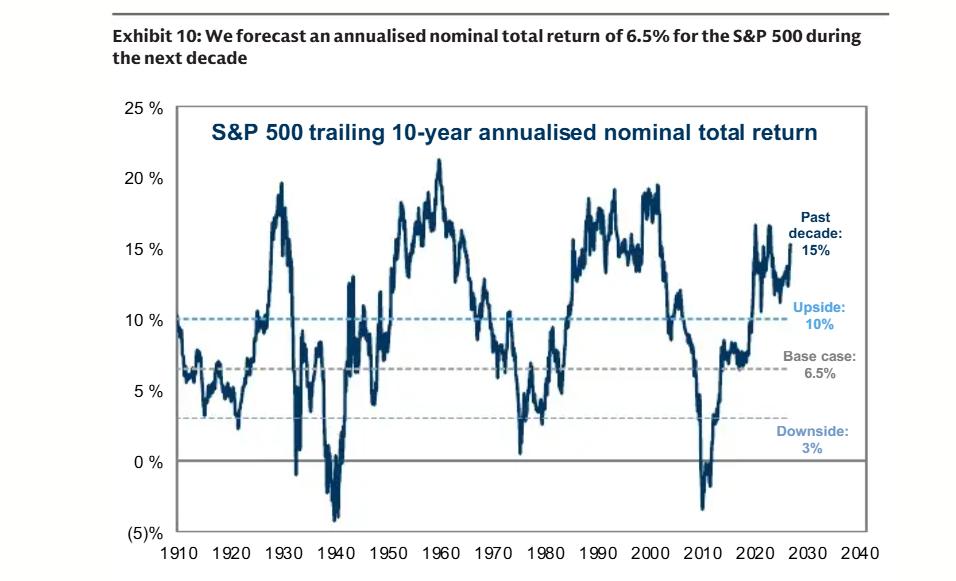
Core Insights - Goldman Sachs released a report titled "2025-2035 Global Stock Market Decadal Outlook," which emphasizes a shift from the previous decade's "U.S. stock dominance" and warns of potential corrections in asset pricing [1] - The report suggests that the S&P 500's annualized nominal total return is expected to decline to 6.5% over the next decade, a significant drop from the 15% annualized return seen in the past ten years [1][3] Return Attribution Analysis - Earnings growth is projected to contribute positively, with an expected annual compound growth rate of approximately 6%, indicating robust fundamentals for U.S. stocks [3] - Dividend returns are anticipated to contribute around 1.4% to total returns [4] - Valuation adjustments are expected to be the largest drag on returns, with the current forward P/E ratio at 23x, which is historically high. A gradual contraction in valuation multiples is predicted to negatively impact total returns by about 1% annually [4] Global Market Opportunities - As U.S. stock returns are expected to decline, relative value in global assets is becoming more apparent. Goldman Sachs forecasts a 7.7% annualized return for global equities (MSCI ACWI), surpassing U.S. stocks [6] - Non-U.S. markets, both developed and emerging, are expected to outperform U.S. stocks due to structural advantages and more attractive valuations [8] Regional Performance Expectations - Emerging markets are projected to have a 10.9% annualized return, driven by strong EPS growth in China and India [10] - Asia (excluding Japan) is expected to yield a 10.3% return, supported by approximately 9% EPS growth and a 2.7% dividend yield [10] - Japan is forecasted to achieve an 8.2% return, bolstered by EPS growth and policy-led improvements in shareholder payouts [12] - Europe is expected to deliver a 7.1% return, with half of this driven by earnings and the other half by shareholder returns [10] Strategic Recommendations - The report suggests a shift from a concentrated investment strategy focused on U.S. stocks, particularly tech giants, to a more balanced global allocation to mitigate risks associated with declining Sharpe ratios [15] - It advocates for increasing exposure to emerging markets and non-U.S. developed markets to capture potential valuation recovery and benefits from currency fluctuations [16]