股东利益平衡

Search documents
渝农商行修订章程,过半H股股东投了反对票
Xin Lang Cai Jing· 2025-12-11 10:05
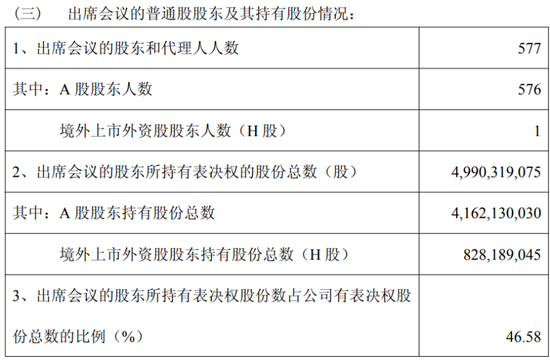
Core Viewpoint - The recent extraordinary general meeting of Chongqing Rural Commercial Bank (渝农商行) revealed significant divisions between A-share and H-share shareholders regarding proposed amendments to the company's articles of association and board meeting rules, highlighting the challenges of balancing interests between different shareholder groups [1][15]. Shareholder Meeting Attendance - A total of 577 shareholders and proxies attended the meeting, with 576 being A-share shareholders and 1 being an H-share shareholder [2][11]. - The total number of voting shares held by attending shareholders was 4,990,319,075, with A-share shareholders holding 4,162,130,030 shares and H-share shareholders holding 828,189,045 shares [2][12]. - The voting shares represented 46.58% of the total voting shares of the company [2][12]. Voting Results - The proposed amendments to the articles of association and board meeting rules faced significant opposition from H-share shareholders, with only 38.03% in favor and 58.49% against the articles of association amendment [3][13]. - In contrast, A-share shareholders showed overwhelming support, with 97.99% in favor and only 1.70% against the same amendment [3][13]. Changes in Company Articles - The amendments included changes to Article 254 regarding dividend distribution, removing the six-year claim period for foreign shareholders to claim dividends, which previously allowed the bank to confiscate unclaimed dividends after six years [4][14]. - This change aims to better balance the interests of A-share and H-share shareholders [15]. Board of Directors Changes - The board of directors saw the approval of three new non-executive directors: Ma Bao, Dong Bin, and Yuan Gang, after an eight-month wait for regulatory approval [6][17]. - Following these additions, the number of non-executive directors increased to six, while the number of independent directors decreased to three due to the resignation of Zhang Qiaoyun after serving six years [20]. Executive Director Status - Currently, the only executive director is the bank's president, Sui Jun, while the nomination of Liu Xiaojun as an executive director has yet to receive approval after eight months [21][22].

【锋行链盟】纳斯达克IPO股权激励核心要点
Sou Hu Cai Jing· 2025-09-30 16:15
Core Points - The article emphasizes the importance of Equity Incentive Plans (EIPs) in attracting and retaining key talent during the Nasdaq IPO process, balancing compliance, tax optimization, and shareholder interests [2][5] Group 1: Types of Incentive Tools - Common equity incentive tools for Nasdaq-listed companies include Stock Options, Restricted Stock Units (RSUs), Restricted Stock (RS), and Employee Stock Purchase Plans (ESPP) [2][4] Group 2: Grant Recipients and Eligibility - The core recipients of equity incentives typically include executives, key employees, critical technical personnel, and directors, with specific eligibility criteria [4][5] Group 3: Pricing and Fair Value - Incentive Stock Options (ISOs) must have an exercise price at or above the fair market value on the grant date, while Non-Qualified Stock Options (NSOs) do not have such restrictions [4] Group 4: Vesting and Performance Conditions - The most common vesting schedule is "4-year vesting with a 1-year cliff," and some plans may include performance milestones linked to the IPO or financial metrics [4][5] Group 5: Disclosure Requirements - The S-1 filing must disclose the overall framework of the equity incentive plan, including types, sizes, and remaining option pool [5] Group 6: Tax Treatment - ISOs allow for capital gains tax benefits if holding period requirements are met, while NSOs and RSUs are taxed as ordinary income upon exercise or vesting [5] Group 7: Lock-Up Period and Trading Restrictions - Typically, there is a 180-day lock-up period for founders and executives post-IPO, during which they cannot transfer shares [5] Group 8: Dilution and Shareholder Interests - Companies usually reserve 10%-20% of the option pool pre-IPO to avoid frequent dilution of existing shareholders [5] Group 9: Compliance and Risk Mitigation - Nasdaq rules require that equity incentive plans be approved by the compensation committee, ensuring proper governance and compliance with SEC regulations [5]