能源治理现代化

Search documents
中国能源治理 现代化报告(2025)发布
Zhong Guo Dian Li Bao· 2026-02-11 03:23
Core Insights - The report emphasizes the integration of green and low-carbon principles throughout the energy governance process, with a focus on the construction of a new power system and deepening electricity market reforms [1][2] Group 1: Energy Governance and Market Reforms - The report outlines that the construction of a new power system has become a key policy focus, with ongoing reforms in the electricity market [1] - The full market entry of renewable energy is identified as a critical driver for transformation, facilitating new energy trading, green electricity trading, and green certificate trading [1] - This initiative aims to enhance the scientific price discovery mechanism and lay a solid foundation for a multi-layered, unified national electricity market system [1] Group 2: Business Model Transformation - The report indicates that the initiative will reconstruct the commercial model of "source-network-load-storage," transitioning thermal power to flexible adjustment resources [1] - Renewable energy plants are encouraged to optimize operations through a "renewable energy + storage" model, promoting a shift from a unidirectional power supply and consumption model to a multi-entity interactive framework [1] Group 3: Addressing Service Quality Risks - To mitigate potential service quality risks arising from collaborative electricity calculations, the report suggests establishing a market mechanism that perceives electricity prices [2] - This mechanism will integrate characteristics of computing power supply and demand with electricity operation signals, guiding users to dynamically optimize task submission based on grid conditions [2] - The dual drive of technological innovation and business model innovation is highlighted as essential for enhancing the operational flexibility of data centers and providing key implementation methods for flexible electricity load management [2] Group 4: Future Directions - The report stresses the need for further market-oriented resource allocation in energy governance by 2026, aiming to deepen the integration of a unified national energy market with regional development strategies [2]
宋宏坤:深化“四个监管”机制创新 全面提升能源治理效能
Zhong Guo Dian Li Bao· 2025-12-09 07:02
Core Viewpoint - The article emphasizes the importance of enhancing energy governance efficiency through the innovation of the "Four Regulatory" mechanisms, which are essential for ensuring energy security and supporting the transition to a clean, low-carbon energy system in China [1][7]. Group 1: Regulatory Mechanism Development - The "Four Regulatory" mechanisms have led to significant breakthroughs in establishing a comprehensive regulatory framework covering key areas such as major engineering projects, electricity market order, energy supply security, and coordination between sources and networks [3][5]. - A closed-loop mechanism for process regulation has been established, enabling full-cycle supervision of 134 major electricity projects, ensuring quality from regulation initiation to operational launch [3]. - Digital regulation has been optimized, with 134 monitoring indicators established, leading to over 60,000 monitored trading behaviors and 230 warnings, effectively maintaining market order [3][4]. Group 2: Regulatory Efficiency Improvement - The "Four Regulatory" mechanisms have enhanced the ability to identify and address issues in energy supply and transformation, with real-time monitoring systems established for national electricity and gas networks [4][10]. - A new regulatory system in Yunnan has reduced the need for public visits by over 860,000 times and saved more than 800 million yuan for small private enterprises [4]. - The average processing time for electricity service requests has been reduced from 11.6 days to 4.7 days through improved regulatory models [4]. Group 3: Market Order Standardization - The "Four Regulatory" mechanisms have contributed to a more transparent and fair electricity market, correcting local policy deviations and ensuring compliance with national energy policies [6][10]. - The Jiangsu regulatory office has guided local governments to implement distributed network management policies, promoting healthy development of renewable energy [6]. - In Gansu, the electricity trading platform disclosed 987 million data entries from January to October, ensuring comprehensive information transparency among market participants [6]. Group 4: Strategic Importance of "Four Regulatory" - The continuous deepening of the "Four Regulatory" mechanisms is seen as a strategic choice to modernize energy governance and enhance regulatory capabilities, aligning with national energy strategies [7][8]. - The approach aims to address the complexities of energy transition and market reforms, necessitating a shift towards a more dynamic, intelligent, and collaborative regulatory framework [9][10]. - The focus on digital regulation, process regulation, and collaborative regulation is essential for building a robust energy regulatory system that meets the demands of a new energy landscape [8][12].
国家能源局副局长宋宏坤:深化“四个监管”机制创新 全面提升能源治理效能
Zhong Guo Dian Li Bao· 2025-12-09 01:55
Core Viewpoint - The article emphasizes the importance of establishing a clean, low-carbon, safe, and efficient energy system in China, highlighting the need for enhanced energy regulation mechanisms to support high-quality energy development [2][8]. Group 1: Regulatory Mechanisms - The "Four Regulations" framework has been developed to enhance energy regulation, focusing on process regulation, digital regulation, penetrating regulation, and cross-departmental collaborative regulation [4][8]. - A comprehensive regulatory framework has been established, covering key areas such as major engineering projects, electricity market order, energy supply security, and source-network coordination [4][5]. - The regulatory system has achieved significant breakthroughs in improving mechanisms, enhancing efficiency, and resolving bottlenecks [3][4]. Group 2: Regulatory Effectiveness - The effectiveness of regulation has improved, with enhanced capabilities in problem detection and implementation support for energy supply and transformation [5][6]. - The establishment of a national electricity and gas network monitoring system has facilitated real-time monitoring of electricity dispatch and gas pipeline operations, aiding in energy supply decision-making [5][6]. - The regulatory framework has successfully reduced the burden on citizens, saving over 800 million yuan for small businesses through streamlined processes [5][6]. Group 3: Market Order and Transparency - The "Four Regulations" have contributed to a more transparent and fair electricity market, promoting compliance among market participants and creating a favorable environment for long-term investment [7][8]. - Regulatory bodies have encouraged local governments to implement distributed network management policies, fostering healthy development of renewable energy [7][8]. - Information disclosure has been emphasized, with significant data shared through the Gansu electricity trading platform, enhancing market transparency [7][8]. Group 4: Strategic Importance - The continuous deepening of the "Four Regulations" is seen as a strategic choice to align with the energy development trends and fulfill regulatory responsibilities [8][9]. - The initiative aims to modernize the energy governance system and enhance governance capabilities, which is crucial for achieving high-quality energy development [8][9]. - The regulatory approach is designed to address the complexities and risks associated with the evolving energy landscape, ensuring robust energy security [9][10]. Group 5: Future Directions - The focus will be on key areas such as energy supply security, electricity market operations, and the fair opening of pipeline facilities, with an emphasis on embedded and source-based regulation [10][11]. - The integration of digital technologies and artificial intelligence into regulatory practices is expected to enhance regulatory capabilities and efficiency [11][12]. - Collaborative regulation across departments will be strengthened to avoid regulatory blind spots and ensure comprehensive governance in the energy sector [11][12].

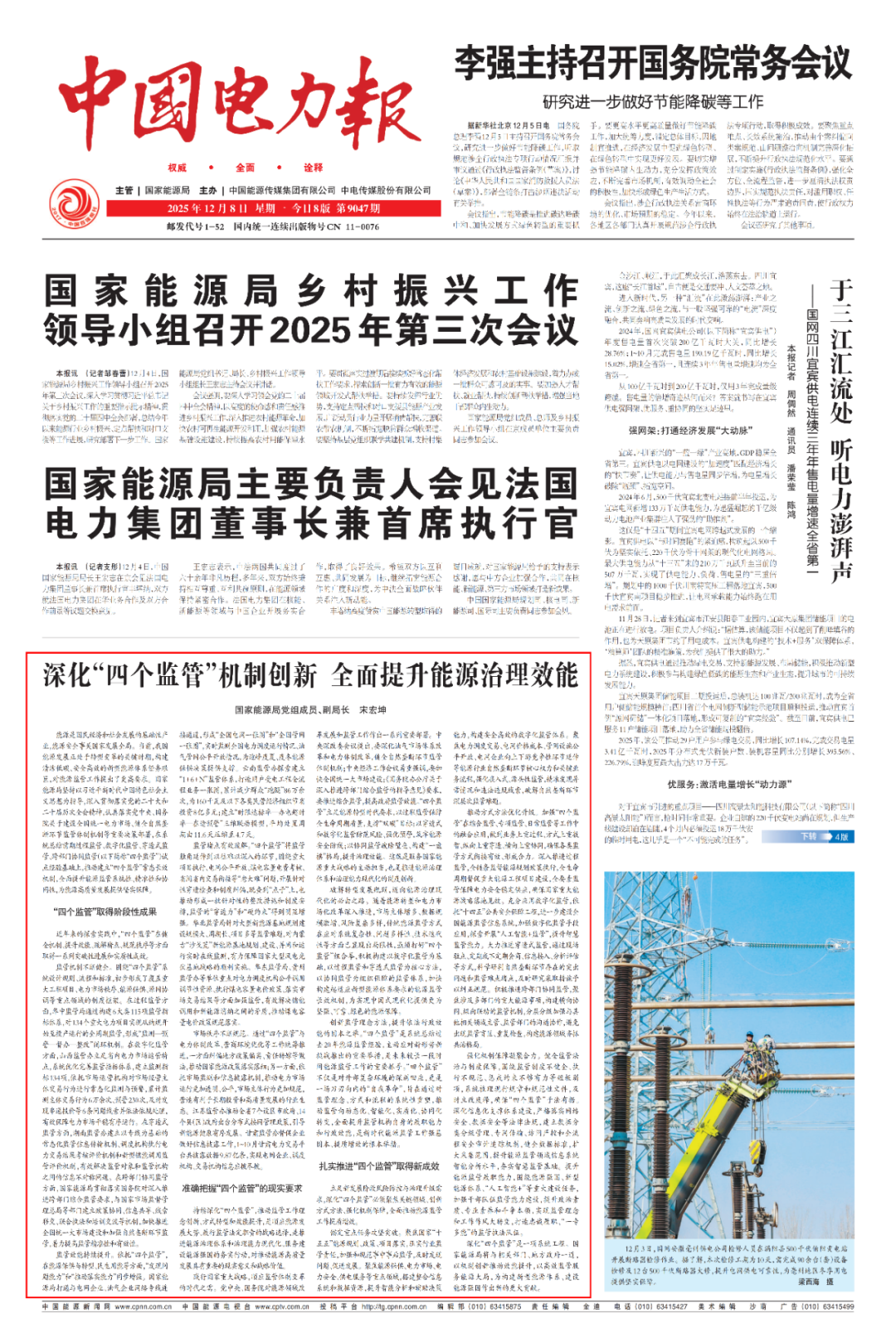
国家能源局党组成员、副局长宋宏坤署名文章
国家能源局· 2025-12-08 09:51
Core Viewpoint - The article emphasizes the importance of deepening the "Four Supervision" mechanisms to enhance energy governance efficiency, ensuring energy security and supporting the transition to a clean, low-carbon energy system in China [1][7][8]. Group 1: Achievements of the "Four Supervision" - The "Four Supervision" has made significant progress in improving mechanisms, enhancing efficiency, and resolving bottlenecks in energy governance [2]. - A comprehensive regulatory framework has been established, covering key areas such as major engineering projects, electricity market order, energy supply security, and source-network coordination [3]. - The Central China Regulatory Bureau has implemented a closed-loop mechanism for 134 major power projects, ensuring full-cycle supervision from regulation to operation [3]. Group 2: Continuous Improvement of Regulatory Efficiency - The "Four Supervision" has enhanced the ability to identify and address issues in energy supply and transformation, as well as in civil energy consumption [4]. - The Yunnan Regulatory Office has developed a regulatory system that has reduced the need for citizens to make 860,000 trips, saving over 800 million yuan for various private enterprises [4]. - The average processing time for electricity service requests has been reduced from 11.6 days to 4.7 days [4]. Group 3: Effective Resolution of Regulatory Bottlenecks - The "Four Supervision" has extended regulatory reach into previously challenging areas, addressing issues related to major project execution and fair access to electricity grids [5]. - The North China Regulatory Bureau has implemented real-time monitoring for large renewable energy bases, ensuring the successful execution of national strategies for wind and solar energy [5]. - Regulatory efforts have effectively resolved conflicts between energy storage utilization and renewable energy consumption [5]. Group 4: Standardization of Market Order - The "Four Supervision" has promoted transparency and fairness in the electricity market, correcting local policy deviations and ensuring compliance with national energy policies [6]. - The Jiangsu Regulatory Office has guided local governments to develop distributed grid connection management policies, fostering healthy development of renewable energy [6]. - The Gansu Regulatory Office has ensured comprehensive data disclosure, with nearly 987 million data entries disclosed on the Gansu electricity trading platform from January to October [6]. Group 5: Realistic Requirements of the "Four Supervision" - Deepening the "Four Supervision" is a strategic choice to adapt to the energy development trend and fulfill regulatory responsibilities, contributing to the modernization of energy governance [7][18]. - The article highlights the need for innovative regulatory concepts and methods to enhance administrative efficiency and adapt to the complexities of the energy sector [9][18]. Group 6: Mechanism Innovation and Strengthening - The article calls for the establishment of a robust legal and institutional framework to support the "Four Supervision," addressing shortcomings in regulatory execution and enforcement [12]. - Emphasis is placed on enhancing the capacity of regulatory personnel to meet the demands of a modern energy system, including the integration of artificial intelligence in regulatory practices [12][19].