能碳双控

Search documents
国网青海电力算力服务助企业绿色转型
Xin Lang Cai Jing· 2026-01-19 18:10
Core Viewpoint - The State Grid Qinghai Electric Power Company is leveraging data and platform resources to enhance clean energy management and carbon emission monitoring, supporting the green transition and high-quality development of the green computing industry in Qinghai Province [1] Group 1: Clean Energy Management - The company has established a multi-dimensional "electric-carbon" measurement system to address issues such as low monitoring efficiency and difficulties in cross-industry data collection for carbon emissions [1] - A total of 926 energy-consuming enterprises in the province have been provided with electric-carbon accounts, with 641 key enterprises' energy consumption data integrated into a comprehensive monitoring platform [1] Group 2: Carbon Emission Monitoring - The company aims to accurately monitor corporate carbon emissions by analyzing the intrinsic relationship between electricity consumption and carbon emissions, facilitating the green transition of enterprises [1] Group 3: Load Optimization - The Qinghai Clean Energy and Green Computing Dispatch Center has achieved approximately 1.4% optimization in peak and valley period electricity transfer [1] - A local coordinated dispatch system has been developed, integrating energy forecasts, pricing policies, and computing load characteristics to guide high-energy computing tasks to operate during periods of abundant wind and solar energy and low electricity prices [1]
国网白银供电公司:银线织就绿色电网 “十四五”能源转型迈上新台阶
Zhong Guo Neng Yuan Wang· 2026-01-09 09:00
Core Viewpoint - The company is committed to ensuring energy security, supporting economic development, and promoting green transformation in Baiyin City during the 14th Five-Year Plan period, while enhancing the resilience of the power grid and optimizing power supply services [1][6]. Group 1: Energy Infrastructure Development - The Baiyin power grid structure has been continuously optimized, with a 96.43% increase in investment compared to the 13th Five-Year Plan, reaching the highest level in history [3]. - The maximum load of the Baiyin power grid increased from 1.447 million kilowatts to 2.42 million kilowatts, significantly enhancing resource allocation capabilities [3]. - Major projects, such as the 330 kV external power supply project for the Gansu traction station, have been completed, providing reliable power for the operation of the passenger dedicated line [4]. Group 2: Renewable Energy Integration - By the end of the 14th Five-Year Plan, the total installed capacity of renewable energy in Baiyin reached 7.29 million kilowatts, a 539% increase compared to the end of the 13th Five-Year Plan [6]. - The proportion of renewable energy in the total installed capacity of the grid rose from 20% to 66%, marking a shift from supplementary to primary energy [6]. - The Baiyin power grid has formed a strong grid pattern centered on the 750 kV Baiyin substation, enhancing the capacity for renewable energy delivery [5]. Group 3: Service and Efficiency Improvements - The company has focused on customer needs, improving electricity access and satisfaction through innovative service models and simplified processes [10]. - A new type of power system demonstration project has been established, significantly improving voltage compliance rates from 91.28% to 99.88% and reducing line loss rates from 7.85% to 4.31% [10]. - The company has built a comprehensive charging network across the city, adding 1,038 public charging piles to support the adoption of electric vehicles [11]. Group 4: Research and Development Initiatives - The establishment of the first municipal energy development research center in the province aims to integrate resources for research in carbon reduction and energy planning [7]. - The company has produced over 40 high-quality research outcomes to support clean energy integration and policy analysis [7]. - The focus on low-carbon transformation strategies has led to the development of a model for energy consumption and carbon emissions reduction in key industries [10].

数字孪生优化零碳园区能源配置
Sou Hu Cai Jing· 2025-05-15 05:30
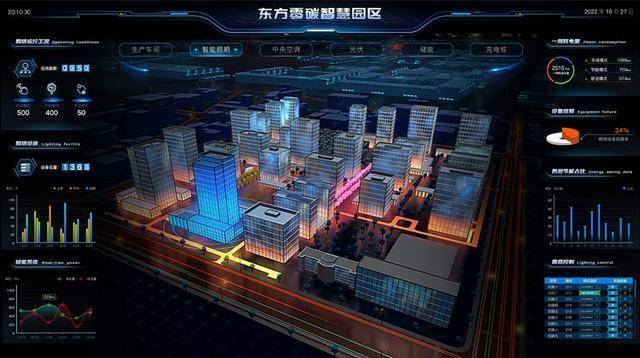
Core Insights - The article discusses the challenges faced by energy systems in parks, including the volatility of renewable energy, lack of synergy among multiple energy sources, and difficulties in dynamic carbon emission monitoring. Digital twin technology is presented as a solution that optimizes energy allocation for zero-carbon parks, transitioning from "passive response" to "active carbon creation" [1][4]. Group 1: Digital Twin Technology - The core value of digital twin technology lies in its "predict-optimise-closed loop" capability, enhancing energy efficiency and operational management [1][3]. - In the planning phase, digital twin technology can simulate different building orientations and photovoltaic layouts, leading to an 18% increase in annual electricity generation for a specific park [1]. - During operation, real-time data collection through IoT sensors allows for precise predictions of peak energy demand, enabling proactive management of energy resources [1][3]. Group 2: Renewable Energy Management - Digital twin technology addresses the unpredictability of renewable energy by integrating various data sources, resulting in a 92% accuracy rate in power forecasting for a wind farm and reducing wind abandonment rates to below 3% [3]. - The integration of digital twin technology with energy routing optimizes energy utilization efficiency from 65% to 85%, leading to a reduction of 12,000 tons of standard coal consumption annually [3]. - Smart microgrid systems driven by digital twin technology enable buildings to function as "power generation, storage, and consumption units," achieving a 40% self-supply rate of electricity in a specific industrial park [3]. Group 3: Carbon Management and Monitoring - The deep integration of digital twin technology with carbon management creates a new paradigm of "dual control" over energy and carbon emissions, allowing for real-time tracking of carbon footprints [3]. - A specific park identified an anomaly in carbon emissions due to aging equipment, leading to a reduction of 1,500 tons of CO2 emissions annually after equipment replacement [3]. - Digital twin technology supports the scientific planning of ecological compensation projects, enhancing carbon sink capacity by 40% through optimal species and planting density selection [3]. Group 4: Technological Integration - Digital twin technology is increasingly coupled with edge computing and blockchain, enhancing decision-making speed to milliseconds and ensuring the integrity of carbon trading data [4]. - A pilot project for carbon asset securitization attracted over 50 million yuan in social capital, demonstrating the potential of this technological integration for transforming zero-carbon parks from isolated developments to regional hubs [4]. - Digital twin technology serves as a "golden key" for solving energy allocation challenges in smart zero-carbon park construction, optimizing all elements from production to consumption and carbon monitoring to trading [4].