自带发电(BYOG)

Search documents
谁等电网,谁就出局? 美国AI巨头掀起“自发电”热潮
Xin Lang Cai Jing· 2026-01-02 03:04
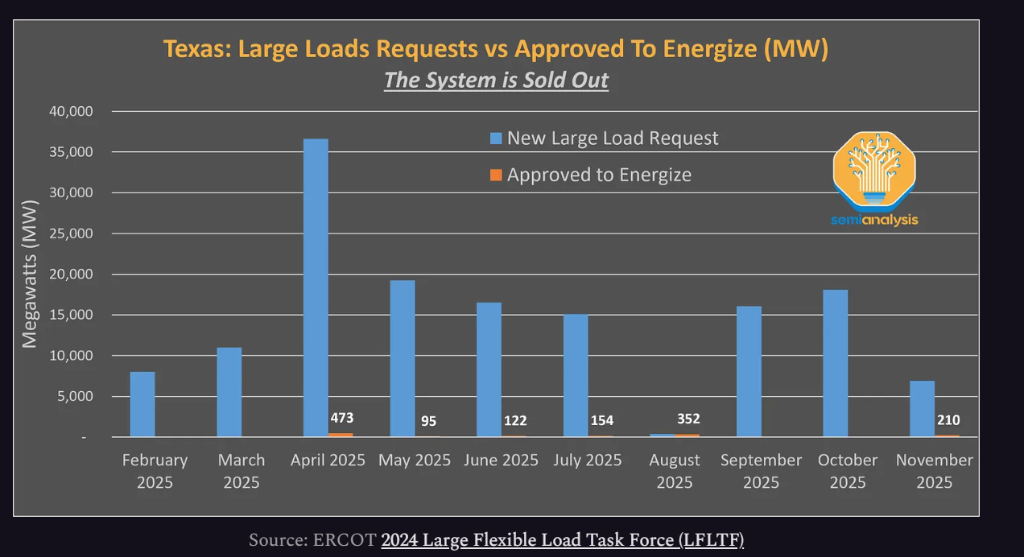
Core Insights - A silent energy revolution is accelerating in the core of the U.S. AI industry, with leading AI labs like OpenAI, xAI, and Google opting to bypass the public grid by building their own gas power plants [1][3] Group 1: Energy Demand and Supply Mismatch - The report from SemiAnalysis highlights that electricity has transformed from a mere operational cost to a primary constraint determining whether computing power can be deployed on schedule [3] - AI data centers are facing a critical mismatch between the pace of grid delivery and the speed of computing power expansion, with construction timelines for data centers being 12-24 months compared to 3-5 years for grid expansion [3][4] - The Texas Electric Reliability Council (ERCOT) has seen data center load requests reach several tens of gigawatts, yet only about 1 gigawatt has been successfully integrated into the grid during the same period [3] Group 2: The Shift to On-Site Power Generation - AI companies are willing to incur higher costs for on-site power generation due to the "time value" of computing power, with a 1-gigawatt AI data center potentially generating annual revenues in the range of billions of dollars [4] - The "BYOG" (Bring Your Own Generation) model allows AI companies to quickly deploy facilities off-grid initially and later connect to the grid, with xAI's rapid construction of a supercluster in Memphis serving as a benchmark [4][5] - By deploying over 500 megawatts of fast-moving gas turbines and engines, xAI has demonstrated a commitment to speed, which is being widely emulated across the industry [4] Group 3: Industry Trends and Future Implications - By the end of 2025, on-site power generation is expected to become a systemic trend, with collaborations like OpenAI and Oracle building a 2.3-gigawatt gas power plant in Texas [5] - Natural gas has emerged as the dominant choice for on-site power generation due to its deployment speed, stability, and technological maturity, while alternatives like nuclear power and renewable energy sources face longer construction timelines [5] - The shift towards self-generated power signifies a new era where the ability to deliver electricity quickly may become as crucial as the quality of algorithms and chips in the competitive AI landscape [6]

SemiAnalysis深度报告:美国电网跟不上,AI数据中心“自建电厂”跟时间赛跑
美股IPO· 2026-01-01 16:08
Core Insights - The article discusses the urgent need for AI companies to bypass the aging public power grid by building their own gas power plants to meet the exponential demand for computing power, which has become a critical constraint for timely deployment [1][3][4]. Group 1: Power Crisis and AI Demand - The real bottleneck for AI data centers is not the lack of electricity but the slow delivery of power that cannot keep pace with the rapid expansion of computing needs [4][8]. - AI data centers are now being constructed in 12-24 months, while the typical cycle for power grid expansion and approval is still 3-5 years, making waiting for the grid a significant risk [5][6]. Group 2: Economic Implications of Power Supply - The time value of computing power is reshaping decision-making, with a 1GW AI data center potentially generating annual revenues of up to $10 billion, making it economically viable to incur higher electricity costs for faster deployment [9][10]. - Power is no longer just an operational cost but a prerequisite for the existence of AI projects, emphasizing the need for immediate power solutions [10][22]. Group 3: Onsite Power Generation Solutions - The BYOG (Bring Your Own Generation) model has emerged as a practical solution, allowing data centers to quickly start operations without waiting for grid connections [11][48]. - Major AI companies, including xAI, OpenAI, and Oracle, are leading the trend of onsite power generation, with significant projects underway, such as a 2.3GW gas power plant in Texas [16][29]. Group 4: Gas as the Preferred Energy Source - Natural gas has become the dominant choice for onsite power generation due to its scalability, stability, and rapid deployment capabilities, unlike nuclear or renewable sources [20][21]. - The competition in AI is increasingly defined by speed rather than cost, with companies prioritizing quick power access over traditional cost considerations [22]. Group 5: Market Dynamics and New Entrants - The onsite gas power generation market is experiencing unprecedented growth, with over a dozen suppliers securing contracts for AI data centers, indicating a shift in how power is viewed within AI infrastructure [17][30]. - New entrants, such as Doosan Energy and Wärtsilä, are capitalizing on this trend, with significant orders for gas turbines to support AI data centers [30][31]. Group 6: Challenges and Considerations - While onsite power generation offers speed, it also presents challenges, including higher long-term costs compared to grid power and complex permitting processes [34][36]. - The deployment of onsite power systems requires careful planning to ensure redundancy and reliability, as the complexity of managing power independently from the grid increases [94][100].




SemiAnalysis深度报告:美国电网跟不上,AI数据中心“自建电厂”跟时间赛跑
Hua Er Jie Jian Wen· 2026-01-01 12:02
Core Insights - The demand for computing power in the AI sector is growing exponentially, leading to a critical mismatch between the rapid expansion of AI data centers and the slow pace of the aging U.S. power grid [1][2][4] - AI companies are increasingly opting to build their own power plants on-site to avoid delays associated with grid connections, with natural gas becoming the primary energy source due to its scalability and quick deployment [5][15][16] - The trend of on-site power generation is expected to become a systemic approach by 2025, as major players like OpenAI and Oracle are already investing in large-scale gas power plants [11][12][22] Group 1: Power Crisis and AI Data Centers - The essence of the power crisis is not a lack of electricity but the slow delivery of power that cannot keep pace with the rapid construction of AI data centers [2][4] - The construction cycle for AI data centers has been compressed to 12-24 months, while the typical cycle for grid expansion and approval remains at 3-5 years, creating a significant risk for companies that wait for grid connections [2][17] Group 2: Economic Implications of Power Generation - The time value of computing power is reshaping decision-making, with potential annual revenues for a 1GW AI data center reaching up to $10 billion, making the cost of electricity a critical factor in project viability [5][20] - Companies are willing to incur higher costs for on-site power generation to ensure timely deployment, as the economic benefits of earlier operation outweigh the additional expenses [5][16] Group 3: BYOG (Bring Your Own Generation) Strategy - The BYOG model has shifted from an unconventional choice to a practical solution, allowing data centers to operate independently of the grid while awaiting connection [6][37] - This strategy enables companies to start operations without waiting for grid upgrades, thus capturing significant revenue opportunities [36][73] Group 4: Industry Trends and Case Studies - xAI has set a precedent by rapidly constructing a 100,000 GPU cluster in Memphis within four months, showcasing the effectiveness of on-site power generation [11][20] - Major companies like Meta, Amazon AWS, and Google are adopting similar strategies, utilizing bridging power solutions to operate AI superclusters before formal grid connections are established [18][20] Group 5: Natural Gas as the Preferred Energy Source - Natural gas has emerged as the dominant choice for on-site power generation due to its ability to meet the demands of AI data centers in terms of scale, stability, and deployment speed [15][16] - The shift towards on-site gas generation is expected to drive significant growth in the market, with numerous suppliers already securing large orders for AI data center projects [13][22] Group 6: Challenges and Considerations - While on-site power generation offers advantages, it also presents challenges such as higher long-term costs compared to grid power and complex permitting processes [26][71] - Companies are exploring innovative solutions to navigate these challenges, including strategic site selection to expedite permitting and deployment [26][37]