
燃料电池

Search documents
氢能领域开年首场大型盛会在京开幕,有哪些新看点?
中国能源报· 2026-03-27 03:34
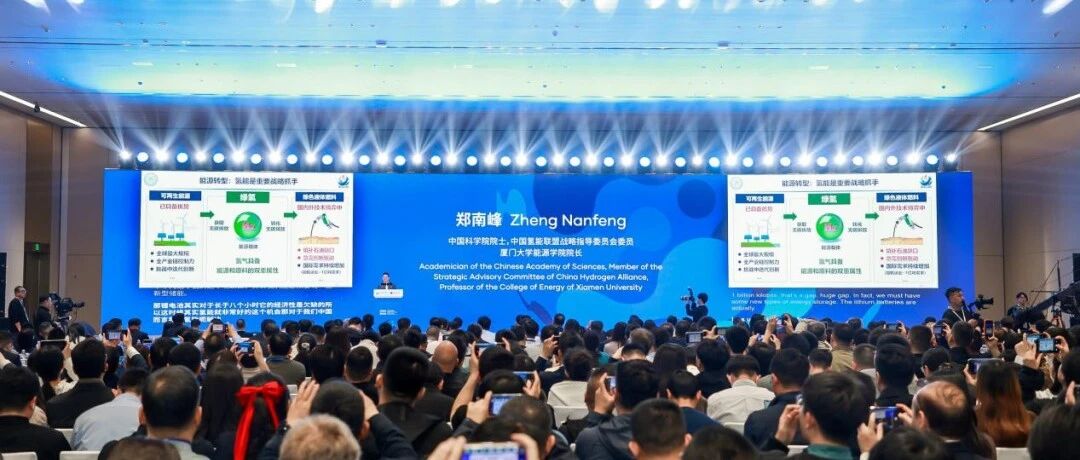
Core Viewpoint - The 2026 China Hydrogen Energy Exhibition and International Hydrogen Energy Conference serves as a significant platform for showcasing innovations and promoting commercial applications in the hydrogen energy sector, emphasizing the importance of hydrogen energy in China's "14th Five-Year Plan" and its role in achieving carbon neutrality goals [1][3][11]. Group 1: Event Overview - The conference, themed "Towards New and Green, Co-creation and Win-win," features a comprehensive activity system including large exhibitions, forums, and international cooperation discussions [1]. - Over 1,300 representatives from government, industry, academia, and research attended, highlighting the event's significance in guiding the hydrogen energy industry's direction [3]. - The event is supported by various governmental bodies, including the National Energy Administration and the Hong Kong Special Administrative Region Government [1]. Group 2: Industry Insights - The National Energy Group aims to drive the hydrogen energy industry through a "green hydrogen industry chain" and "hydrogen innovation service chain," focusing on key areas such as renewable energy and green chemicals [4]. - The China Hydrogen Alliance introduced a global carbon code identification system for the hydrogen industry, enhancing data management and carbon footprint tracking [4]. Group 3: Exhibition Highlights - The exhibition covers an area of 50,000 square meters, featuring over 400 leading hydrogen energy companies, showcasing a full industry chain from hydrogen production to storage and transportation [5]. - More than 60 innovative hydrogen energy technologies and products were launched during the event, facilitating the transition from technology demonstration to commercial application [7]. Group 4: International Collaboration - The conference included multiple forums focusing on global trends in green hydrogen markets and cross-border trading mechanisms, addressing key commercial challenges [9]. - The event attracted international participation from over 20 countries, fostering collaboration and knowledge exchange in the hydrogen energy sector [11]. Group 5: Strategic Importance - The successful hosting of the conference is seen as a strategic move to address global climate change challenges and enhance the integration of the hydrogen energy industry on a global scale [9][11].

中国碳纸行业发展分析与投资前景研究报告2026年
智信中科研究网· 2026-03-26 09:00
Investment Rating - The report does not explicitly state an investment rating for the carbon paper industry Core Insights - Carbon paper is the preferred material for the gas diffusion layer (GDL) in fuel cells due to its excellent conductivity, porous structure, mechanical stability, and chemical compatibility, which meet the core demands of fuel cell applications [13][14] - The carbon paper industry is positioned within the carbon fiber materials sector, primarily serving the new energy equipment and aerospace industries, and is experiencing rapid growth driven by domestic substitution [16][27] - The industry faces challenges such as reliance on imported high-end production equipment and the need for cost reduction to enhance commercial viability [30] Summary by Sections Chapter 1: Overview of the Carbon Paper Industry - Carbon paper is made from short-cut carbon fibers and is categorized as a special paper or carbon fiber product, with its supply chain encompassing raw materials, manufacturing processes, and downstream applications [17] - The regulatory framework involves multiple government departments focusing on industrial planning, quality control, environmental compliance, and market access [18][19] - National standards for carbon paper testing methods are established to ensure product quality and performance consistency [21][24] Chapter 2: Global Development of the Carbon Paper Industry - The global carbon paper industry has evolved from military applications in the 1960s-1980s to commercial use in the 1990s-2000s, with significant technological advancements and market expansion [48][49] - The industry is characterized by a competitive landscape with key players like Toray and SGL leading in production capabilities and technological innovation [6][7] Chapter 3: Current Status of the Chinese Carbon Paper Industry - The Chinese carbon paper market is driven by strong demand from fuel cell applications, with a focus on enhancing production capabilities and reducing costs [3][30] - The market is witnessing a shift towards domestic production as companies aim to reduce reliance on imports and improve product consistency [27][30] Chapter 4: Technological Advances and Supply Chain - The report highlights the importance of technological innovation in production processes, including wet and dry forming techniques, to enhance the performance of carbon paper [4][28] - The supply chain is under pressure to improve raw material sourcing and production efficiency, with a focus on developing high-performance carbon fibers domestically [28][30] Chapter 5: Market Analysis of Carbon Paper Substitutes - The report discusses the competitive landscape of carbon paper substitutes, including carbon cloth and carbon black paper, and their respective market positions [5][15] Chapter 6: Application Analysis of Carbon Paper - Carbon paper is primarily used in fuel cells, with significant potential for growth in other applications such as electrolysis and energy storage [6][42] Chapter 8: Policy Environment and Development Potential - The report outlines the policy framework supporting the carbon paper industry, emphasizing the role of government initiatives in promoting technological advancements and market growth [8][19] Chapter 9: Investment Opportunities and Strategic Recommendations - The report identifies investment opportunities within the carbon paper industry, focusing on weak links in the supply chain and potential growth areas in specific market segments [9][30]
行业点评报告:氢能应用试点下发,“十五五”有望跑通商业化
KAIYUAN SECURITIES· 2026-03-17 05:02
Investment Rating - The industry investment rating is "Overweight" (看好) for the first time [2] Core Insights - The report highlights the issuance of hydrogen energy application pilot notifications by three departments, aiming to expand hydrogen energy applications from fuel cell vehicles to various fields such as transportation and industry by 2030 [5][6] - The goal is to achieve large-scale application of hydrogen energy in multiple fields, with the average terminal hydrogen price dropping below 25 yuan per kilogram, and striving for a reduction to around 15 yuan in some advantageous regions [5] - The report emphasizes the importance of expanding application scenarios and technological innovation in hydrogen energy to support economic growth and green transformation [5] Summary by Sections Industry Overview - The hydrogen energy application pilot program aims to explore innovative application scenarios, forming a comprehensive ecosystem that includes fuel cell vehicles, green ammonia, hydrogen-based chemical raw material substitution, hydrogen metallurgy, and more [6][7] Policy Support - The central government will provide financial incentives for selected city clusters, with a maximum reward of 1.6 billion yuan per city cluster during the pilot period, totaling up to 8 billion yuan [7] - Local governments are encouraged to enhance financial collaboration and support key technologies in hydrogen production, storage, transportation, and utilization [7] Beneficiary Companies - Beneficiary companies identified in the report include: - Green Alcohol: China Tianying, Fuke Technology, CIMC Anrui, Jiazhen New Energy, Goldwind Technology - Fuel Cells: Guofu Hydrogen Energy, Guohong Hydrogen Energy, Yihua Tong, Reshape Energy - Electrolyzers: Huadian Technology, Huaguang Huaneng, Shuangliang Energy Saving, Shenghui Technology [9]
一图看懂 | 燃料电池概念股
市值风云· 2026-03-16 10:12
Core Insights - The article discusses the recent policy direction for hydrogen energy, emphasizing the goal of large-scale application in urban areas by 2030, with hydrogen prices expected to drop below 25 yuan per kilogram, and a target of doubling the number of fuel cell vehicles to 100,000 units [4]. Group 1: Latest Policy Direction - On March 16, three ministries released a notice on hydrogen energy comprehensive application pilot projects, aiming for significant advancements in technology innovation and industry chain upgrades to support green transformation [4]. Group 2: Key Materials and Components - Upstream key materials include catalysts from companies like 贵研铂业 and 中自科技, proton exchange membranes from 泛亚微透 and 百利科技, and membrane electrodes from 雄韬股份 and 威孚高科 [8]. - Upstream core components consist of air compressors from 汉钟精机 and 吴志机电, hydrogen circulation pumps from 德尔股份 and 腾龙股份, and thermal management systems from 银轮股份 and 腾龙股份 [8]. - Midstream system integration and testing involve fuel cell system integration by 亿华通 and 潍柴动力, along with testing equipment and technical services from 科威尔 and 中国汽研 [8].


新能源汽车行业周报:美国取消部分电池材料关税,产业景气度迎来上行-20260315
Huaxin Securities· 2026-03-15 14:22
Investment Rating - The report maintains a "Recommended" rating for the new energy vehicle industry [2][3]. Core Insights - The supply-demand structure is continuously optimizing, with many product prices on the rise. In February, China's new energy vehicle production and sales reached 694,000 and 765,000 units, respectively, down 21.8% and 14.2% year-on-year. Cumulatively, from January to February, production and sales totaled 1.735 million and 1.71 million units, down 8.8% and 6.9% year-on-year. New energy vehicles accounted for 41.2% of total new car sales. The supply side is seeing new products from battery and main engine manufacturers, with positive feedback on demand, leading to a continuous optimization of the supply-demand structure. Prices are stabilizing and rising, particularly for lithium carbonate and lithium iron phosphate, with strong demand and tight supply [3][4][5]. Summary by Sections 1. Market Tracking - The new energy vehicle index, lithium battery index, fuel cell index, charging pile index, and energy storage index had weekly changes of +0.91%, +5.37%, -0.79%, -2.15%, and +5.55%, respectively [4][21]. 2. Lithium Battery Industry Chain Price Tracking - Since the beginning of the year, lithium carbonate prices have increased by 33.1%, driving up lithium iron phosphate by 27.3%. The price of lithium hexafluorophosphate has decreased by 38.3%. This week, lithium carbonate was priced at 159,100 CNY/ton, up 2.5% from last week [29][30][32]. 3. Production and Sales Data Tracking - In February, China's new energy vehicle production and sales were 694,000 and 765,000 units, respectively, with year-on-year declines of 21.8% and 14.2%. Cumulatively, from January to February, production and sales reached 1.735 million and 1.71 million units, with new energy vehicles making up 41.2% of total new car sales [45][49]. 4. Industry Dynamics - The U.S. has decided not to impose tariffs on certain battery materials imported from China, which is expected to positively impact the industry [5][71].


氢能与燃料电池行业研究:能源安全与双碳目标交汇,氢能开启规模化元年
SINOLINK SECURITIES· 2026-03-13 11:11
Investment Rating - The report indicates a significant increase in national-level attention and policy support for hydrogen energy, suggesting a strong investment opportunity in the sector [2]. Core Insights - Hydrogen energy is emerging as a crucial solution to China's dual challenges of energy security and deep decarbonization, with unprecedented strategic importance and policy support. The reliance on imports for oil and gas is highlighted, with 43% of oil and 17% of gas consumption expected to depend on imports from the Middle East and Russia by 2025. The geopolitical instability has further exposed vulnerabilities in the energy supply chain [1][13]. - The decarbonization process is entering a critical phase, with industrial, chemical, and transportation sectors becoming the main battlegrounds for carbon reduction. The demand for green hydrogen is projected to reach 3 million tons by 2026, driven by government carbon reduction targets, and is expected to rise to 65 million tons during the 14th Five-Year Plan period [1][25]. - The report emphasizes that hydrogen energy, with its roles as an energy fuel, industrial raw material, and energy storage medium, has received strategic endorsement at the central government level. The acceleration of green hydrogen's cost-competitive progress is anticipated as policies such as direct connection to renewable electricity and the removal of grid fees are implemented [1][31]. Summary by Sections Section 1: Energy Autonomy and Non-Electric Energy Decarbonization Trends - The urgency to reduce dependence on foreign energy sources and the need for non-electric energy decarbonization are increasing. China's energy resources are characterized as rich in coal but lacking in oil and gas, leading to high import dependence [11][13]. - The report outlines that the transition from fossil fuels to non-fossil fuels is essential for achieving carbon neutrality goals, with hydrogen and its derivatives becoming key solutions for reducing carbon emissions in hard-to-abate sectors [20][21]. Section 2: Application Scenarios and Economic Viability - The report identifies that hydrogen applications are beginning to break through in sectors with lower price sensitivity, such as transportation and chemicals. The economic viability of hydrogen in these sectors is becoming clearer, with green methanol and hydrogen fuel cell vehicles leading the way [2][38]. - In the transportation sector, the cost of fuel cell systems has dropped significantly, making hydrogen fuel cell vehicles more economically viable. The report states that when hydrogen prices fall to 37.5 yuan/kg, the cost of hydrogen heavy-duty trucks can match that of diesel vehicles [4][38]. - Green methanol is expected to achieve price parity with traditional marine fuels when the EU carbon price reaches 100 euros/ton, and domestic low electricity prices further enhance its economic viability [4][38]. Section 3: Policy-Driven Industry Dynamics - The hydrogen industry is primarily driven by policy support, with a focus on achieving economic viability in key segments. The report highlights that the industry is in its early commercial phase, with significant potential for growth as policies stimulate demand for green hydrogen applications [2][19]. - The report emphasizes the importance of establishing a robust industrial chain and the need for clear application scenarios to drive demand for green hydrogen. The economic viability of green hydrogen is expected to improve as renewable energy and hydrogen production costs decline [23][24]. Section 4: Investment Recommendations - The report suggests focusing on three key areas for investment: green methanol, electrolyzers, and fuel cells, which are expected to benefit from strong demand and policy support [2].
新能源行业2026年《政府工作报告》点评
Guoxin Securities Co., Ltd· 2026-03-06 13:30
Investment Rating - The industry investment rating is "Positive," indicating that the industry index is expected to outperform the market index by more than 5% over the next six months [7]. Core Insights - The report emphasizes the continuation of the green transition strategy, aiming for high-quality development in the green low-carbon economy, with a focus on carbon peak and carbon neutrality goals [3][4]. - Significant investments in smart grid construction and the introduction of "computing power and electricity coordination" are highlighted as new infrastructure initiatives [4]. - The photovoltaic and wind power sectors are projected to experience rapid growth, with domestic photovoltaic installations expected to reach approximately 252.87 GW in 2025, a year-on-year increase of 39.5% [5][8]. - The hydrogen and green fuel sectors are anticipated to accelerate towards commercialization, with the establishment of a national low-carbon transition fund [9][10]. Summary by Sections Smart Grid and Infrastructure - The government plans to invest 4 trillion yuan in the State Grid during the 14th Five-Year Plan, focusing on major projects like ultra-high voltage and flexible DC transmission [4]. - The introduction of "computing power load" as a new adjustable resource is expected to enhance the demand for smart grid equipment [4]. Renewable Energy Development - The photovoltaic industry is expected to stabilize and improve profitability, while the wind power sector is projected to add 130 GW of new installations in 2025, a 49.9% increase year-on-year [5]. - The report indicates that renewable energy installations will exceed 50% of total power installations during the 14th Five-Year Plan, with a target of 30% of electricity generation from renewable sources by 2030 [5]. Hydrogen and Green Fuel - The report outlines plans for a comprehensive hydrogen industry technology innovation system by 2030, with significant growth in renewable energy-based hydrogen production [9][10]. - The cost of green hydrogen production is expected to drop below 15 yuan per kilogram by 2027, nearing the cost of gray hydrogen, indicating a critical point for commercialization [10]. Investment Recommendations - The report suggests focusing on leading companies in the fields of ultra-high voltage, smart grids, and power automation due to increased demand from grid investments [11]. - For the photovoltaic and wind sectors, it recommends investing in high-efficiency technologies and leading companies, particularly in the polysilicon and component sectors [11]. - In the hydrogen and green fuel sector, it advises attention to core equipment manufacturers and companies involved in green hydrogen production and storage [11].
Ameresco(AMRC) - 2025 Q4 - Earnings Call Transcript
2026-03-02 22:32
Financial Data and Key Metrics Changes - The company reported record quarterly revenue of $581 million for Q4 2025, representing a 9% year-over-year increase, with growth across all core business lines [12][16] - Net income attributable to common shareholders was $18.4 million, with GAAP EPS of $0.34 and non-GAAP EPS of $0.39 [16] - Adjusted EBITDA was $70 million, resulting in a margin of 12% [16] - Total project backlog remained above $5 billion, reflecting sustained demand for energy infrastructure solutions [13] Business Line Data and Key Metrics Changes - Projects revenue grew by 11%, driven by strong backlog conversion and performance from the European joint venture [12] - Energy asset revenue increased by 5%, supported by the growth of the operating asset portfolio, with 87 MW placed into operation during the quarter [13][14] - Recurring O&M revenue increased by 11%, with a long-term O&M revenue backlog of approximately $1.5 billion [14] Market Data and Key Metrics Changes - The company highlighted strong growth in Europe, with a focus on Southern and Eastern Europe, which are experiencing higher growth rates and fewer entrenched competitors [6][8] - The demand for electricity is expected to increase by 78% by 2050, necessitating 80 GW of capacity added annually for the next 20 years [8][9] - The company is well-positioned to benefit from increasing energy costs and the demand for resilient energy solutions [9][10] Company Strategy and Development Direction - The company aims to continue investing prudently to support demand and drive growth, with a guidance of approximately $2.1 billion in revenue and $283 million in adjusted EBITDA for 2026 [17][18] - The strategy includes opportunistic acquisitions and partnerships to expand in Europe, particularly in solar and battery storage [6][46] - The company is focused on technical innovation and long-term growth, leveraging its differentiated portfolio of energy infrastructure solutions [22] Management's Comments on Operating Environment and Future Outlook - Management expressed confidence in the company's ability to deliver strong profitable growth in 2026, building on the momentum from 2025 [22] - The company is prepared for challenges in the operating environment, including potential impacts from tariffs and weather-related delays [83][32] - Management emphasized the importance of execution and disciplined cost management to achieve the top end of guidance [97] Other Important Information - The company has secured approximately $175 million in new project financing commitments during the quarter [16] - The gross margin improved to 16.2%, reflecting better project mix and disciplined cost management [15] Q&A Session Summary Question: Energy assets revenue trajectory and margin profile - Management indicated that the majority of assets placed in service will be towards the middle to back half of the year, with no expected change in margin contributions per segment [25][27] Question: Impact of weather on project work - Management acknowledged that severe weather impacted project execution timing but expects revenue to recover in Q2 [32][33] Question: Growth strategy in Europe - Management confirmed plans for strategic acquisitions and partnerships to bolster growth in Europe, particularly in solar and battery storage [46] Question: Update on data center market - Management noted strong demand for behind-the-meter solutions for data centers, with a robust pipeline of opportunities [48][50] Question: Operating cash flow and working capital - Management explained that quarterly cash flow can be lumpy and working capital is expected to normalize across the year [95][96] Question: Tariff landscape and risk management - Management is incorporating tariff protections into contracts and is managing risks associated with potential tariff fluctuations [83][84]

Ameresco(AMRC) - 2025 Q4 - Earnings Call Transcript
2026-03-02 22:32
Financial Data and Key Metrics Changes - The company reported record quarterly revenue of $581 million for Q4 2025, representing a 9% year-over-year increase, with growth across all core business lines [12][16] - Net income attributable to common shareholders was $18.4 million, with GAAP EPS of $0.34 and non-GAAP EPS of $0.39 [16] - Adjusted EBITDA was $70 million, resulting in a margin of 12% [16] - Total project backlog remained above $5 billion, reflecting sustained demand for energy infrastructure solutions [13] Business Line Data and Key Metrics Changes - Projects revenue grew by 11%, driven by strong backlog conversion and performance from the European joint venture [12] - Energy asset revenue increased by 5%, supported by the growth of the operating asset portfolio, with 87 megawatts placed into operation during the quarter [13][14] - Recurring O&M revenue rose by 11%, with a long-term O&M revenue backlog of approximately $1.5 billion [14] Market Data and Key Metrics Changes - The company highlighted strong growth in Europe, driven by opportunistic acquisitions and partnerships, particularly in Southern and Eastern Europe [6][7] - The demand for electricity is expected to increase by 78% by 2050, necessitating 80 gigawatts of capacity added annually for the next 20 years [8] - The company is well-positioned to benefit from increasing energy costs and the demand for resilient energy solutions [9][10] Company Strategy and Development Direction - The company aims to continue investing prudently to support demand and drive growth, with a guidance of approximately $2.1 billion in revenue and $283 million in adjusted EBITDA for 2026 [17] - The focus will be on technical innovation and targeted investments to enhance long-term growth [22] - The company plans to expand its presence in Europe and explore new opportunities in the energy infrastructure sector, particularly in data centers and battery storage [46][102] Management's Comments on Operating Environment and Future Outlook - Management expressed confidence in the company's ability to deliver strong profitable growth in 2026, supported by a diversified business model and disciplined execution [21][22] - The company acknowledged challenges from the recent severe weather impacting project execution but expects revenue to recover in subsequent quarters [32][33] - Management emphasized the importance of resilience and speed to power in meeting customer demands, particularly from hyperscalers [88] Other Important Information - The company has secured approximately $175 million in new project financing commitments during the quarter [16] - The company is exploring next-generation energy infrastructure technologies, including micro and small modular nuclear reactors [9] Q&A Session Summary Question: Insights on energy assets revenue trajectory and margin profile - Management indicated that the majority of assets placed in service will be towards the middle to back half of the year, with no expected change in margin contributions per segment [25][27] Question: Impact of weather on project work and labor inefficiencies - Management noted that severe weather impacted project execution timing but expects revenue to recover in Q2 [32][33] Question: Growth strategy in Europe and potential acquisitions - Management is looking for accretive acquisitions and partnerships to bolster growth in Europe, particularly in solar and battery storage [46][47] Question: Update on the RNG market and project opportunities - Management confirmed a strong backlog of RNG facilities and is open to M&A opportunities in the sector [72][75] Question: Operating cash flow and working capital considerations - Management explained that working capital is expected to normalize across the year, with cash generation reflecting project timing and milestone billings [95][96] Question: Factors driving margin improvements in 2026 - Management attributed margin improvements to disciplined project selection, pricing, and cost management [67][68]
Ameresco(AMRC) - 2025 Q4 - Earnings Call Transcript
2026-03-02 22:30
Financial Data and Key Metrics Changes - The company reported record quarterly revenue of $581 million for Q4 2025, representing a 9% year-over-year increase, with growth across all core business lines [10] - Net income attributable to common shareholders was $18.4 million, with GAAP EPS of $0.34 and non-GAAP EPS of $0.39 [13] - Adjusted EBITDA was $70 million, resulting in a margin of 12% [13] - Total project backlog exceeded $5 billion, reflecting sustained demand for energy infrastructure solutions [10] Business Line Data and Key Metrics Changes - Projects revenue grew by 11%, driven by strong backlog conversion and performance from the European joint venture [10] - Energy asset revenue increased by 5%, supported by the growth of the operating asset portfolio, with 87 megawatts placed into operation during the quarter [11] - Recurring O&M revenue increased by 11%, with a long-term O&M revenue backlog of approximately $1.5 billion [11] Market Data and Key Metrics Changes - The company highlighted strong growth in European operations, contributing significantly to overall performance [4] - The demand for electricity is expected to increase by 78% by 2050, necessitating 80 gigawatts of capacity added annually for the next 20 years [6] - The company is well-positioned to benefit from increasing energy costs and the demand for resilient energy solutions [8] Company Strategy and Development Direction - The company aims to expand its presence in Europe through opportunistic acquisitions and partnerships, focusing on Southern and Eastern Europe [5] - The strategy includes investing in technical innovation and driving long-term growth, particularly in energy infrastructure and efficiency solutions [18] - The company plans to continue building on its momentum from 2025 to deliver strong profitable growth in 2026 [18] Management's Comments on Operating Environment and Future Outlook - Management expressed confidence in the company's ability to navigate challenges, including the recent government shutdown and weather impacts on project execution [10][28] - The company anticipates continued strong demand across its end markets, supported by recurring revenue from energy assets and O&M businesses [14] - Management emphasized the importance of disciplined execution and risk management in achieving growth targets [91] Other Important Information - The company ended the quarter with approximately $72 million in cash and corporate debt of about $300 million, with leverage comfortably below covenant levels [13] - The company is exploring next-generation energy infrastructure technologies, including micro and small modular nuclear reactors [7] Q&A Session Summary Question: Insights on energy assets revenue trajectory and margin profile - Management indicated that the majority of assets placed in service will be towards the middle to back half of the year, with no expected change in margin contributions per segment [21][25] Question: Impact of weather on project work and labor inefficiencies - Management acknowledged that severe weather impacted project execution timing but expects revenue to recover in Q2 as conditions improve [28][29] Question: Growth strategy in Europe and potential acquisitions - Management confirmed a focus on strategic acquisitions and partnerships to bolster growth in Europe, particularly in solar and battery storage [40][42] Question: Update on the RNG market and project opportunities - Management stated that there are at least 10 RNG facilities in the backlog, with ongoing interest in new projects and potential M&A opportunities [67][69] Question: Tariff landscape and its impact on negotiations - Management is incorporating tariff protections into contracts and managing risks associated with fluctuating tariff policies [78][79]