航空业供需关系改变

Search documents
悄悄上涨20%!这个板块大反转了?
Ge Long Hui A P P· 2026-01-23 12:37
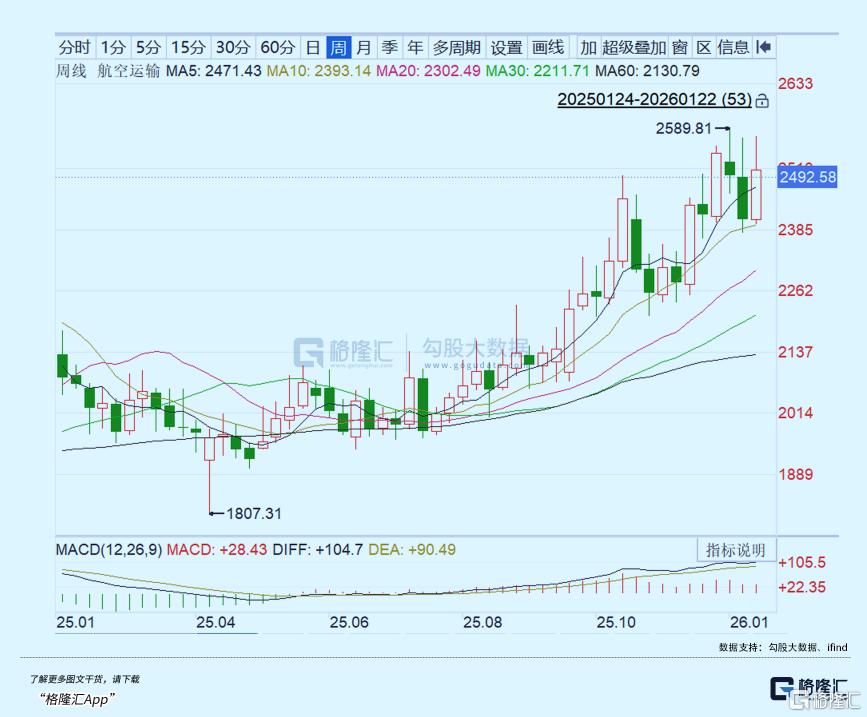
Core Viewpoint - The aviation sector is experiencing a resurgence, driven by favorable policies and increasing consumer demand, indicating a potential turning point for the industry [1][5][44]. Group 1: Market Performance - The aviation transportation sector has seen an overall increase of over 20% in the last three months and nearly 40% in the past year [3]. - Following the National Civil Aviation Work Conference, policies aimed at improving flight quality and passenger experience have been introduced, contributing to the sector's positive sentiment [7][8]. - The average ticket price for economy class in 2025 is projected to be 738 yuan, a decrease of 3.1% year-on-year, following a 12.7% decline in 2024 [12]. Group 2: Policy Impact - The Civil Aviation Administration has outlined measures to combat "involution" in the industry, including establishing a cost monitoring mechanism and prohibiting the sale of tickets below government guidance prices [8][9]. - The "anti-involution" policy is seen as a significant step to address the long-standing issue of price wars that have eroded industry profits [14][10]. Group 3: Supply and Demand Dynamics - The demand for air travel is on the rise, with domestic passenger volume reaching 85 million in January, a 28% increase year-on-year, marking a historical high [15][16]. - The overall passenger load factor for civil aviation is expected to reach 84.9% in 2025, up 1.6 percentage points from 2024 and 1.7 percentage points from 2019 [19]. - The industry is facing a supply constraint, with the growth rate of the fleet at its lowest in over two decades, projected to be 2-3% in the coming years [32][34]. Group 4: Future Outlook - The aviation sector is anticipated to enter a phase of stable development characterized by simultaneous increases in volume and price, contingent on the success of the "anti-involution" measures [21][47]. - The industry is expected to benefit from rising airport revenues due to increased flight volumes, leading to improved valuations for both the aviation and airport sectors [42][43]. - The third quarter of 2025 marked the first collective profit for the three major state-owned airlines in five years, indicating a potential turning point for profitability in the sector [45][46].

国庆价格暴涨!行情启动?
格隆汇APP· 2025-10-06 09:52
Core Viewpoint - The aviation sector has experienced a decade of turbulence since 2016, leading to decreased market attention and only two significant price increases in the past [1][2][3]. Group 1: Recent Trends and Performance - The aviation sector has seen a recent uptick, with the aviation transportation index rising by 6% since early September, and airlines like China Airlines and Juneyao Airlines experiencing over 10% growth in the past month [6]. - During the recent National Day holiday, travel demand surged, with over 340 million expected travelers, marking a historical peak, and domestic flight ticket bookings exceeding 11.89 million, a 3% increase year-on-year [7][8]. - Ticket prices have risen significantly, with the average domestic economy class ticket price during the holiday reaching 819 yuan, a 9.1% increase compared to the previous year [11]. Group 2: Supply and Demand Dynamics - The aviation industry is facing a supply-demand imbalance, with demand increasing but airlines not significantly boosting capacity, leading to sold-out flights on popular routes [14]. - The Civil Aviation Administration of China has implemented measures to stabilize ticket prices, preventing the typical price drops seen in previous years [15][17]. - The industry is still recovering from the pandemic, with significant losses reported, including nearly 400 billion yuan in total losses over three years, and major airlines continuing to report losses in 2025 [26][28]. Group 3: Competitive Landscape and Challenges - The aviation sector is characterized by intense competition, with 65 airlines competing in the market, making it difficult to implement effective exit strategies for underperforming airlines [22][58]. - The domestic market is experiencing overcapacity, exacerbated by high-speed rail services that attract short-haul travelers, with approximately 1,900 routes overlapping with rail services [30]. - International routes, which typically yield higher profits, are recovering slowly, with a 24.9% increase in international flights year-on-year but still down 12% compared to 2019 [33]. Group 4: Future Outlook - The long-term outlook suggests a tightening supply in the aviation industry, with a projected fleet growth of only 2-3% over the next five years, significantly lower than the pre-pandemic average of 9% [39][43]. - The industry may see a shift in supply-demand dynamics due to manufacturing bottlenecks and regulatory measures aimed at reducing price wars, which could improve profitability for airlines [46]. - Cost control will be crucial for airlines' profitability, with Spring Airlines being a notable example of effective cost management, achieving net profits exceeding 2.2 billion yuan in recent years [47][48].