航空事故调查

Search documents
济州航空空难中期调查称飞行员错误关闭发动机!被指推卸责任
Nan Fang Du Shi Bao· 2025-07-21 10:43
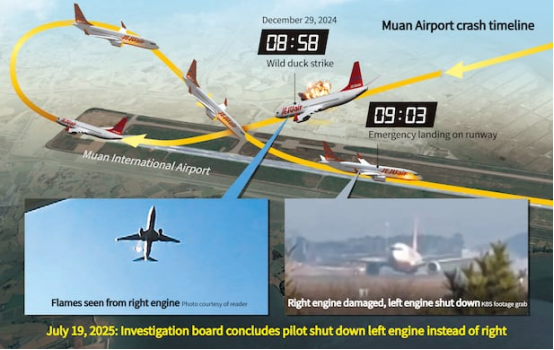
Core Viewpoint - The investigation into the Jeju Air plane crash indicates that the pilot mistakenly shut down the functioning left engine after both engines were damaged by a bird strike, leading to strong protests from victims' families and unions regarding the accountability of the investigation committee [1][2]. Group 1: Investigation Findings - The aircraft experienced a bird strike that damaged both engines, with the right engine suffering severe damage and emitting flames and smoke [1]. - The cockpit voice recorder revealed the pilot's acknowledgment of issues with the right engine, but the investigation concluded that the left engine was incorrectly shut down by the pilot during emergency procedures [1][2]. - The investigation committee, in collaboration with U.S. and French authorities, found no defects in the engines, attributing the failure to pilot error rather than mechanical issues [1][2]. Group 2: Reactions and Protests - Victims' families expressed strong opposition to the investigation's conclusions, labeling them as untrustworthy and demanding the release of cockpit recordings, black box data, and engine information [2]. - The Jeju Air pilots' union criticized the investigation for attempting to simplify the cause of the accident to pilot error, while also highlighting the responsibility of the construction of concrete bases near the runway as a critical factor in the incident [2]. - The Korean Civil Aviation Pilots' representative group condemned the investigation's approach, asserting that it seeks to shift responsibility onto the pilots [2].
韩国最新报告显示“济州航空空难与飞行员错误关闭发动机有关”,调查结果遭遇难者家属反对
Huan Qiu Wang· 2025-07-21 08:07
Group 1 - The core conclusion of the investigation by the Aviation and Railway Accident Investigation Board (ARAIB) indicates that the Jeju Air crash was primarily due to pilot error in shutting down the functioning left engine instead of the damaged right engine [1][3] - The report highlights that the left engine was operational at the time of the incident, and its shutdown led to a complete loss of power for the aircraft, resulting in a failure to deploy the landing gear [1][3] - Initial explanations suggested that both engines were damaged by a bird strike, causing electrical and hydraulic failures, but the latest findings attribute the left engine failure to pilot error rather than bird damage [3][4] Group 2 - The flight involved, Jeju Air flight 7C2216, crashed during landing at Muan Airport on December 29, 2022, with a total of 181 individuals on board, resulting in 179 fatalities [4] - The ARAIB's initial report indicated that both engines ingested birds, specifically the common winter migratory bird, the Eurasian Wigeon [4] - The investigation faced criticism from the victims' families, who felt that the ARAIB was unfairly placing blame on the pilot while ignoring other potential factors such as runway conditions and mechanical failures [3]

国际航空运输协会总干事:赞扬印度和印度航空事故调查局发布详细、及时的印度航空事故初步报告。
news flash· 2025-07-16 02:27
Core Viewpoint - The International Air Transport Association (IATA) Director General praised India and the Indian Aircraft Accident Investigation Bureau for releasing a detailed and timely preliminary report on an aviation accident [1] Group 1 - The report is recognized for its thoroughness and promptness, reflecting a commitment to aviation safety [1]
印度坠机调查:聚焦发动机燃油开关为何关闭
Xin Hua She· 2025-07-12 08:30
Core Insights - The preliminary investigation report by the Indian Aircraft Accident Investigation Bureau reveals that both engines of the aircraft lost fuel supply shortly after takeoff, with a focus on the operation of the fuel switches [1][2][8] Group 1: Incident Details - The report indicates that the fuel switches for both engines were switched from "on" to "off" within one second, leading to the loss of engine power [2][4] - A "MAYDAY" distress signal was issued by one of the pilots during the emergency, but the report does not specify which pilot made the call [2][6] - The aircraft crashed approximately half a minute after the fuel switches were cut off, with the black box ceasing to record five seconds before the crash [4][5] Group 2: Pilot Information - The captain, Sumit Sabharwal, has over 15,000 flight hours, including 8,596 hours on the Boeing 787, while the co-pilot, Clive Kundal, has 3,403 flight hours, with 1,128 hours on the Boeing 787 [6] - Both pilots were reported to have received adequate rest before the flight and passed alcohol breath tests [8] Group 3: Investigation Focus - The investigation is narrowing down on the operation of the fuel switches, with experts suggesting that the switches could not have been accidentally activated [8] - The final analysis report may take several months to complete, as the investigation continues to gather additional evidence [9]
15名济州航空空难事故责任人被立案调查!涉业务过失致死伤
Nan Fang Du Shi Bao· 2025-06-21 09:11
Group 1 - The investigation into the Jeju Air plane crash has led to the filing of charges against 15 individuals for professional negligence resulting in death and injury [1][2] - The crash occurred on December 29, 2024, when Jeju Air flight 7C2216, carrying 181 people, overshot the runway at Muan International Airport, resulting in 179 fatalities [2][3] - Preliminary reports indicate that the aircraft's black boxes stopped recording shortly before the crash, with the plane approaching the runway at a speed of approximately 298 km/h and colliding with a concrete base [2][3] Group 2 - Factors contributing to the crash include the failure of reverse thrust after landing, a short runway, and inadequate airport response [3] - Issues identified at the airport included the presence of obstacles at the runway's end and insufficient ground rescue response [3]

唯一幸存者亲述灾难瞬间!波音787首次致命空难,至少265人死亡
Sou Hu Cai Jing· 2025-06-13 03:12
Core Points - A Boeing 787-8 aircraft crashed in Ahmedabad, India, resulting in 241 fatalities among the 242 onboard, with one survivor [1][3] - The crash occurred shortly after takeoff, with the aircraft losing signal at an altitude of 625 feet (approximately 190 meters) [3][5] - The sole survivor, Vishwas Kumar Ramesh, was seated near the emergency exit and managed to call his father after the crash [5][7] - The black box of the aircraft has been recovered, and preliminary data indicates potential issues with the landing gear system during takeoff [5][7] - Boeing has expressed its willingness to cooperate fully with the investigation led by the Indian aviation authorities [5][7] - This incident marks the first fatal accident involving the Boeing 787-8 model, which has been in service for over 11 years [7] - Following the crash, Boeing's stock price fell by 8% in pre-market trading [7] Industry Impact - The crash has raised concerns regarding the safety record of the Boeing 787 series, which has transported over 1 billion passengers in less than 14 years [7] - The incident has prompted international condolences from various leaders and organizations, highlighting the global impact of aviation safety [8][10]