芯片之争

Search documents
激光雷达芯片第一案升级 专利反诉胜算几何?
Xin Lang Cai Jing· 2025-12-18 14:24
Core Viewpoint - The ongoing legal dispute between Shenzhen Lingming Photon Technology Co., Ltd. and Shenzhen Suteng Juchuang Technology Co., Ltd. has escalated, with Lingming Photon filing a counterclaim for patent infringement while Suteng Juchuang asserts that the core issue is the alleged infringement of its trade secrets [3][18]. Group 1: Patent Strength and Legal Strategies - Lingming Photon has a significantly weaker patent portfolio, holding only 7 patents compared to Suteng Juchuang's 100 patents, which raises concerns about the viability of its counterclaim strategy [6][21]. - Suteng Juchuang's patent applications total approximately 2,300 globally, while Lingming Photon has less than 300, indicating a substantial disparity in intellectual property strength [6][21]. - The industry authority report ranks Suteng Juchuang first in authorized effective patents, while Lingming Photon ranks 17th, further highlighting the competitive disadvantage [7][22]. Group 2: Technical and Commercial Implications - Lingming Photon’s rapid development of a high-resolution large-area chip within six months after terminating its collaboration with Suteng Juchuang raises questions about the legitimacy of its technological advancements [4][19]. - The ongoing legal disputes may jeopardize Lingming Photon’s plans to mass-produce its ADS6311 chip by 2025, potentially leading to project delays in the automotive supply chain [9][24]. - The legal challenges could lead to cautious decision-making from potential clients and partners, impacting Lingming Photon’s ability to secure collaborations and financing [10][25]. Group 3: Trade Secret Litigation Challenges - Suteng Juchuang's choice to pursue a trade secret infringement claim presents high evidentiary hurdles, requiring clear definitions of the alleged trade secrets and substantial proof of their confidentiality [14][29]. - The legal framework allows for a shift in the burden of proof to Lingming Photon if Suteng Juchuang provides solid initial evidence, complicating Lingming Photon’s defense [29][30]. - The outcome of this litigation will not only affect the companies involved but also set new standards for competition and intellectual property management within the lidar industry [30].


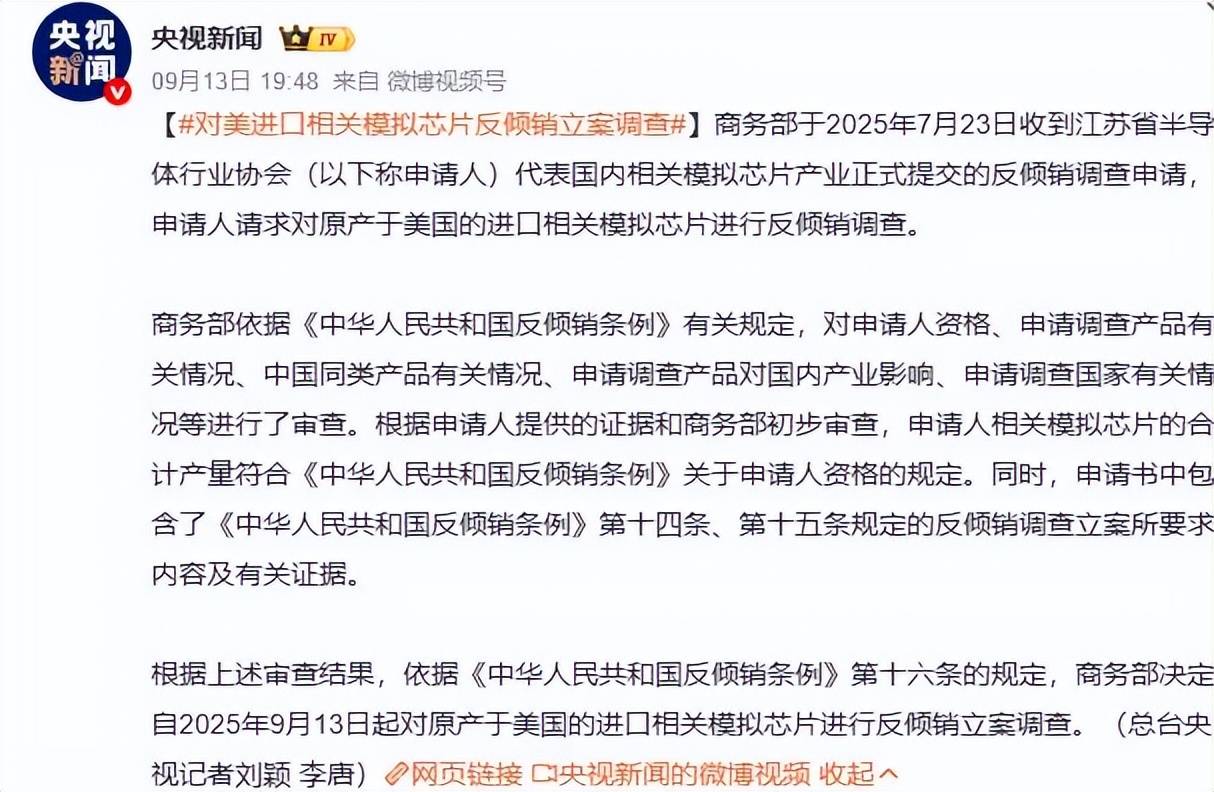
商务部连发两大公告,中国以1敌38国,或退出中美经贸谈判
Sou Hu Cai Jing· 2025-09-15 21:12
Group 1 - China's Ministry of Commerce has initiated anti-dumping investigations against certain U.S. semiconductor products, specifically targeting simulation chips, which are essential across various sectors including electric vehicles and industrial control [2][6] - The investigation period has been set until 2026, indicating a serious and long-term approach rather than a superficial response [2] - Additionally, China has launched an investigation into the U.S.'s discriminatory restrictions in the semiconductor sector, citing a history of tariffs and export controls that have affected Chinese companies [2][10] Group 2 - The narrative of China facing a coalition of 38 countries against it is misleading; the number refers to entities on U.S. restriction lists rather than a unified global front [4] - European countries, while appearing to align with the U.S., are unlikely to fully abandon the Chinese market due to their own economic interests [4] Group 3 - China holds significant leverage in the semiconductor market as it is the largest buyer globally, with projected investments in semiconductor equipment reaching nearly $38 billion by 2025 [6][9] - The legal framework for the investigations aligns with WTO regulations, showcasing China's strategy of utilizing legal avenues rather than mere rhetoric [6][9] Group 4 - The ongoing negotiations between China and the U.S. are characterized as a "game of courage," with both sides testing each other's limits while being cautious of potential backlash from their respective domestic audiences [10][12] - The trade conflict has evolved into a comprehensive battle involving rules, psychology, and industrial capabilities, rather than just tariffs and retaliations [12]