芯片回流

Search documents
美媒炒作“2027年大陆攻台”,库克开始担忧,芯片更难买了
Sou Hu Cai Jing· 2026-02-26 12:17
Core Viewpoint - The U.S. is increasingly concerned about its reliance on Taiwan for semiconductor production, particularly in light of geopolitical tensions and the potential for supply chain disruptions due to a hypothetical military conflict in 2027 [1][6][10] Group 1: Geopolitical Concerns - The CIA has raised alarms about the potential for a military conflict over Taiwan, emphasizing the strategic importance of Taiwanese semiconductor production for U.S. technology companies [1] - U.S. tech leaders are warned about the risks of supply chain disruptions, yet they continue to rely on Taiwan for critical components due to cost and ecosystem advantages [3][6] Group 2: Economic Factors - Building semiconductor manufacturing facilities in the U.S. is significantly more expensive, with costs estimated to be 30-50% higher than in Taiwan [3][6] - The U.S. government's efforts to bring semiconductor production back home have faced delays and challenges, leading to a reliance on Taiwanese production for advanced chips [8][10] Group 3: Technological Challenges - The U.S. is lagging behind Taiwan in advanced semiconductor technology, with TSMC maintaining a lead in the production of cutting-edge chips [3][8] - The final stages of chip production, particularly advanced packaging, remain dependent on Taiwanese facilities, highlighting the limitations of U.S. manufacturing capabilities [8][10] Group 4: Strategic Implications - The U.S. dependency on Taiwan for semiconductors has evolved from a comparative advantage to a strategic vulnerability, raising concerns about national security [10] - Despite significant investments aimed at increasing domestic semiconductor production, projections suggest that the U.S. share of global chip production may only reach 10% by 2030, indicating minimal progress [8][10]



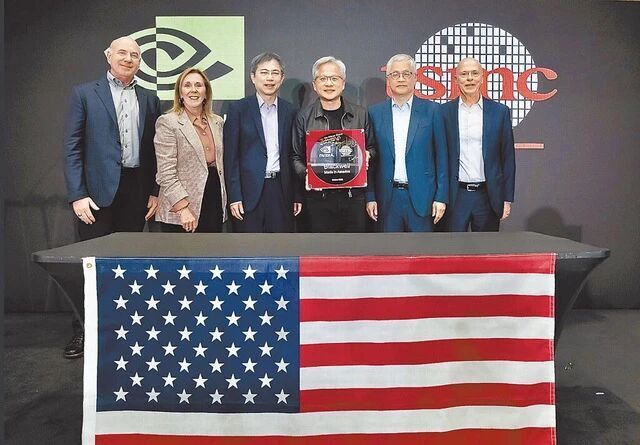
英伟达、台积电在美开花!岛内学者曝“黄仁勋发言藏警讯”
Xin Lang Cai Jing· 2025-10-21 03:51
Core Viewpoint - The collaboration between TSMC and NVIDIA highlights the importance of semiconductor manufacturing in the U.S., but it raises concerns about Taiwan's strategic position in the global semiconductor supply chain [1][3]. Group 1: TSMC's Global Position - TSMC's ability to manufacture AI chips in the U.S. showcases its technological strength and global competitiveness, but this does not necessarily translate to a stronger Taiwan without a comprehensive strategy [3][4]. - As TSMC's core manufacturing and investments shift to the U.S., Japan, and Europe, Taiwan's dominant position in the semiconductor industry is gradually being diluted [3][4]. - The statement by NVIDIA's CEO that "the most important chips will be made in America" suggests that the U.S. may no longer rely on Taiwan for critical production lines, reflecting a significant geopolitical shift [3][4]. Group 2: Economic Implications for Taiwan - The establishment of TSMC's factory in Phoenix will create high-paying jobs and stimulate the local supply chain in the U.S., but these benefits will not extend to Taiwan [4][6]. - The transfer of technology, talent development, and key suppliers will likely move away from Taiwan, indicating a trend of "de-Taiwanization" despite the gradual nature of this process [4][6]. - While Taiwanese investors can still benefit from TSMC's success in the financial markets, the glory of TSMC's achievements will be shared globally, leading to a relative decline in Taiwan's strategic position [6].