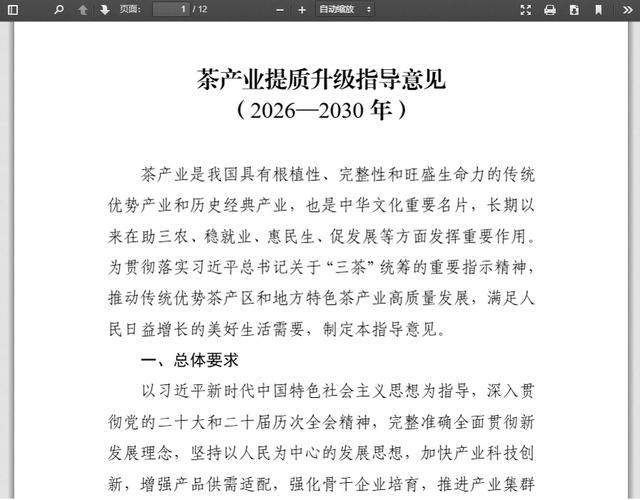
茶产业提质升级

Search documents
一图读懂!《茶产业提质升级指导意见(2026—2030年)》发布
Nan Fang Nong Cun Bao· 2026-02-14 13:33
Core Viewpoint - The "Guiding Opinions on the Quality Improvement and Upgrading of the Tea Industry (2026-2030)" aims to enhance the quality and competitiveness of China's tea industry, focusing on technological innovation, product development, and cultural value creation [2][18]. Group 1: Key Objectives - By 2028, the goal is to cultivate over five tea industry clusters with annual revenues exceeding 10 billion yuan, and several leading enterprises in the entire tea industry chain with revenues over 5 billion yuan [12][13]. - By 2030, the entire tea industry chain is expected to reach a scale of 15 trillion yuan, with the refined tea processing industry achieving revenues exceeding 200 billion yuan, establishing a robust, green, intelligent, and internationally competitive tea industry system [14][15]. Group 2: Key Tasks - The document outlines 19 key tasks focusing on enhancing technological processes, product innovation, and the cultivation of traditional and local tea industries [10][11]. - It emphasizes the importance of developing a comprehensive tea culture value system and improving supporting systems [9][11]. Group 3: Industry Development Strategies - The strategy includes fostering deep processing enterprises and strengthening leading enterprises in the industry chain through resource integration and international expansion [26][27]. - It encourages the development of specialized supporting enterprises in quality testing, packaging, and equipment manufacturing [28]. Group 4: Cultural and Market Integration - The plan aims to enhance the cultural value of tea by developing digital resources and promoting tea culture through modern technology and storytelling [35][36]. - It also focuses on internationalizing the "Chinese Tea" brand and enhancing the competitiveness of tea products in global markets [36]. Group 5: Quality and Safety Standards - The document stresses the need for robust quality and safety supervision, including the establishment of food safety management systems and enhancing inspection capabilities [38][39]. - It calls for the development of a comprehensive standard system that aligns with international standards [40]. Group 6: Talent Development - There is a strong emphasis on cultivating a specialized talent pool through educational partnerships and skill recognition systems [41]. - The initiative aims to promote the integration of traditional craftsmanship with modern practices to enhance the overall quality of the tea industry [41].


如何推动茶产业和酿酒产业提质升级?官方解读来了→
Nan Fang Nong Cun Bao· 2026-02-14 13:32
Group 1 - The core viewpoint of the article emphasizes the importance of upgrading the tea and liquor industries in China to enhance quality and drive economic growth [4][11] - The tea and liquor industries are traditional advantageous sectors in China, contributing significantly to economic stability, consumer demand, and cultural heritage [8][12][20] - The total scale of the tea and liquor industries exceeds 2 trillion yuan, with revenue from large-scale tea processing and liquor enterprises surpassing 940 billion yuan and profits exceeding 220 billion yuan [13][14] Group 2 - Upgrading these industries is crucial for stabilizing industrial economic operations and supporting continuous economic recovery [12][15] - High-quality supply from these industries can stimulate consumption and expand domestic demand, particularly through new product innovations like "new-style tea drinks" and "craft beer" [16][19] - The tea and liquor sectors serve as vital economic pillars for rural areas, enhancing local food industries and promoting regional economic development [21][24][26] Group 3 - The article outlines the current development status of the tea and liquor industries, noting that quality has improved and transformation has accelerated since the 18th National Congress [48][49] - By 2025, the revenue from large-scale tea processing enterprises is expected to exceed 120 billion yuan, while the liquor industry is projected to achieve over 820 billion yuan in revenue [51][53] - The guidance documents set ambitious goals for the industries, aiming for a tea industry scale of 1.5 trillion yuan and significant revenue growth for key enterprises by 2030 [65][66] Group 4 - The guidance documents propose 19 key tasks for the tea industry and 21 for the liquor industry, focusing on technological innovation, brand culture, and structural optimization [72][76] - Emphasis is placed on enhancing brand culture to improve market competitiveness and adapt to consumer trends [78][83] - The documents advocate for a collaborative environment involving government, market, and society to support the development of these industries [84][88]
我国力争到2030年茶全产业链规模达1.5万亿元
Xin Hua Wang· 2026-02-14 08:46
Core Viewpoint - The "Guiding Opinions on the Quality Improvement and Upgrading of the Tea Industry (2026-2030)" aims to enhance the tea industry's scale and quality, targeting a total industry chain value of 1.5 trillion yuan by 2030, with significant improvements in operational efficiency and revenue generation [1][2]. Group 1: Industry Goals and Projections - By 2030, the entire tea industry chain is expected to reach a scale of 1.5 trillion yuan, with the revenue from large-scale refined tea processing exceeding 200 billion yuan [1]. - By 2025, the revenue from large-scale refined tea processing enterprises is projected to surpass 120 billion yuan, with the total industry chain scale exceeding 1 trillion yuan and creating over 6 million job opportunities annually [1]. - By 2028, traditional tea-producing regions are expected to see steady progress, with the development quality and efficiency of local specialty tea industries continuously optimized [2]. Group 2: Key Tasks and Focus Areas - The opinions outline 19 key tasks across six areas, including enhancing technological innovation, fostering business entities, and promoting the construction of specialty industry clusters [2]. - Specific initiatives include extending tea raw materials and components into home, daily chemical, beauty, and health sectors, and supporting the development of AI models tailored for the tea industry [2]. - The document emphasizes the importance of improving technical processes, product innovation, and the cultivation of competitive enterprise brands within the tea industry [2].
工信部等五部门印发《茶产业提质升级指导意见(2026—2030年)》
Jin Rong Jie· 2026-02-14 08:07
Core Viewpoint - The Ministry of Industry and Information Technology and four other departments have issued the "Guidance on Quality Improvement and Upgrading of the Tea Industry (2026-2030)", aiming to enhance the tea industry's development and modernization by 2030 [1] Group 1: Development Goals - By 2028, traditional tea-producing regions are expected to see steady progress, with local specialty tea industries optimizing quality and efficiency [1] - The modernization level of the industry chain is projected to significantly improve, with a continuous expansion of product varieties, consumption scenarios, and business models [1] - The goal is to cultivate over five tea industry clusters with annual revenues exceeding 10 billion yuan, along with several leading enterprises in the entire tea industry chain generating over 5 billion yuan in annual revenue [1] Group 2: Future Projections - By 2030, the development levels of digitalization, greening, and diversification are expected to continue improving [1] - The overall scale of the entire industry chain is anticipated to reach 1.5 trillion yuan, with a significant increase in development quality and efficiency [1] - The revenue from the refined tea processing industry is projected to exceed 200 billion yuan, aiming to establish a robust, green, intelligent, and internationally competitive tea industry system [1]
五部门印发《茶产业提质升级指导意见(2026—2030年)》
Xin Lang Cai Jing· 2026-02-14 05:03
Core Viewpoint - The Ministry of Industry and Information Technology, along with four other departments, has issued the "Guiding Opinions on the Quality Improvement and Upgrading of the Tea Industry (2026-2030)" to enhance the development of the tea industry in China [1][2]. Group 1 - The document aims to provide a framework for the tea industry to improve quality and upgrade its operations over the next five years [1]. - It emphasizes the importance of collaboration among various governmental departments to ensure effective implementation of the guidelines [2].