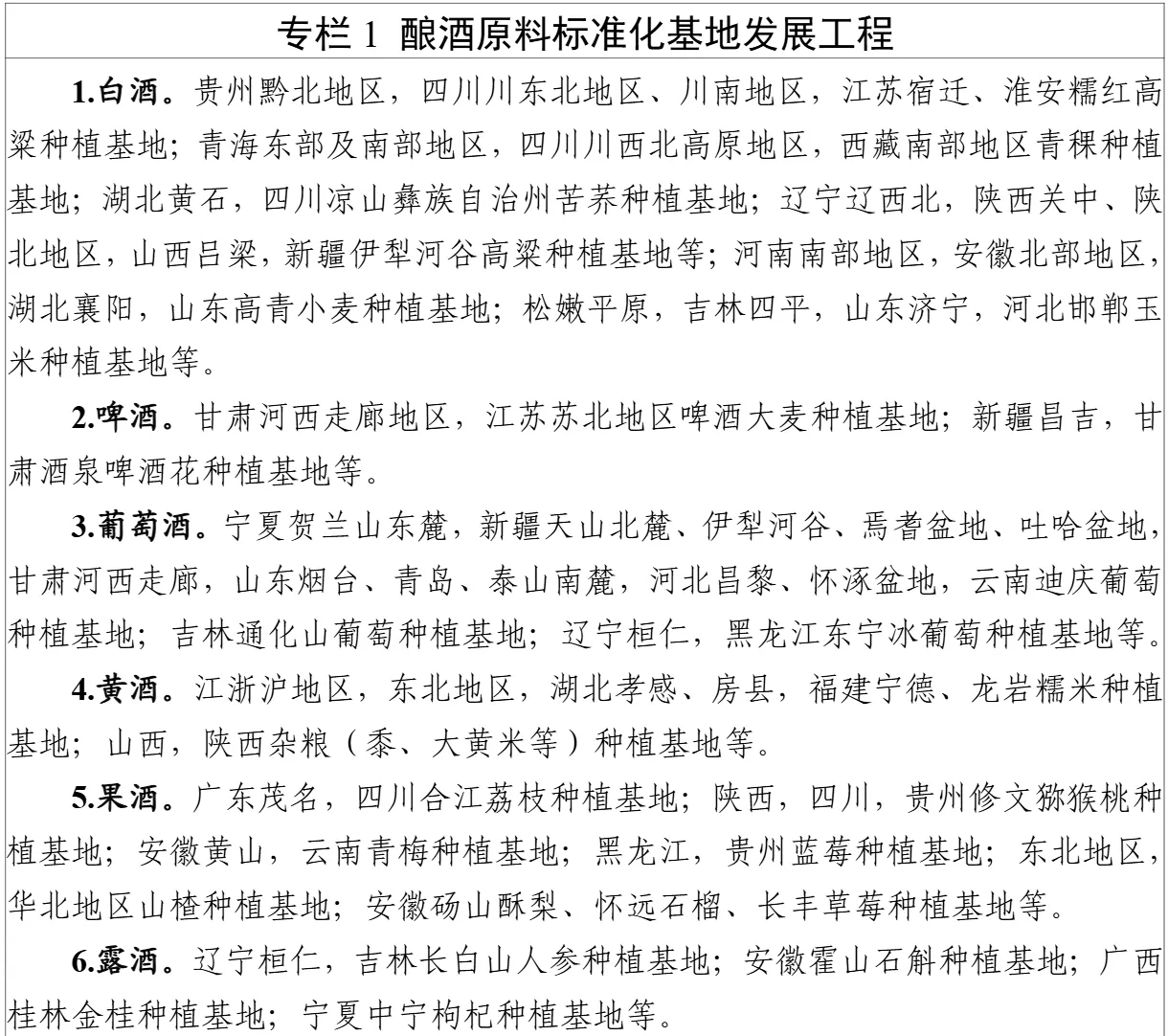
酿酒产业提质升级

Search documents
酿酒产业提质升级意见出台 天佑德青稞酒以产业实践回应政策导向
Quan Jing Wang· 2026-02-25 05:06
Core Viewpoint - The Ministry of Industry and Information Technology, Ministry of Agriculture and Rural Affairs, and Ministry of Commerce of China jointly issued the "Guiding Opinions on the Quality Improvement and Upgrading of the Brewing Industry (2026-2030)", outlining a clear blueprint for the high-quality development of China's brewing industry over the next five years [1] Group 1: Quality Improvement and Standardization - The document prioritizes the integration of raw material planting, production brewing, and circulation consumption, emphasizing the establishment of a controllable and traceable system from "field to table" [2] - Tianyoude Wine has established a closed-loop full industry chain from the breeding of special organic barley varieties to large-scale planting and brewing processing, ensuring quality control of core raw materials [2] - The company is advancing the digitalization and standardization of brewing processes, having introduced automated control systems and quality traceability systems to strengthen its position as a representative and standard setter for barley wine [2] Group 2: Product Diversification and Consumer Experience - The Opinions encourage industry innovation and support the development of "special fruit wines, craft beers, and ready-to-drink cocktails," as well as flexible customization and wine-meal integration [3] - Tianyoude has actively explored product diversification and consumer scenario expansion, developing a series of products based on the health-oriented barley ingredient [3] - The company is integrating brand communication with consumer experience through initiatives like barley wine cultural experience centers and regional tourism, aligning with the direction of personalized consumption and scenario expansion [3] Group 3: Industry Development and Strategic Positioning - The top-level design aims to cultivate over three trillion-level traditional advantageous wine-producing areas and more than ten hundred-billion-level characteristic brewing industry parks by 2028 [4] - Tianyoude's core production base is located in the Qinghai province, recognized as a key area for the barley wine industry, closely linking its development with the prosperity of the region [4] - With policy support, the Qinghai barley wine region, led by Tianyoude, is expected to gain more assistance in infrastructure construction, brand collaboration, and technology resource sharing, accelerating towards the goal of "hundred-billion-level characteristic brewing industry parks" [4]

酒价内参2月25日价格发布,精品茅台逆势上涨7元
Xin Lang Cai Jing· 2026-02-25 02:01
Core Viewpoint - The Chinese white liquor market is experiencing a significant price correction, with the average retail price of the top ten products declining as of February 25, indicating a cautious market sentiment following the post-holiday price surge [1]. Price Trends - The total price for a package of one bottle from each of the top ten products is 9,221 yuan, which represents a decrease of 37 yuan from the previous day, marking a new low for the week [1]. - Out of the top ten products, eight saw price declines while two experienced price increases, reflecting a cautious market atmosphere [1]. Specific Product Performance - Moutai's premium product increased by 7 yuan per bottle, serving as a key support for the market [1]. - Yanghe Dream Blue M6 saw a slight increase of 3 yuan per bottle, continuing its narrow fluctuation trend [1]. - The most significant decline was observed in Guojiao 1573, which dropped by 18 yuan per bottle, following a previous five-day price increase [1]. - Other notable declines included: - Gujing Gong 20 down by 13 yuan - Xijiu Junpin down by 5 yuan - Shuijing Jian'nan Chun down by 3 yuan - Several other products, including Feitian Moutai and Wuliangye, saw minor decreases of 2 yuan each [1][6]. Industry Developments - The Ministry of Industry and Information Technology, the Ministry of Human Resources and Social Security, and the State Administration for Market Regulation jointly issued the "Guidance on Quality Improvement and Upgrading of the Brewing Industry (2026-2030)," marking the beginning of a high-quality development path for the Chinese liquor industry [3]. - The guidance outlines seven key areas for improvement, including enhancing raw material supply, boosting technological innovation, and optimizing industry structure, with 21 specific tasks identified [3].





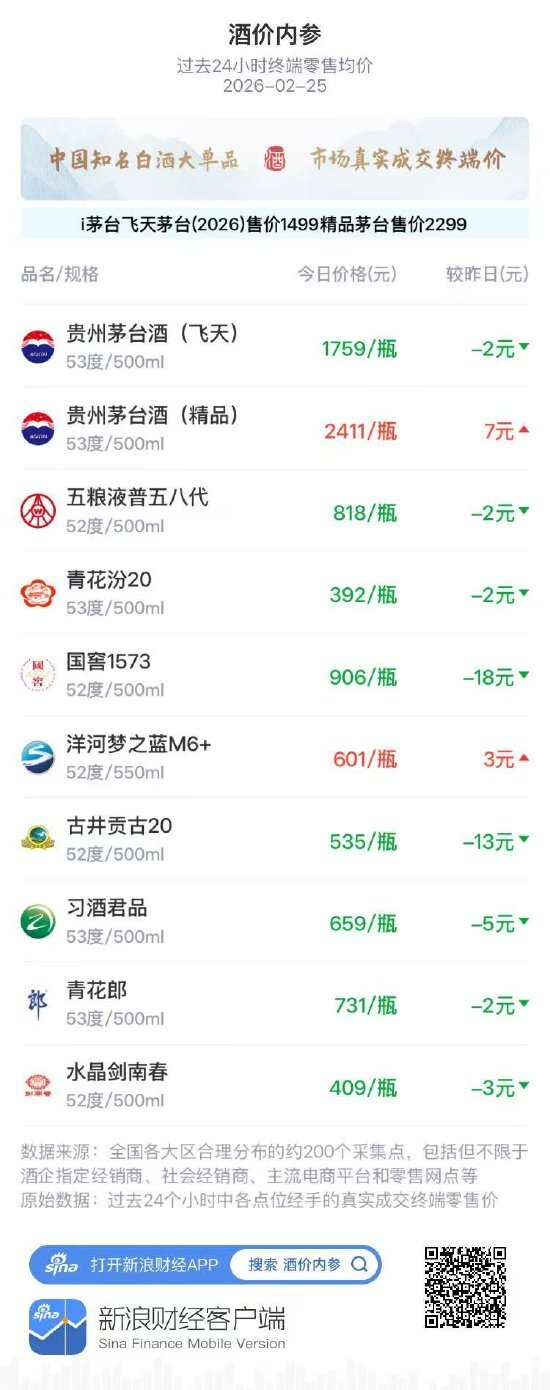
酒价内参2月25日价格发布,国窖1573跌幅居前下调18元
Xin Lang Cai Jing· 2026-02-25 01:42
Core Viewpoint - The Chinese white liquor market is experiencing a significant price correction, with the average retail price of the top ten products declining after the Spring Festival, indicating heavy selling pressure on previously high-demand items [1][6][7]. Price Trends - As of February 25, the total retail price for a package of the top ten products is 9,221 yuan, a decrease of 37 yuan from the previous day, marking a new low for the week [1][6][7]. - Out of the top ten products, eight saw price declines while two experienced price increases, reflecting cautious market sentiment [1][7]. Individual Product Performance - Moutai's premium product increased by 7 yuan per bottle, serving as a key support for the market [1][7]. - Yanghe Dream Blue M6+ rose by 3 yuan per bottle, continuing its narrow fluctuation trend [1][7]. - The largest decline was seen in Guojiao 1573, which dropped by 18 yuan per bottle, following a previous five-day price increase [1][7]. - Other notable declines include: - Gujing Gong 20 down by 13 yuan - Xijiu Junpin down by 5 yuan - Shuijing Jian'nan Chun down by 3 yuan - Several other brands, including Feitian Moutai and Wuliangye, saw minor decreases of 2 yuan each [1][7][12]. Market Data Collection - The price data is sourced from approximately 200 collection points across various regions, including designated distributors, social distributors, e-commerce platforms, and retail outlets, ensuring a comprehensive and objective representation of the market [2][8]. - The introduction of new sales channels for Moutai products has begun to influence their market prices, with the retail price for Feitian Moutai set at 1,499 yuan and premium Moutai at 2,299 yuan [2][8]. Industry Developments - A recent report highlighted the release of the "Guidance on Quality Improvement and Upgrading of the Brewing Industry (2026-2030)" by three government departments, marking the start of a high-quality development path for the Chinese liquor industry [9]. - The guidance outlines seven key areas for improvement, including enhancing raw material supply, boosting technological innovation, and optimizing industry structure, with a total of 21 key tasks identified [9].
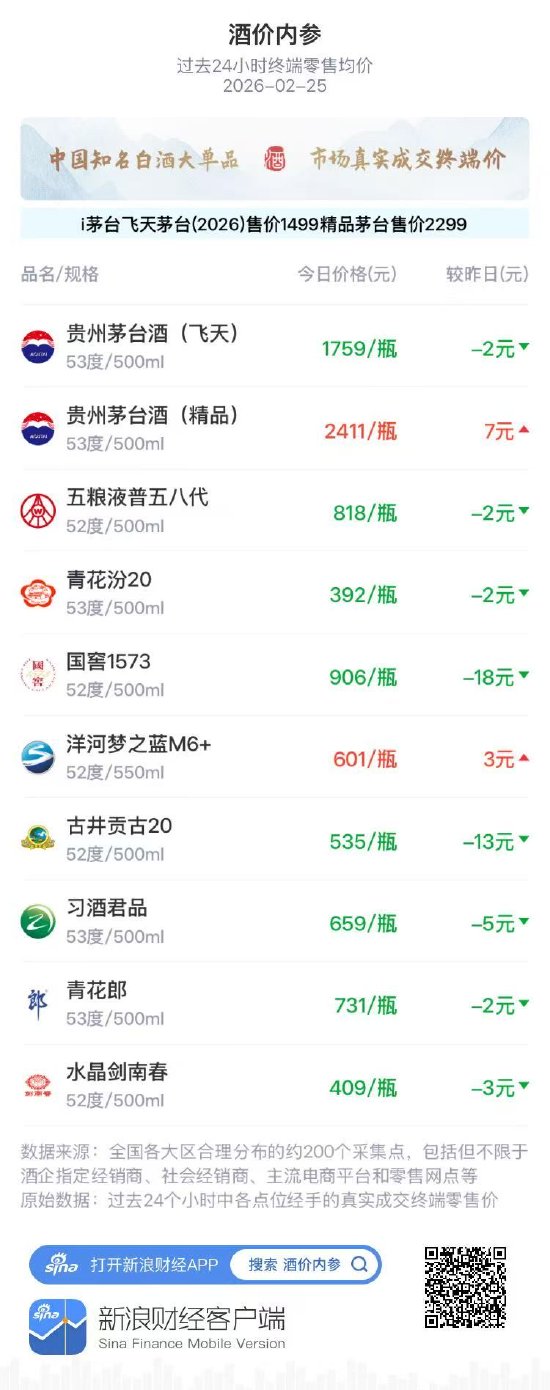
酒价内参2月25日价格发布,洋河梦之蓝M6+小幅上涨3元
Xin Lang Cai Jing· 2026-02-25 01:42
Core Viewpoint - The Chinese white liquor market is experiencing a significant price correction, with the average retail price of the top ten products dropping, indicating market pressure following the holiday price increases [1][6][7]. Price Trends - As of February 25, the total retail price for a package of the top ten liquor products is 9,221 yuan, a decrease of 37 yuan from the previous day, marking a new low for the week [1][6][7]. - Out of the top ten products, eight saw price declines while two experienced price increases, reflecting cautious market sentiment [1][7]. Individual Product Performance - Moutai's premium variant increased by 7 yuan per bottle, serving as a key support for the market [1][7]. - Yanghe Dream Blue M6+ rose by 3 yuan per bottle, continuing its narrow fluctuation trend [1][7]. - The largest decline was observed in Guojiao 1573, which fell by 18 yuan per bottle, indicating a significant downward shift after a previous five-day price increase [1][7]. - Other notable declines included: - Gujing Gong 20 down by 13 yuan - Xijiu Junpin down by 5 yuan - Shuijing Jian'nan Chun down by 3 yuan - Several other brands, including Feitian Moutai and Wuliangye, saw minor decreases of 2 yuan each [1][7][12]. Market Data Collection - The price data is sourced from approximately 200 collection points across various regions, including designated distributors, social distributors, e-commerce platforms, and retail outlets, ensuring a comprehensive and objective representation of the market [2][8]. Industry Developments - A recent report highlighted the release of the "Guidance on Quality Improvement and Upgrading of the Brewing Industry (2026-2030)" by three government departments, marking the beginning of a high-quality development path for the Chinese liquor industry [9]. - The guidance outlines seven key areas for improvement, including enhancing raw material supply, boosting technological innovation, and optimizing industry structure, with 21 specific tasks identified [9].
酿酒产业重大机遇!工信部等三部门发文:到2028年培育至少10个百亿级特色酿酒产业园区
Mei Ri Jing Ji Xin Wen· 2026-02-16 05:10
Core Viewpoint - The "Guiding Opinions on the Quality Improvement and Upgrading of the Brewing Industry (2026-2030)" outlines a strategic plan for the Chinese brewing industry, aiming for significant development milestones by 2028 and 2030, focusing on quality, efficiency, and sustainability [1][2]. Group 1: Development Goals - By 2028, the plan aims to cultivate over three traditional advantageous liquor production areas worth over 100 billion yuan and more than ten specialty brewing industrial parks worth over 10 billion yuan, establishing a development pattern of "billion parks, trillion clusters, and trillion industries" [1]. - By 2030, the industry is expected to enhance its digital, green, and international development levels, improve quality and efficiency, and optimize production capacity and product structure [1]. Group 2: Key Tasks and Engineering Projects - The opinions identify 21 key tasks across seven areas: raw material supply, technological innovation, industrial structure, development methods, business models, brand culture, and support systems [1]. - Four major engineering projects are proposed: development of standardized raw material bases, upgrading of technology and equipment, cultivation of local specialty liquor production areas, and establishment of standardization systems [1]. Group 3: Raw Material Supply - The plan emphasizes the establishment of standardized planting bases for brewing raw materials, focusing on high-quality sources of grains like sorghum, barley, and wine grapes [3]. - It encourages collaboration between universities, research institutions, and enterprises to develop high-yield, flavorful, and resilient raw material varieties [3][4]. Group 4: Regional Collaboration and Industry Clusters - The "big production area" concept promotes resource integration among adjacent production areas to create unified brands and overcome fragmentation and homogenization [5]. - The plan outlines a "beautiful wine map" for developing local specialty liquor production areas across seven major regions in China, leveraging local natural and cultural resources [5]. Group 5: Full-Chain Transformation - The opinions call for a shift towards intelligent, green, and international development, including the elimination of coal-fired boilers and the promotion of zero-carbon factories [7]. - It supports the development of smart factories and the use of advanced technologies like AI and IoT in the brewing process [7]. Group 6: New Business Models and Consumption Scenarios - The transformation in distribution emphasizes the development of new business models, encouraging deep integration between production and distribution companies [8]. - The plan aims to create diverse consumption scenarios by embedding liquor products into nightlife, dining areas, and commercial complexes, enhancing consumer experiences [8]. Group 7: Cross-Industry Integration - The plan promotes cross-industry integration, encouraging collaboration in production, brand partnerships, and the development of innovative consumer products [8]. - It supports the establishment of cultural and tourism hubs that combine liquor production, cultural displays, and immersive consumer experiences [8].
我国力争到2028年培育3个以上千亿级传统优势酒产区
Xin Hua Wang· 2026-02-15 08:41
Core Insights - The Ministry of Industry and Information Technology and two other departments have jointly issued the "Guiding Opinions on Quality Improvement and Upgrading of the Brewing Industry (2026-2030)" [1] - By 2028, the industry layout will be further optimized, with the aim to cultivate over three traditional advantageous wine production areas worth over 100 billion yuan and more than ten characteristic brewing industrial parks worth over 10 billion yuan each [1][2] - The opinions emphasize the integration of raw material planting, production brewing, and circulation consumption, with a focus on enhancing production methods and business models [1] Summary by Categories Industry Development Goals - By 2028, the brewing industry aims to achieve a development pattern of "billion parks, trillion clusters, and trillion industries" [1] - By 2030, the industry is expected to see significant improvements in digitalization, greening, and internationalization, leading to a healthier industrial ecosystem [1] Key Tasks and Focus Areas - The opinions outline 21 key tasks across seven areas, including enhancing raw material supply security, improving technological innovation, and optimizing industry structure [1] - Specific tasks include promoting the cultivation of key brewing raw materials such as sorghum, barley, and wine grapes, and accelerating cross-industry integration [1][2] Economic Impact - The brewing industry is recognized as a traditional advantageous and essential livelihood industry in China, with projected revenues exceeding 820 billion yuan for large-scale brewing enterprises by 2025 [2]
三部门印发《酿酒产业提质升级指导意见(2026—2030年)》,一图读懂
Nan Fang Nong Cun Bao· 2026-02-14 13:33
Core Viewpoint - The document outlines the "Guiding Opinions on the Quality Improvement and Upgrading of the Brewing Industry (2026-2030)", aiming to enhance the brewing industry's quality and adapt to new market demands for high-quality development [2][13]. Group 1: Key Objectives - The guiding opinions focus on seven key areas: enhancing raw material supply security, improving technological innovation, optimizing industry structure, transforming development methods, developing new models and formats, strengthening brand culture, and improving industry support systems [5][6][14]. - By 2028, the industry layout is expected to be further optimized, with the cultivation of over three traditional advantageous wine production areas worth over 100 billion yuan and more than ten characteristic brewing industrial parks worth over 10 billion yuan each [8][9]. Group 2: Key Tasks - The document specifies 21 key tasks, including enhancing raw material supply capabilities, improving technological innovation levels, and adjusting and optimizing industry structures [22][25][28]. - It emphasizes the need for a robust raw material supply chain, encouraging the establishment of standardized bases for brewing raw materials and promoting the use of advanced technologies in production [23][24]. Group 3: Development Strategies - The opinions advocate for the promotion of intelligent transformation and green development within the industry, encouraging the adoption of AI and sustainable practices [31][32]. - It also highlights the importance of internationalization, urging companies to align with international standards and expand their global presence [33]. Group 4: Brand and Cultural Empowerment - The document stresses the need to deepen the cultural value of brewing, encouraging the construction of digital resources and the promotion of traditional brewing techniques as part of cultural heritage [38][39]. - It calls for the development of a systematic brand strategy to cater to diverse consumer groups and enhance brand recognition [40][41]. Group 5: Implementation and Support - A collaborative mechanism involving government, industry organizations, and enterprises is proposed to optimize resource allocation and support technological upgrades [45]. - The document emphasizes the importance of talent development and establishing a comprehensive standard system to ensure quality and safety in the brewing industry [41][42][43].

如何推动茶产业和酿酒产业提质升级?官方解读来了→
Nan Fang Nong Cun Bao· 2026-02-14 13:32
Group 1 - The core viewpoint of the article emphasizes the importance of upgrading the tea and liquor industries in China to enhance quality and drive economic growth [4][11] - The tea and liquor industries are traditional advantageous sectors in China, contributing significantly to economic stability, consumer demand, and cultural heritage [8][12][20] - The total scale of the tea and liquor industries exceeds 2 trillion yuan, with revenue from large-scale tea processing and liquor enterprises surpassing 940 billion yuan and profits exceeding 220 billion yuan [13][14] Group 2 - Upgrading these industries is crucial for stabilizing industrial economic operations and supporting continuous economic recovery [12][15] - High-quality supply from these industries can stimulate consumption and expand domestic demand, particularly through new product innovations like "new-style tea drinks" and "craft beer" [16][19] - The tea and liquor sectors serve as vital economic pillars for rural areas, enhancing local food industries and promoting regional economic development [21][24][26] Group 3 - The article outlines the current development status of the tea and liquor industries, noting that quality has improved and transformation has accelerated since the 18th National Congress [48][49] - By 2025, the revenue from large-scale tea processing enterprises is expected to exceed 120 billion yuan, while the liquor industry is projected to achieve over 820 billion yuan in revenue [51][53] - The guidance documents set ambitious goals for the industries, aiming for a tea industry scale of 1.5 trillion yuan and significant revenue growth for key enterprises by 2030 [65][66] Group 4 - The guidance documents propose 19 key tasks for the tea industry and 21 for the liquor industry, focusing on technological innovation, brand culture, and structural optimization [72][76] - Emphasis is placed on enhancing brand culture to improve market competitiveness and adapt to consumer trends [78][83] - The documents advocate for a collaborative environment involving government, market, and society to support the development of these industries [84][88]
三部委联合发文:拟培育10个以上百亿级特色酿酒产业园区
Nan Fang Du Shi Bao· 2026-02-14 12:05
Core Insights - The Chinese liquor industry is set to benefit significantly from the "Guidance on Quality Improvement and Upgrading of the Liquor Industry (2026-2030)" issued by various government departments, which outlines developmental goals for the industry [1][2] Industry Development Goals - By 2028, the liquor industry aims to enhance the integration of raw material planting, production, and consumption, leading to improved product diversity, quality recognition, and brand reputation [1] - The industry is expected to cultivate over three traditional liquor production areas with a scale of over 100 billion yuan and more than ten characteristic liquor industry parks with a scale of over 10 billion yuan, establishing a tiered development structure of "billion parks, trillion clusters, and trillion industries" [1][2] Future Industry Outlook - By 2030, the liquor industry is projected to achieve significant advancements in digitalization, greening, and internationalization, with improved quality and efficiency, stable industry scale, and optimized capacity layout and product structure [1] - The industry is anticipated to develop a healthy ecosystem characterized by diverse product types, orderly production and circulation, and reasonable regional distribution [1] Economic Impact - The liquor industry, having transitioned from a restricted to a historical classic industry, is viewed as a major opportunity for growth, with projected revenues exceeding 820 billion yuan for large-scale liquor enterprises by 2025 [2] - The China Alcoholic Drinks Association believes that upgrading the liquor industry will stabilize industrial economic operations and contribute to sustained economic recovery, highlighting its significant role in tax contributions and economic stability [2]
工信部:到2028年培育3个以上千亿级传统优势酒产区、10个以上百亿级特色酿酒产业园区
Cai Jing Wang· 2026-02-14 08:38
Core Viewpoint - The Ministry of Industry and Information Technology, along with other departments, has issued guidelines for the upgrading and quality improvement of the brewing industry in China from 2026 to 2030, emphasizing the industry's role in cultural heritage, regional economic development, rural revitalization, and job creation [1][3]. Group 1 - The brewing industry is recognized as a traditional advantageous industry and a fundamental livelihood sector in China, playing a significant role in various socio-economic aspects [3]. - The guidelines aim to align the brewing industry with new market demands and promote high-quality development, following previous directives for the transformation of traditional manufacturing [3]. - By 2028, the integration of raw material cultivation, production, and consumption is expected to improve, with enhanced product diversity, quality recognition, and brand reputation [3][5]. Group 2 - The plan includes the establishment of over three traditional advantageous wine production areas with a scale of over 100 billion yuan and more than ten characteristic brewing industrial parks with a scale of over 10 billion yuan [3]. - By 2030, the industry is expected to achieve significant advancements in digitalization, greening, and internationalization, with improved quality and efficiency [5]. - The goal is to create a healthy industrial ecosystem characterized by a diverse product range, orderly production and distribution, and a rational regional layout [5].