行为面试法

Search documents
高效招聘策略,做好这5点就足够了
3 6 Ke· 2026-02-02 00:16
Group 1 - The article emphasizes the importance of efficient interviewing and highlights that a clear talent profile is key to recruitment [1][2] - It discusses the significant costs associated with hiring unsuitable employees, which can amount to 15 times their salary [2] - The article provides insights into the recruitment practices of successful companies, such as ByteDance and Xiaomi, where founders personally conducted interviews for their early hires [3][4] Group 2 - The article outlines the process of creating a talent profile, which includes analyzing the company's current situation, talent reserves, and specific hiring needs based on the company's development stage [7][8] - It suggests using SWOT analysis to determine the quantity and quality of talent needed for the upcoming year [8] - The article stresses that the talent profile should be dynamic and involve collaboration between the CEO, business departments, and HR [11] Group 3 - The article details the interview process, recommending a structured approach that includes a brief introduction, an overview of the interview process, and a core questioning segment lasting 30-40 minutes [14][17] - It introduces three common interview methods: behavioral, situational, and stress interviews, each with specific applications and techniques [18][21][23] - The article emphasizes the importance of asking targeted questions and following up to ensure the accuracy and depth of candidates' responses [25][26] Group 4 - The article outlines principles for writing interview evaluations, including avoiding being misled by resumes, focusing on details, and assessing the problem-solving process rather than just the outcomes [30][31] - It suggests that evaluations should be based on the match between candidates' abilities and the job requirements, distinguishing between essential and discretionary behaviors [32] - The article recommends documenting candidates' responses and observations during interviews to maintain objectivity and provide a reference for future interviewers [34]
“这人不行,就换掉”,是公司最昂贵的想法
3 6 Ke· 2026-01-08 07:42
Core Insights - The prevalent mindset in companies is to replace employees when issues arise, which is an expensive and shortsighted approach [2][12][25] Financial Costs - The direct financial costs of replacing an employee include not only salary but also recruitment fees, training costs, and severance pay, which can amount to 1.5-2 times the employee's annual salary [6][5][4] Team Morale - Frequent employee turnover negatively impacts team morale, leading to insecurity among remaining employees and a conservative work environment where innovation is stifled [7][8][9] Root Causes - Problems attributed to individual performance may actually stem from organizational issues such as poor job design, unclear processes, or misalignment of values, which need to be addressed before considering replacement [10][11][12] Management Practices - To avoid the trap of frequent replacements, companies should focus on selecting the right people, placing them in suitable roles, developing their skills, and regularly evaluating their performance [13][25] Selection Process - The selection process should emphasize alignment of candidates' values and skills with the company's needs, using behavioral interview techniques to assess past performance [14][15][16] Role Assignment - Properly assigning employees to roles that match their strengths is crucial for maximizing productivity and achieving results [16][17] Employee Development - Viewing employees as assets rather than costs encourages investment in their growth, which can enhance company value over time [18][19] Performance Evaluation - Regular assessment of employee performance is necessary to ensure alignment with company goals, and adjustments should be made if there is a mismatch [20][21] When to Replace - Replacement may be warranted in cases of severe value misalignment or consistent underperformance despite support and training [23][24]
从马拉松女护士说起:一颗冠军的心,为何成了团队的“毒药”?
虎嗅APP· 2025-09-07 23:52
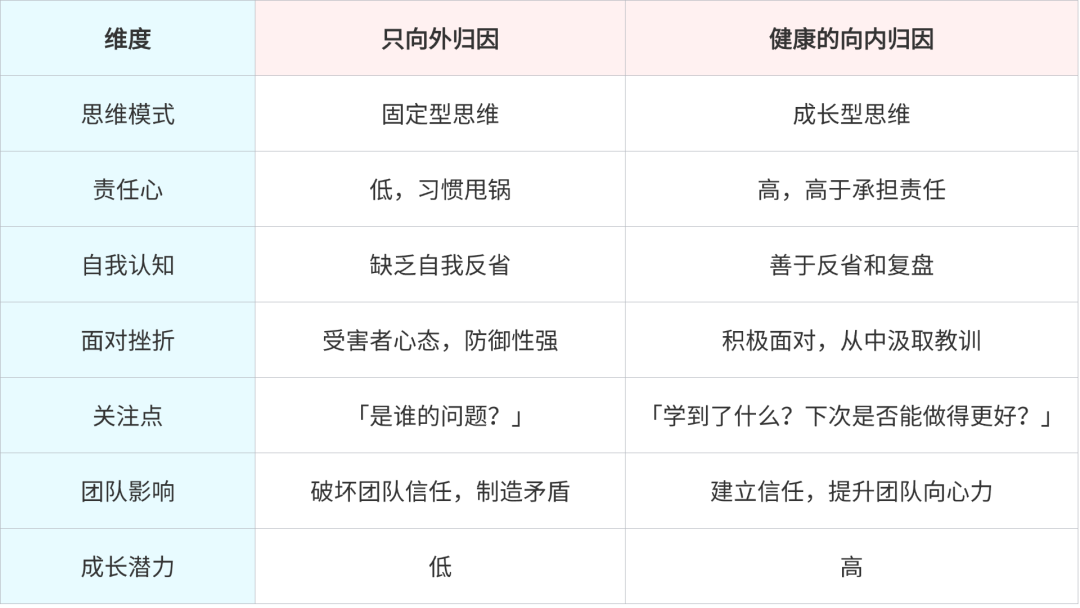
Core Viewpoint - The article discusses the importance of internal versus external attribution in the workplace, highlighting how a nurse's external attribution of her challenges led to negative perceptions from colleagues and management [5][15][18]. Group 1: External vs Internal Attribution - The nurse attributed her success to her own efforts while blaming her leadership for the difficulties she faced, demonstrating a defensive mindset [14][15]. - This external attribution can lead to a lack of support from colleagues, as they may feel unappreciated and resentful [9][25]. - The article emphasizes that a healthy internal attribution fosters personal growth and accountability, while external attribution can hinder teamwork and trust [21][22][33]. Group 2: Impact on Team Dynamics - Individuals who consistently blame others for their failures are seen as detrimental to team cohesion and are often avoided by colleagues [24][33]. - The article provides an example of a candidate who attributed their project's failure to external factors, indicating a pattern of avoiding responsibility [28][30]. - Such behavior can create a toxic work environment, as team members may feel they cannot rely on someone who does not take accountability [33][35]. Group 3: Behavioral Interviewing Insights - The article discusses the use of behavioral interviewing techniques to assess candidates' responses to failure, focusing on their ability to learn and adapt [44][46]. - Candidates are encouraged to reflect on their past failures and articulate what they learned, which can indicate their potential for future success [48][56]. - The STAR-L model is suggested as a framework for candidates to structure their responses, emphasizing the importance of learning from experiences [55][56]. Group 4: Organizational Culture and Responsibility - The article suggests that a company's leadership style influences the attribution tendencies of its employees, with a culture of external attribution leading to widespread blame-shifting [57]. - Organizations that foster a safe environment for accountability are more likely to cultivate employees who take responsibility for their actions [57].


从马拉松女护士说起:一颗冠军的心,为何成了团队的“毒药”?
Hu Xiu· 2025-09-07 11:15
Group 1 - The article discusses the case of a nurse, Zhang Shuihua, who completed a marathon in 2 hours and 35 minutes and expressed her desire for time off from work, which was met with skepticism from colleagues and the public [2][5][6] - The nurse's statements reflect an external attribution of blame towards her leadership for not supporting her marathon participation, while internally attributing her success to her own efforts [14][15] - The article highlights the negative impact of a mindset that consistently blames external factors for failures, suggesting that such individuals are often viewed unfavorably in the workplace [25][26][35] Group 2 - The article emphasizes the importance of internal versus external attribution in professional settings, indicating that a healthy balance is necessary for personal growth and team dynamics [22][24] - It suggests that individuals who fail to recognize their own contributions to team efforts and instead focus on external blame can become detrimental to team morale and collaboration [35][36] - The article proposes that effective communication and gratitude towards colleagues can foster a supportive work environment, enhancing the likelihood of receiving future assistance [40][42] Group 3 - The article introduces the behavioral interviewing technique, which assesses candidates based on their past experiences with failure to predict future behavior [48][50] - It stresses the significance of learning from failures and the ability to reflect on personal contributions to outcomes, which is crucial for managerial roles [53][55] - The article concludes that a culture of accountability within an organization can lead to more responsible and effective employees, contrasting with environments where blame is frequently shifted [67]