裁员焦虑

Search documents
AI竞赛下,OpenAI的天才们也尝到了996的味道,更惨的“这在未来可能是常态”
Hua Er Jie Jian Wen· 2026-02-27 01:38
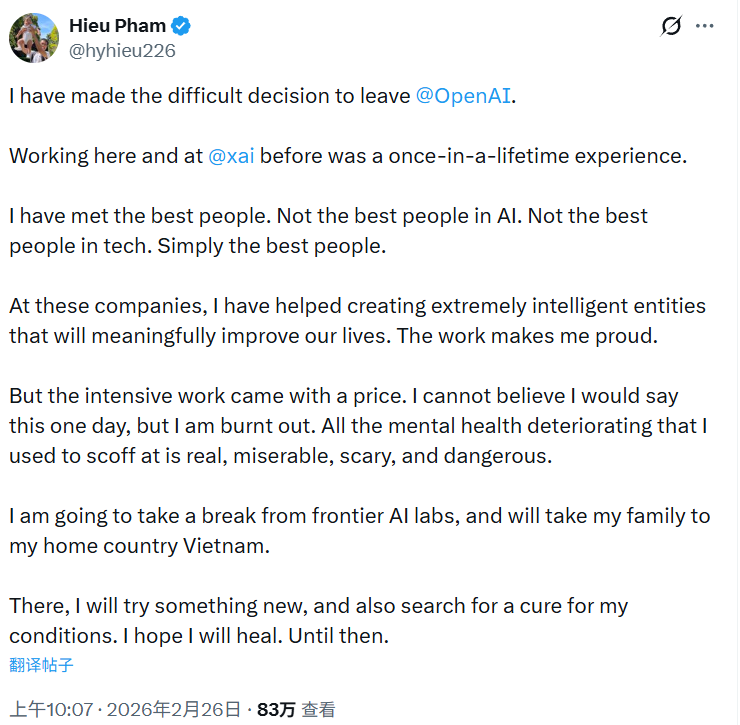
Core Insights - The extreme work culture in Silicon Valley's AI sector is leading to burnout among researchers, exemplified by a recent resignation from a former AI researcher at xAI and OpenAI, who cited exhaustion as the reason for leaving [1][2][3] - The high-pressure environment is not only a personal choice but is also influenced by the ongoing transformation of the labor market due to AI, resulting in job insecurity and anxiety among workers [1][7] Group 1: Work Culture - The work culture in Silicon Valley has escalated beyond the traditional "996" model, with reports indicating that top AI researchers are working up to 100 hours a week, often described as a "0-0-2" work pattern [4][5] - Some startups are explicitly requiring employees to work seven days a week, offering incentives like free housing to attract talent [5] - The intense competition and passion for AI are driving many professionals to work long hours voluntarily, despite the associated health risks [6] Group 2: Impact on Workers - The consequences of this overwork include loss of family time, health issues, and a growing sense of burnout among employees [7] - The labor market is shifting, with predictions of significant layoffs in the tech sector, particularly affecting junior positions, as AI continues to evolve [7][9] - Concerns are rising about job security, with many workers questioning their future employment in the face of rapid technological advancements [7][9] Group 3: Broader Implications - Economists warn that the current situation may be indicative of a larger transformation in the workforce, with AI potentially eliminating a substantial number of entry-level jobs in the coming years [8][9] - The impact of AI on the labor market is being compared to a "tsunami," with predictions that up to 60% of jobs in some developed economies could be altered or disappear [9]