
规模为王

Search documents
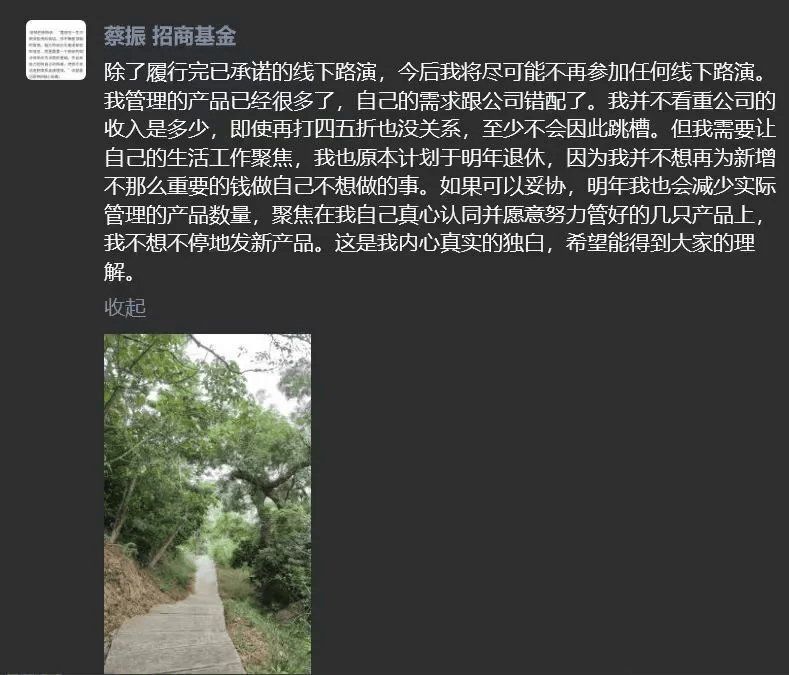
“喊累”后,招商基金蔡振名下反添两只新基金
Sou Hu Cai Jing· 2025-12-08 10:36
Core Viewpoint - The public sentiment expressed by Cai Zhen, a fund manager at China Merchants Fund, highlights the tension between individual desires for reduced workload and the structural pressures of the fund management industry, as he recently announced a desire to focus on fewer products while simultaneously launching new funds [1][5][10] Group 1: Fund Management Dynamics - Cai Zhen's recent social media post indicated a desire to reduce the number of funds he manages due to feeling overwhelmed, stating that his personal needs do not align with company demands [1][5] - Despite his expressed wish to "reduce the burden," he has launched two new funds shortly after his post, indicating a disconnect between individual sentiments and corporate strategies [3][4] - The rapid increase in the number of funds managed by Cai Zhen, from around 7 to 12 in a short period, reflects a broader trend in the industry where fund managers are often required to manage multiple products simultaneously [7][8] Group 2: Industry Trends and Challenges - The average fund manager in the industry manages approximately 2.74 funds, with nearly 300 managers overseeing more than 10 funds, indicating a prevalent "one manager, many funds" phenomenon [7][8] - Regulatory changes have been introduced to address the issue of fund managers handling excessive numbers of products, with new guidelines aimed at promoting a more sustainable management model [8] - The industry is shifting from a scale-driven approach to one that emphasizes long-term performance and client interests, as evidenced by recent regulatory frameworks [10] Group 3: Performance Insights - Cai Zhen's long-term management of certain bond funds has yielded strong performance, with returns of 27.52% and 24.46% for specific funds, showcasing his expertise in multi-asset strategies [9] - In contrast, his more recent actively managed equity and flexible allocation products have underperformed, suggesting a need for focus on fewer, high-performing products [9][10] - The disparity in performance across different fund types managed by Cai Zhen underscores the rationale behind his desire to concentrate on a select few products [10]

债券承销费再现“地板价” 恶性竞争破坏行业生态
Zhong Guo Jing Ying Bao· 2025-07-18 16:19
Core Viewpoint - The bond underwriting market is experiencing severe price competition, leading to extremely low underwriting fees, which poses risks to the industry's health and sustainability [1][4][7]. Group 1: Market Dynamics - Six financial institutions shared a total underwriting fee of 63,448 yuan, with the highest bid at 35,000 yuan and the lowest at 700 yuan, highlighting the extreme price competition in the bond underwriting market [1][2]. - The low pricing strategy is driven by lead underwriters seeking to win large issuance projects, which enhances their market share and ranking, creating a vicious cycle of price reduction [1][5]. Group 2: Regulatory Response - The China Interbank Market Dealers Association has initiated a self-regulatory investigation into the six institutions for their low-price underwriting practices, following new regulations that prohibit quoting below cost [1][4]. - The association's recent notice emphasizes that underwriting institutions must not quote fees below their costs when participating in bond project bids [4][6]. Group 3: Financial Implications - Despite the increase in underwriting scale, the fees collected by underwriters have been declining, leading to a "revenue growth without profit" scenario [6][7]. - From 2021 to 2024, the total underwriting scale for brokers increased significantly, while the corresponding underwriting fees decreased from 6.489 billion yuan to 3.084 billion yuan [6][7]. Group 4: Industry Impact - The long-term presence of the "floor price" phenomenon is detrimental to the bond underwriting industry's health, potentially leading to a reduction in market diversity as smaller underwriters may exit due to unsustainable pricing [7][8]. - Low pricing may compromise the quality of services provided by underwriters, affecting due diligence and overall bond issuance quality, which could harm investor interests [7][8].