规模竞赛

Search documents
鸣鸣很忙敲钟后,戴永红必须换路而生
Xin Lang Cai Jing· 2026-02-09 03:22
Core Viewpoint - The listing of "Mingming Hen Mang" on the Hong Kong Stock Exchange is seen as a signal of the peak for the bulk snack industry, indicating that the competitive landscape has reached a critical point where scale becomes a significant barrier to entry for other players [3][4][24]. Industry Analysis - The bulk snack retail sector is characterized by a "scale competition" where larger players like "Mingming Hen Mang" (with over 20,000 stores) dominate through purchasing power and pricing strategies, making it difficult for smaller regional brands to compete effectively [4][24]. - The dynamics of the market suggest that as companies grow, they gain not only lower procurement costs but also the ability to define product offerings, leading to a situation where price reductions by competitors inadvertently reinforce the market position of larger players [4][25]. Competitive Landscape - The industry is moving towards a dual oligopoly, where the competition is not just about speed or scale but about strategic direction, with smaller players needing to rethink their approaches to survive [26]. - Regional brands like "Dai Yonghong" are struggling as they focus on local preferences while larger brands emphasize price certainty, leading to a shift in consumer expectations [27][28]. Strategic Directions for Regional Players - Regional companies are encouraged to pivot away from direct price competition and explore three strategic paths: 1. Transition from "snack stores" to "city-level curators," focusing on local tastes and unique offerings rather than competing on price [30][31]. 2. Shift towards short-shelf-life, made-to-order products that are harder for large-scale operations to replicate, thus creating a niche market [33]. 3. Acknowledge market boundaries and aim to become a long-term fixture within a community, fostering strong local relationships and customer loyalty [35]. Market Characteristics in Hunan - Hunan is identified as a fertile ground for new consumption models due to its high frequency of snack purchases, strong community store presence, and a culture that embraces scaling from small businesses to larger chains [37][38].
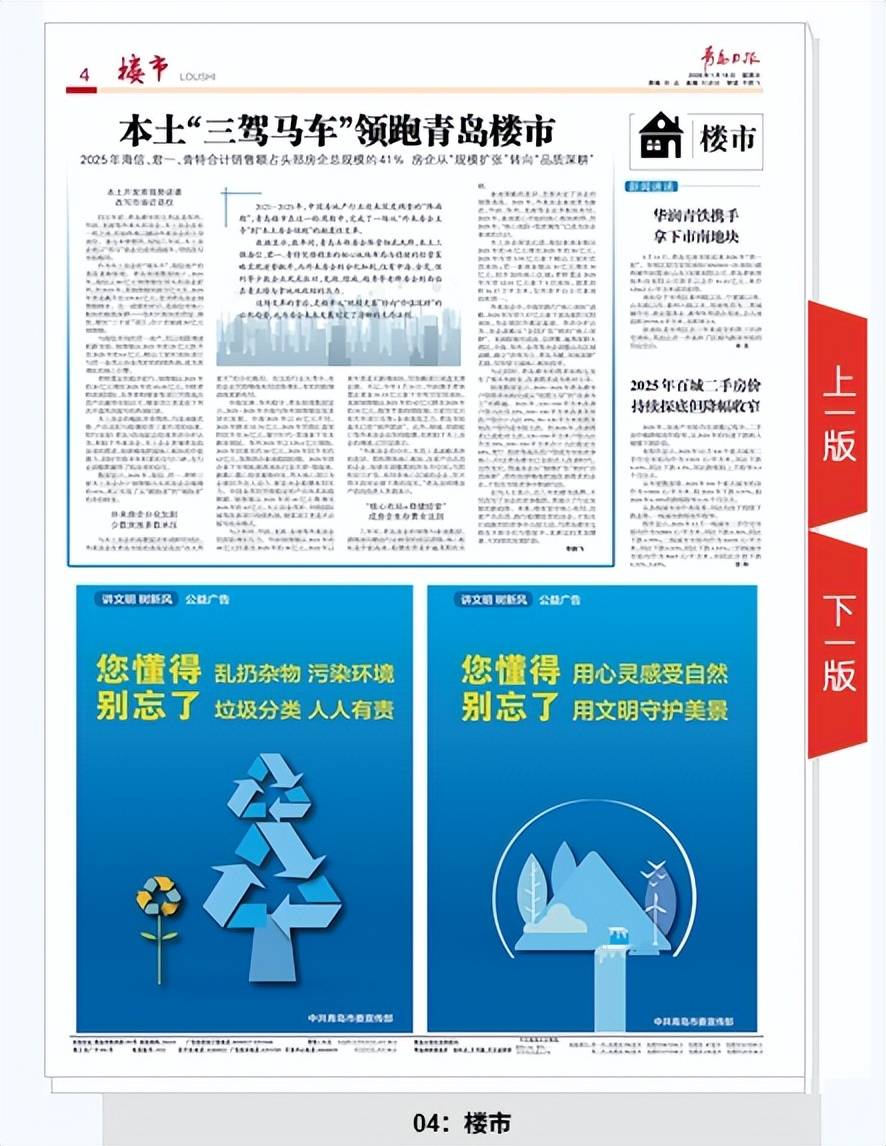
飞阅楼市第210期丨本土“三驾马车”领跑青岛楼市
Sou Hu Cai Jing· 2026-01-26 15:26
Core Insights - The Chinese real estate industry is undergoing a significant adjustment period from 2021 to 2025, with Qingdao's market experiencing a transformative shift from dominance by external developers to local firms leading the way [1][2][4] Group 1: Local Developers' Rise - Local companies such as Hisense, Junyi, and Qingtai have achieved remarkable sales growth, with Hisense's sales increasing from 8 billion yuan in 2021 to over 10 billion yuan in 2023, and projected to reach 13.98 billion yuan by 2025 [4][5] - Junyi's sales surged from 2.5 billion yuan in 2021 to 6.4 billion yuan in 2025, driven by strong performance in key projects [4] - Qingtai's sales rose from 2 billion yuan in 2021 to 4.5 billion yuan in 2025, supported by high-quality products [5][7] Group 2: External Developers' Challenges - External developers are facing a stark contrast in performance, with some like China Overseas and Poly maintaining stability, while others like China Resources and Longfor are experiencing significant declines [8][9] - China Overseas' sales fluctuated from 4.5 billion yuan in 2021 to 3.2 billion yuan in 2023, rebounding to 3.4 billion yuan in 2025 [8] - Poly's sales dropped from 12.56 billion yuan in 2021 to around 5 billion yuan in 2023, recovering to approximately 6.2 billion yuan in 2025 [8][9] Group 3: Market Dynamics and Strategic Shifts - The shift in the market is characterized by a transition from "scale competition" to "value cultivation," with a focus on core areas and stable operations becoming essential for survival [2][10] - Local firms are better positioned to understand buyer needs and leverage their established reputations, leading to a significant increase in their market share [7][10] - By 2025, local firms are expected to account for 41% of the total sales among leading developers in Qingdao, marking a shift from "followers" to "leaders" [7] Group 4: Changing Demand Structure - The demand structure in Qingdao's real estate market has shifted from a focus on first-time buyers to a predominance of improvement-oriented purchases, with larger units becoming more popular [10][11] - By 2025, the proportion of units in the 120-150 square meter range is expected to rise to 35%, indicating a clear trend towards higher-quality living spaces [10][11] Group 5: Future Outlook - The ongoing reshuffling of the real estate market highlights the necessity for firms to adhere to core strategies, prioritize product quality, and maintain stable operations to thrive in a competitive environment [13]