计算复杂性理论

Search documents
清华姚班20年,毕业生撑起全球AI半边天
Sou Hu Cai Jing· 2026-02-06 09:31
Core Insights - The article highlights the recent recruitment of two prominent talents from Tsinghua University's Yao Class, Chen Lijie and Yao Shunyu, by OpenAI and Tencent respectively, showcasing the influence of this elite program in the AI industry [1][11]. Group 1: Chen Lijie's Journey - Chen Lijie, a graduate of Tsinghua's Yao Class and a PhD from MIT, is now an assistant professor at UC Berkeley, recognized for his achievements in theoretical computer science [1][3]. - Initially struggling academically, Chen became engrossed in computer programming during middle school, leading to a remarkable turnaround in his academic performance [3][6]. - He excelled in national informatics competitions, winning multiple awards, including a gold medal at the National Olympiad in Informatics and a gold medal at the International Olympiad in Informatics, establishing himself as a leading figure in the field [6][8]. Group 2: Yao Shunyu's Profile - Yao Shunyu, also from Tsinghua's Yao Class, was appointed as Tencent's Chief Scientist at the age of 27, drawing attention due to his impressive background [11][12]. - Despite not being a top student initially, Yao demonstrated exceptional computer skills, earning a silver medal at the National Olympiad in Informatics and later achieving high academic scores to enter Tsinghua [11][13]. - Yao's diverse interests include founding a rap society at Tsinghua, indicating a multifaceted personality that blends creativity with technical expertise [13][14].

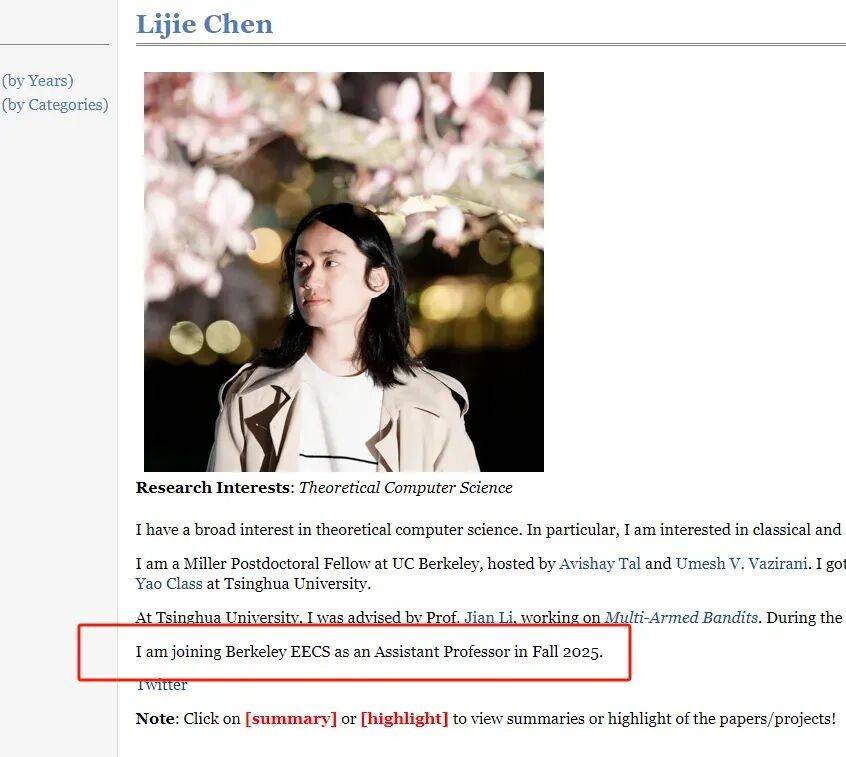
姚班传奇陈立杰入职OpenAI!16岁保送清华,30岁拿下UC伯克利助理教授
创业邦· 2026-01-15 10:15
Core Insights - Chen Lijie, a prominent figure from Tsinghua University's Yao Class, has joined OpenAI to focus on mathematical reasoning [3][6] - His recent research is centered on Diffusion Language Models, aligning with the current evolution of generative models [6] Group 1: Background of Chen Lijie - Born in 1995, Chen Lijie won a gold medal at the National Olympiad in Informatics at the age of 16 and was admitted to Tsinghua University [11] - He became an assistant professor at UC Berkeley in 2025, specializing in computational complexity theory [11][16] - Chen has a remarkable academic history, having published multiple papers in prestigious conferences during his undergraduate studies [14] Group 2: Academic Achievements - He was the first Chinese undergraduate to publish at the FOCS conference in 2017, solving significant problems in computational complexity [15] - Chen received his PhD from MIT in 2022 and was awarded the Miller Fellowship at UC Berkeley, a prestigious honor for outstanding young scholars [15] - His research contributions include advancements in derandomization and complexity lower bounds, with a recent paper addressing a long-standing problem in complexity theory [15][19] Group 3: Current Research Focus - Chen's primary research areas include P vs NP, circuit complexity, and algorithmic lower bounds, with applications in quantum physics and AI safety [19] - His involvement with OpenAI marks a significant step in exploring AI safety, particularly in the context of his expertise in complexity theory [19]

姚班陈立杰入职OpenAI,破解50年世界难题的30岁天才,要颠覆ChatGPT
3 6 Ke· 2026-01-15 08:41
Core Insights - Chen Lijie, a prominent figure in theoretical computer science, is rumored to join OpenAI, leaving his position as an assistant professor at UC Berkeley [1][3][6] - His achievements include winning a gold medal at the NOI at age 16 and the IOI at age 18, showcasing his exceptional talent in programming and mathematics [6][10] - If the rumors are confirmed, Chen Lijie could significantly contribute to OpenAI's advancements in theoretical frameworks [6][7] Background and Achievements - Chen Lijie is a graduate of Tsinghua University's Yao Class and has a PhD from MIT, where he studied under Ryan Williams, focusing on computational complexity theory [6][12] - He has received numerous accolades, including the best student paper awards at top conferences in theoretical computer science and the prestigious Miller Fellowship at UC Berkeley [12][14] - His research interests span complexity theory and its applications in quantum physics and AI safety, indicating a broad and impactful academic focus [14][16] Personal Journey - Chen's early life included struggles with academic performance until he discovered programming, which led to a dramatic turnaround in his academic career [17][19] - His story of transformation from a gaming enthusiast to a leading researcher exemplifies resilience and dedication, inspiring many in the field [21]
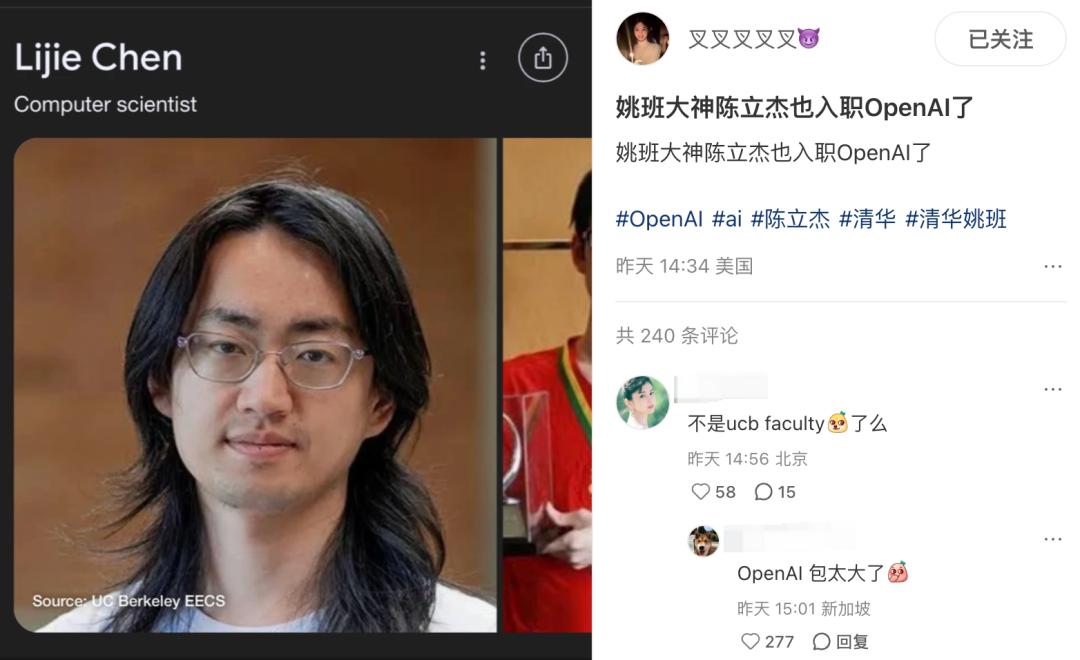
已证实!清华姚班陈立杰全职加入OpenAI,保留伯克利教职
机器之心· 2026-01-15 03:52
Core Viewpoint - Lijie Chen, a prominent young scholar in theoretical computer science and a Tsinghua University "Yao Class" alumnus, has officially joined OpenAI as a full-time researcher while on leave from UC Berkeley [1][2]. Group 1: Academic Background - Lijie Chen graduated from Tsinghua University and obtained his PhD from MIT, excelling in computational complexity theory [2]. - He was a standout competitor in informatics competitions, winning a gold medal at the National Olympiad in Informatics (NOI) in 2011 and achieving first place globally at the International Olympiad in Informatics (IOI) in 2013 [6]. - During his undergraduate studies, he shifted focus from programming competitions to theoretical computer science research, earning a special scholarship at Tsinghua University [8]. Group 2: Research Contributions - Chen published a paper at FOCS as an undergraduate, becoming the first Chinese undergraduate to do so, addressing an open problem in quantum statistical zero-knowledge proofs [10][12]. - His doctoral research led to significant breakthroughs in computational complexity, circuit complexity, and pseudorandomness, earning multiple best student paper awards at top theoretical computer science conferences [13]. - He proposed a potential path to bypass the "natural proofs" barrier, demonstrating that certain problems are hard under weak circuit models, which could imply P ≠ NP [14]. Group 3: Current Position and Future Prospects - After completing his PhD, Chen received the Miller Fellowship at UC Berkeley, allowing him to focus on cutting-edge topics with complete academic freedom [16]. - He joined UC Berkeley's Electrical Engineering and Computer Sciences department as an assistant professor in July 2025, continuing his teaching and research endeavors [17].
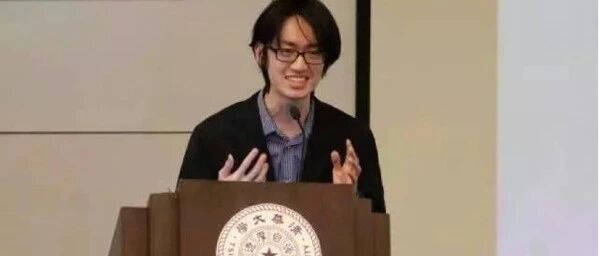
姚班传奇陈立杰入职OpenAI,16岁保送清华,30岁拿下UC伯克利助理教授
3 6 Ke· 2026-01-15 01:43
Core Insights - Chen Lijie, a prominent figure from Tsinghua University's Yao Class and an assistant professor at UC Berkeley, has joined OpenAI to focus on mathematical reasoning [1][2]. Group 1: Chen Lijie's Background - Chen Lijie was born in 1995 and won the national informatics Olympiad gold medal at the age of 16, gaining admission to Tsinghua University [7]. - He became an assistant professor at UC Berkeley in 2025, specializing in theoretical computer science and computational complexity theory [7][19]. - His educational journey includes significant achievements in informatics competitions, culminating in a gold medal at the International Olympiad in Informatics in 2013 [8][10]. Group 2: Research Contributions - Chen's recent research focuses on Diffusion Language Models, aligning with the current evolution of generative models [2]. - He has made substantial contributions to theoretical computer science, including solving a long-standing open problem in quantum information during his time at MIT [13][14]. - His work has been recognized with multiple awards, including the Best Student Paper awards at FOCS and STOC in 2019 [14][19]. Group 3: OpenAI Involvement - OpenAI has acknowledged Chen's previous research, including a paper he co-authored that was cited in their 2022 publication on language model hallucinations [3]. - His role at OpenAI will involve exploring AI safety, particularly in the context of his expertise in computational complexity and its applications to quantum physics and AI [19].
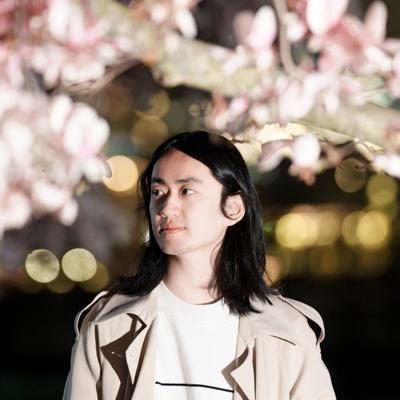
姚班传奇陈立杰入职OpenAI!16岁保送清华,30岁拿下UC伯克利助理教授
量子位· 2026-01-15 01:23
Core Insights - Chen Lijie, a prominent figure from Tsinghua University's Yao Class and an assistant professor at UC Berkeley, has joined OpenAI to focus on mathematical reasoning [2][10][30] Group 1: Chen Lijie's Background - Chen Lijie was born in 1995 and won a gold medal in the National Olympiad in Informatics at the age of 16, leading to his admission to Tsinghua University [10][12] - He graduated from Tsinghua University in 2017 and pursued a Ph.D. at MIT, where he researched computational complexity theory under Ryan Williams [21][22] - Chen has published multiple papers in top-tier conferences and received several awards, including the Best Student Paper Award at FOCS in 2019 [24][27] Group 2: Research Contributions - His research interests include P vs. NP problems, circuit complexity, fine-grained complexity, and derandomization, contributing significantly to the field of theoretical computer science [27][28] - Chen's recent work has focused on the connection between derandomization and complexity lower bounds, as well as applying complexity theory methods to quantum physics and AI safety [28][29] Group 3: OpenAI Involvement - At OpenAI, Chen will be involved in exploring diffusion language models, aligning with current advancements in generative models [7][30] - His previous research was cited in OpenAI's paper on language model hallucinations, indicating his influence in the field [4][30]

清华姚班大神陈立杰,联手00后逆向破局,颠覆50年计算机难题
3 6 Ke· 2025-12-02 08:08
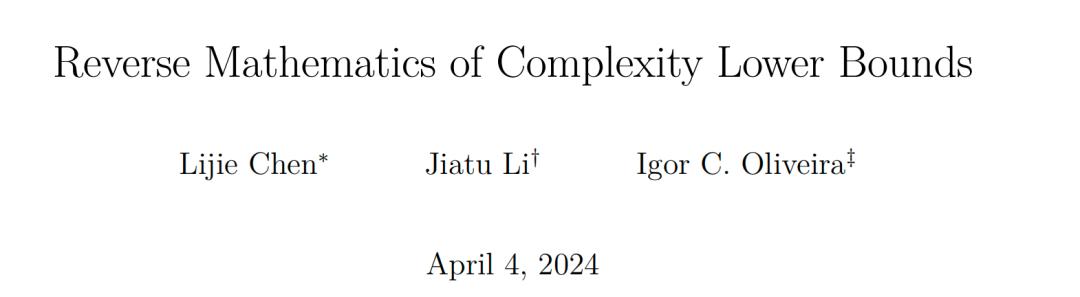
Core Insights - A groundbreaking paper titled "Reverse Mathematics Below the Turing Jump" has emerged from a team including Tsinghua University's Chen Lijie, undergraduate Li Jiatu, and renowned scholar Igor Carboni Oliveira, challenging traditional approaches in theoretical computer science [1][3][9] - The paper employs a novel method called "reverse mathematics," which flips the conventional approach of deriving theorems from axioms, revealing that many seemingly unrelated theories are logically equivalent [3][9][19] Group 1 - The paper addresses long-standing challenges in computer science, such as the "Traveling Salesman Problem," which has stumped researchers for decades without a clear proof of its complexity [1][5] - Researchers have increasingly pondered why proving certain problems is so difficult, leading to the exploration of "metamathematics," which studies the proofs themselves [6][7] - The authors successfully demonstrated that the "Pigeonhole Principle" and the "Palindrome Lower Bound" theorem are equivalent within the framework of a popular axiom set called PV₁ [19][21] Group 2 - The research began when Chen Lijie, preparing for his MIT PhD, decided to delve into metamathematics, leading to insights about communication complexity and the "equality problem" [11][15] - The team discovered that by using the "Pigeonhole Principle" to prove the lower bound of the equality problem, they could also reverse the process, proving the principle itself [17][19] - This new equivalence network not only connects various complexity theorems but also highlights the limitations of the PV₁ axioms, suggesting that some theorems may not be provable within this framework [23][25][26]
半世纪计算机理论僵局被打破!MIT科学家偶然发现:少量内存节省大量计算时间
量子位· 2025-05-25 03:40
Core Insights - A significant breakthrough has been made in computer science after a 50-year stagnation regarding the relationship between time and memory in algorithms [1][8]. Group 1: Breakthrough Discovery - MIT scientist Williams discovered that memory is more powerful than previously thought, indicating that a small amount of memory can be as valuable as a large amount of time in computations [2][4]. - Williams proved that there exists a mathematical program that can convert any algorithm into a form that occupies less space [4][7]. Group 2: Historical Context - The problem stems from the intuition that space can be reused, but time cannot, leading to a half-century challenge in proving the relationship between time and space in computational complexity theory [8][10]. - The complexity theory, established in the 1960s, categorizes problems based on the resources (time and space) required to solve them, with P representing problems solvable in reasonable time and PSPACE representing those solvable with limited space [11][13]. Group 3: Theoretical Implications - The relationship between P and PSPACE is a core issue in complexity theory, with scientists historically believing that space is a more powerful computational resource than time [15][19]. - Williams' results suggest that some problems cannot be solved unless more time is used than space, hinting at a potential resolution to the long-standing P vs. PSPACE question [33][34]. Group 4: Personal Journey of the Researcher - Williams has been fascinated by this problem since his university days and has pursued various avenues, including studying logic and philosophy, to find inspiration [27][42]. - His breakthrough was influenced by a 2010 advancement in understanding computational memory, which led him to realize that data could be compressed, allowing for significant reductions in space usage [28][31].