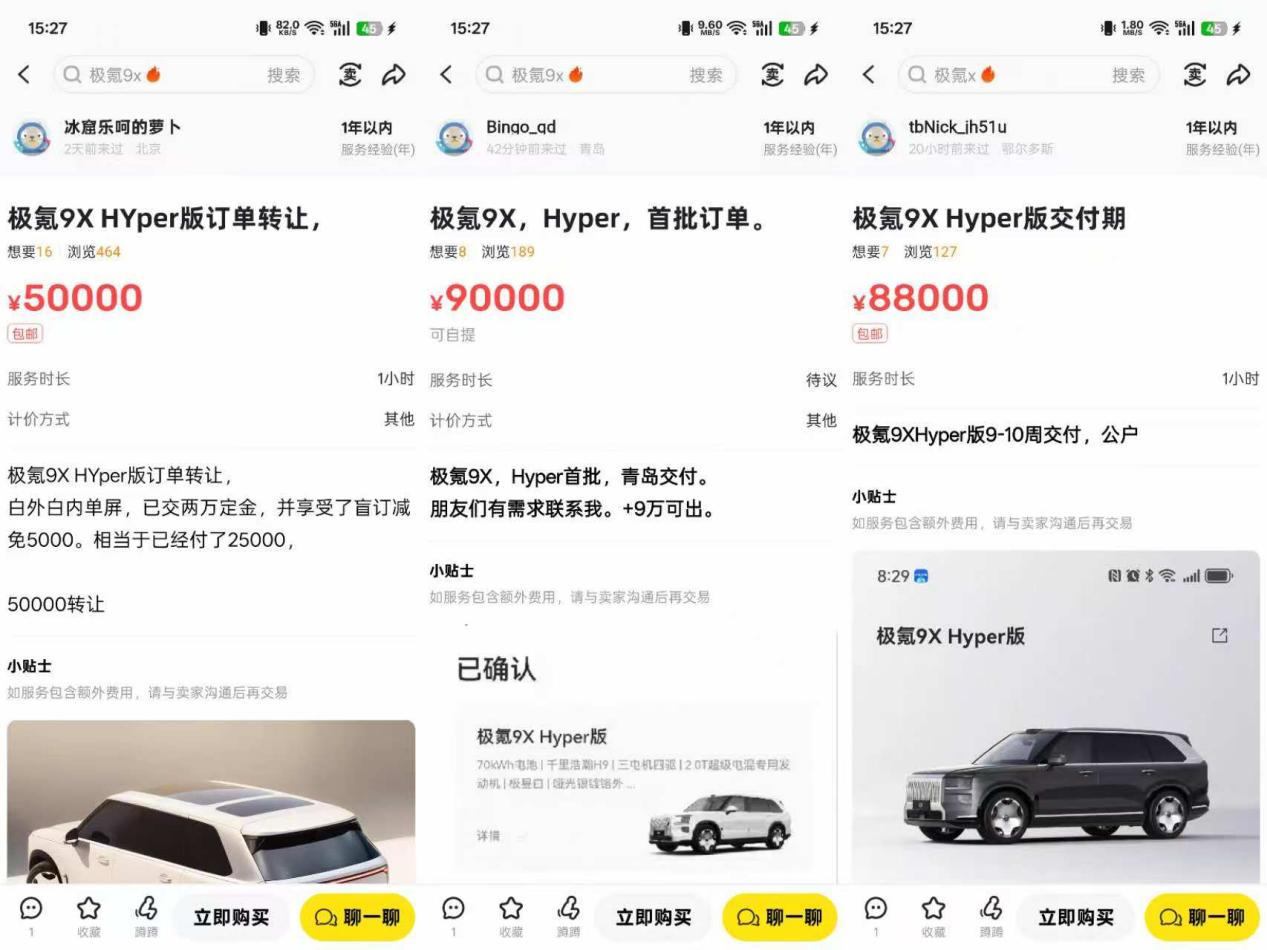
订单加价转让

Search documents
极氪订单闲鱼转手躺赚5万,饥饿营销的风终于还是刮到车圈了?
3 6 Ke· 2025-12-04 01:44
Core Viewpoint - The phenomenon of order transfer and price markup in the new energy vehicle market is creating a new wealth generation opportunity, with significant premiums being charged for vehicle orders, reflecting a speculative market dynamic [1][3][15]. Group 1: Market Dynamics - High-end new energy vehicle orders are being resold at significant premiums, with examples showing markups ranging from 50,000 to 90,000 yuan, indicating a more than 20% increase over the original price of 465,900 yuan for the Zeekr 9X [1][3]. - The practice of order transfer has become a new trend in the new energy vehicle sector, likened to a "hunger marketing" strategy that was previously seen in consumer electronics [4][20]. - The transfer of orders is characterized by a price gradient based on delivery timelines, with shorter wait times commanding higher prices, similar to futures markets [6][20]. Group 2: Consumer Behavior - Consumers are willing to pay premiums for quicker delivery, viewing the additional cost as a reasonable trade-off for time saved, reflecting a shift in consumer psychology towards valuing time over money [12][14]. - The acceptance of price markups is rooted in a historical context where such practices were common in traditional car sales, leading to a perception of transparency and efficiency in the current market [13][19]. Group 3: Corporate Strategy - Automakers benefit from the order transfer market as it creates a perception of high demand and allows them to segment customers based on their willingness to pay, without directly raising prices [16][19]. - The existence of a gray market for order transfers allows car manufacturers to maintain a favorable public image while indirectly profiting from the speculative activities of resellers [15][20]. Group 4: Future Outlook - The current market conditions that support order markups, such as production capacity constraints and sustained demand, are expected to change, potentially leading to a decline in this practice as production ramps up and competition increases [20][22]. - Price wars among manufacturers could disrupt the order transfer market by reducing delivery times and lowering prices, making the speculative nature of order transfers less viable [20][22].