认知结构

Search documents
企业软件底层逻辑脱胎换骨:从席位订阅到决策订阅,下一个万亿公司属于这类玩家
量子位· 2026-03-27 07:00
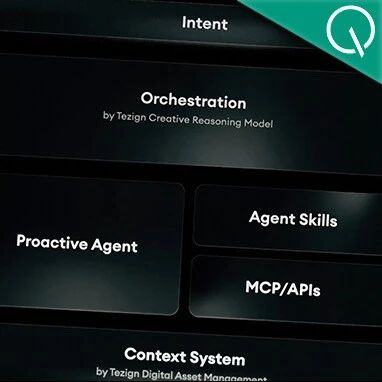
Core Viewpoint - The article discusses the transformative shift in enterprise software driven by the emergence of Generative Enterprise Agents (GEA), which fundamentally changes how businesses form judgments and make decisions [2][43]. Group 1: Historical Context and Paradigm Shift - The development of ERP, CRM, and BI systems has historically focused on managing resources, customers, and data [2]. - The introduction of GEA architecture by 特赞 aims to address a deeper question: how enterprises can form judgments, indicating a paradigm shift in software architecture [2][43]. Group 2: Competitive Landscape - As foundational models become as ubiquitous as electricity, competitive differentiation among enterprises will no longer rely on model parameters but rather on cognitive structures [4][5]. - The competition in enterprise AI is shifting from model capability to cognitive structure [5]. Group 3: Changes in Software Structure - The focus of the technology stack is moving from interfaces to agents, with AI fundamentally altering the form of software [7]. - The control structure in enterprise software is evolving; previously, human interfaces triggered business logic, but with the advent of reasoning capabilities, control is shifting upwards [8][9]. Group 4: Value Structure Transformation - In the SaaS era, enterprises purchased seats; in the Agent era, they will purchase outcome capabilities, indicating a change in value structure [10][11]. - The emphasis is shifting from data as the center to context as the new gravitational structure for enterprises [12][16]. Group 5: GEA Architecture - The GEA architecture consists of four layers: Intent Layer, Execution Layer, and Context System, which enable agents to reason around business goals and execute tasks continuously [18][30]. - The Intent Layer focuses on understanding business objectives rather than specific instructions, allowing for more effective reasoning and execution [20][21][25]. Group 6: Decision-Making Systems - The transition from data operation systems to decision operation systems reflects a significant structural change in enterprise software, with GEA being a crucial infrastructure for this new phase [31][35]. - The revenue structure is evolving from seat subscriptions to decision subscriptions, emphasizing the depth of business participation rather than mere tool provision [36][38]. Group 7: Future Outlook - The next decade will see enterprises deploying intelligent systems capable of participating in operational judgments, marking a new chapter in enterprise intelligence [46][47].

在 AI 时代,没有认知的人力在脑力劳动中几乎毫无价值
阿尔法工场研究院· 2026-01-30 00:24
Group 1 - The core viewpoint of the article emphasizes that the value of cognitive labor has shifted significantly in the AI era, where traditional metrics of effort and knowledge are no longer sufficient for success [2][3][5] - The new formula for effective decision-making in a complex environment is now based on cognitive structure, judgment ability, and responsibility, rather than merely completing tasks [6][22] - Low cognitive labor is characterized by three structural deficiencies: lack of structural understanding, lack of judgment ability, and inability to take cognitive responsibility [8][9][10] Group 2 - AI is not merely replacing jobs but is consuming low cognitive areas, excelling in tasks such as information organization and template-based analysis [14][15][16] - In complex systems, low cognitive labor can even create negative value, leading to structural inefficiencies and misinterpretations of uncertainty [17][18][20] - Individuals who retain irreplaceable value in the AI era possess a complete feedback loop: positioning, judgment, accountability, and model updating, which AI cannot replicate [21][22][24] Group 3 - The valuation of cognitive labor is transitioning from a headcount model to a focus on cognitive nodes, indicating that a single clear cognitive node can outperform a low cognitive density team [23][24] - The article argues that this shift is not a reflection of coldness but rather a structural reality where value judgments are increasingly based on cognitive capability rather than effort or tenure [25][26][28]