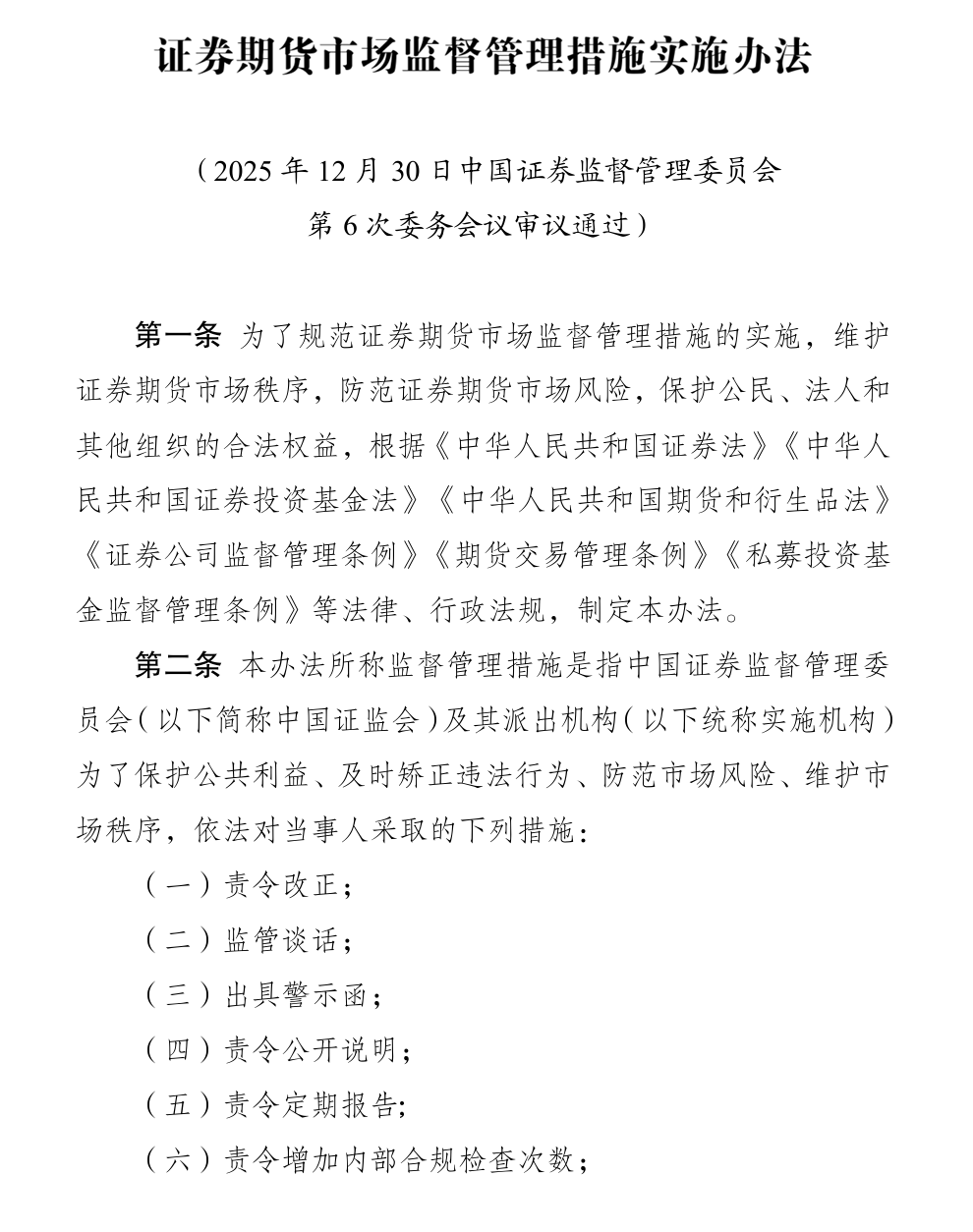
证券期货市场监管

Search documents
《证券期货市场监督管理措施实施办法》出台
Jin Rong Shi Bao· 2026-01-07 02:05
Core Viewpoint - The China Securities Regulatory Commission (CSRC) has established the "Implementation Measures for Supervision and Administration of Securities and Futures Markets," which will take effect on June 30, 2026, to standardize the procedures for implementing regulatory measures in the securities and futures markets [1] Group 1: Types of Regulatory Measures - The implementation measures specify 14 common types of regulatory actions, including orders for correction, regulatory talks, issuance of warning letters, and orders for periodic reporting [1] - The measures also include a catch-all provision for other supervisory and management measures as stipulated by laws, administrative regulations, and CSRC rules [1] Group 2: Principles of Implementation - Regulatory measures must adhere to principles of legality, efficiency, and fairness, ensuring compliance with legal and regulatory procedures [1] - The measures emphasize timely correction of illegal activities, prevention of risk spread, and a combination of risk control and education [1] - Decisions should be based on facts and proportionate to the nature, circumstances, severity, and risk level of the behavior [1] Group 3: Procedural Requirements - The measures outline general procedural requirements for evidence collection, decision-making, delivery, on-site enforcement, recusal, and legal review [1] - Special procedural requirements include prior notification and a rapid response mechanism for urgent situations [1] Group 4: Decision-Making and Execution Requirements - The regulatory decision documents must specify certain items, public disclosure requirements, and delivery procedures [1]
东兴证券晨报-20260105
Dongxing Securities· 2026-01-05 08:42
Core Insights - The report highlights the expected improvement in the securities industry in 2026, driven by supportive policies and accelerated consolidation, which is anticipated to enhance industry prosperity [6][11] - The report emphasizes the importance of self-operated investment stability and sustainable growth for securities firms, indicating that these factors will be crucial for overall performance [9][10] Economic News - The State Council has issued a solid waste comprehensive management action plan aiming for a comprehensive utilization of 4.5 billion tons of major solid waste by 2030 [2] - The China Securities Regulatory Commission (CSRC) has revised regulations on public offering securities investment fund sales fees, effective from January 1, 2026, to reduce investor costs [2] - The CSRC has announced the pilot program for commercial real estate investment trusts (REITs), marking a significant step in market practice [2] - The Ministry of Culture and Tourism reported that during the 2026 New Year holiday, domestic travel reached 142 million trips, with total spending of 84.789 billion yuan [2] Company Insights - The report covers the performance of major companies in the securities sector, noting that the top ten real estate companies achieved sales exceeding 100 billion yuan in 2025, indicating resilience among leading firms [2] - The report mentions that the company has a strong financial performance, with revenue increasing from less than 300 million yuan in 2019 to over 1.5 billion yuan in 2024, while maintaining a low debt-to-asset ratio [16][18] - The company is expected to benefit from a recovery in domestic demand and is positioned to capture opportunities in the international market due to the aging fleet of chemical tankers globally [15][18] Investment Strategy - The report suggests that the securities industry may see more policy support in 2026, which could significantly influence industry performance and valuation recovery [10][11] - It is recommended to focus on head institutions within the industry that are innovating and adapting to market changes, with a particular emphasis on value stocks that remain undervalued [11]
中国规范证券期货市场监管措施 政策护航筑牢2万亿规模发展根基
Chang Jiang Shang Bao· 2026-01-05 00:04
Core Viewpoint - The China Securities Regulatory Commission (CSRC) has introduced new regulations to enhance the supervision of the securities and futures market, aiming to maintain market order and mitigate risks, with the implementation of these regulations set for June 30, 2026 [1][2]. Group 1: Regulatory Developments - The CSRC has released the "Implementation Measures for the Supervision and Administration of Securities and Futures Markets," which includes 25 articles detailing the types of regulatory measures, principles, and procedures for implementation [2][4]. - The new regulations include 14 common regulatory measures such as orders for correction, regulatory talks, and issuance of warning letters, with stricter procedures for more severe measures [3][4]. Group 2: Market Growth - In 2025, the total funds in the futures market and client equity surpassed 2 trillion yuan, driven by an improved variety of futures products, increased corporate hedging needs, and the entry of medium to long-term funds [2][3]. - As of November 2025, there were 164 listed futures and options products, with 18 new products added during the year, and the cumulative trading volume reached 8.117 billion contracts, with a transaction value of 67.545 trillion yuan, reflecting year-on-year growth of 14.74% and 20.19% respectively [1][2]. Group 3: Commitment System Revisions - The CSRC has amended the "Implementation Regulations for the Commitment System of Administrative Law Enforcement Parties," which clarifies the conditions for accepting commitments and standardizes the processing procedures [5][6]. - The revised regulations specify five scenarios under which applications for the commitment system will not be accepted, enhancing the integrity and seriousness of the commitment system [6].
证监会进一步规范 监管措施实施程序
Xin Lang Cai Jing· 2026-01-04 21:06
Core Viewpoint - The China Securities Regulatory Commission (CSRC) has officially released the "Implementation Measures for Supervision and Administration of Securities and Futures Markets," which will take effect on June 30, 2026, aiming to standardize the implementation procedures of regulatory measures and enhance the rule of law in capital markets [1]. Group 1: Overview of the Implementation Measures - The "Implementation Measures" consists of 25 articles, outlining 14 common types of regulatory measures, including orders for correction, regulatory talks, warning letters, and orders for regular reporting, with a catch-all provision for other supervisory measures [2]. - The measures emphasize principles of legality, efficiency, and fairness, ensuring that regulatory actions are timely, fact-based, and proportionate to the nature and severity of the violations [2]. - The procedures for implementing regulatory measures include requirements for evidence collection, decision-making, delivery, on-site enforcement, and legal review, along with a rapid response mechanism for emergencies [2]. Group 2: Context and Rationale - Regulatory measures are a type of administrative action independent of administrative penalties and are crucial for financial regulation. The CSRC previously issued a trial version in 2008, which has since revealed issues in implementation, such as inadequate procedural rights for parties involved [3]. - The new "Implementation Measures" introduces additional procedural requirements compared to the 2008 version, including implementation timelines, prior notifications, and legal reviews, enhancing transparency and strictness in regulatory enforcement [3]. - The measures aim to improve the standardization of regulatory enforcement, ensuring that the legal rights of administrative counterparts are adequately protected and reinforcing the legal foundation for the CSRC's administrative actions [3].
【金融政策】中国证监会发布《证券期货市场监督管理措施实施办法》
Xin Lang Cai Jing· 2026-01-04 11:30
Core Viewpoint - The China Securities Regulatory Commission (CSRC) has developed the "Implementation Measures for Supervision and Administration of Securities and Futures Markets," which will take effect on June 30, 2026, to enhance the regulatory framework in line with the spirit of the 20th National Congress of the Communist Party of China and related meetings [1][3]. Group 1 - The "Implementation Measures" consists of 25 articles that clarify the types of regulatory measures, including 14 common measures such as orders for correction, regulatory talks, warning letters, and orders for regular reporting, with a catch-all provision for other measures as per laws and regulations [2][4]. - The principles for implementing regulatory measures are defined, emphasizing legality, efficiency, and fairness, and ensuring that actions are based on facts and proportional to the nature, circumstances, severity, and risk of the violations [2][4]. - The procedural requirements for implementing regulatory measures are specified, including evidence collection, decision-making, delivery, on-site enforcement, recusal, legal review, and special procedures for urgent situations [2][4]. Group 2 - The requirements for making and executing regulatory decisions are outlined, detailing what must be included in the decision document, public disclosure requirements, and delivery procedures [2][4]. - Prior to finalizing the "Implementation Measures," the CSRC solicited public opinions, receiving overall support and recognition from various sectors, which led to modifications and improvements based on the feedback [2][4]. - The CSRC will ensure the effective implementation of the "Implementation Measures" moving forward [2][4].
证监会发布!2026年6月30日起施行
Jin Rong Shi Bao· 2026-01-02 02:40
Core Viewpoint - The China Securities Regulatory Commission (CSRC) has released the "Implementation Measures for the Supervision and Administration of Securities and Futures Markets," which aims to further standardize the implementation procedures of regulatory measures in the securities and futures markets, effective from June 30, 2026 [1]. Group 1: Background and Purpose - The regulatory measures are crucial for financial supervision, with the CSRC having established the "Implementation Measures for the Supervision and Administration of Securities and Futures Markets (Trial)" in 2008, which has played a positive role in maintaining market order and protecting legal rights [2]. - The 2008 trial measures have revealed issues such as inadequate procedural rights for parties involved and difficulties in the delivery of regulatory decisions, necessitating updates to align with recent legal developments [2]. Group 2: Key Principles of the Implementation Measures - The drafting of the Implementation Measures adheres to principles of lawful administration, problem orientation, procedural law positioning, and efficiency in regulatory measures [3]. - The measures aim to enhance the standardization of regulatory enforcement and ensure consistency and continuity in CSRC's regulatory practices [3]. Group 3: Content of the Implementation Measures - The Implementation Measures consist of 25 articles, detailing the types of regulatory measures, implementation principles, general and special procedural requirements, and emergency response mechanisms [4]. - It specifies 14 common regulatory measures, including orders for correction, regulatory talks, and issuance of warning letters, while also including a catch-all provision for other supervisory measures [4]. Group 4: Procedural Requirements - General procedural requirements include the need for documentation of evidence collection, decision-making, and delivery of regulatory measures, as well as the requirement for at least two qualified enforcement personnel during on-site enforcement [4]. - The measures stipulate that if a violation is not discovered within two years, regulatory actions are generally not taken unless specified by law or if the effects of the violation persist [4]. Group 5: Special Circumstances and Accountability - In urgent situations where immediate action is necessary to prevent significant harm to financial order or public interest, the implementing agency can bypass prior notification procedures [5]. - The measures outline the requirements for regulatory decision documentation, public disclosure, and the process for parties to appeal decisions, as well as accountability for serious misconduct during the implementation of regulatory measures [5].
明确监管措施实施程序!证监会发布
Xin Lang Cai Jing· 2026-01-01 05:23
Core Viewpoint - The China Securities Regulatory Commission (CSRC) has released the "Implementation Measures for Supervision and Administration of Securities and Futures Markets," which aims to further standardize the procedures for implementing regulatory measures in the securities and futures markets [1][4]. Group 1: Types of Regulatory Measures - The "Implementation Measures" specifies fourteen common types of regulatory measures, including orders for correction, regulatory talks, warning letters, and orders for regular reporting, while also including a catch-all provision for other supervisory measures as defined by laws and regulations [2]. Group 2: General Procedural Requirements - The implementing agency must maintain a record of evidence collection, decisions, and notifications; on-site enforcement must be conducted by at least two qualified enforcement personnel; and generally, regulatory measures will not be taken for violations not discovered within two years unless specified otherwise [2][3]. Group 3: Special Procedural Requirements - In addition to general provisions, special procedures such as prior notification must be followed, where the agency informs the parties involved about the intended measures, facts, reasons, and their rights to respond [3]. Group 4: Emergency Response Mechanism - In urgent situations that pose significant risks to financial order or public interest, the agency can bypass prior notification procedures to quickly address the issue, provided that the main responsible person approves this action [3]. Group 5: Decision-Making and Execution Requirements - The measures outline specific requirements for the content of regulatory decision documents, public disclosure after decisions are made, delivery procedures, and the rights of parties to appeal decisions through administrative review or court [3][5]. Group 6: Principles of Lawfulness, Efficiency, and Fairness - The "Implementation Measures" reflects the spirit of comprehensive law-based governance and aims to enhance the standardization of regulatory enforcement, ensuring that measures are timely and proportionate to the nature and severity of violations [4][5].
明确监管措施实施程序!证监会发布
券商中国· 2026-01-01 04:55
Core Viewpoint - The article discusses the implementation of the "Regulatory Measures for the Securities and Futures Market" by the China Securities Regulatory Commission (CSRC), which aims to standardize the procedures for administrative regulatory measures and protect the legal rights of parties involved [2][5]. Summary by Sections Regulatory Measures - The "Implementation Measures" outlines various types of regulatory measures, including 14 commonly used actions such as orders for correction, regulatory talks, warning letters, and orders for regular reporting [3]. - It emphasizes that regulatory measures are independent of administrative penalties and serve as a crucial tool for financial regulation, aimed at protecting public interests and maintaining market order [3]. General Procedural Requirements - The document specifies that regulatory measures must be documented, with requirements for evidence collection, decision-making, and delivery processes [3]. - It mandates that at least two qualified enforcement personnel must be present during on-site enforcement actions, and measures cannot be taken for violations not discovered within two years unless specified by law [3]. Special Procedural Requirements - The article highlights the need for prior notification to parties involved, detailing the type of measures, facts, reasons, and rights to respond [4]. - In urgent situations, the regulatory body can bypass prior notification to address risks promptly, provided that the main responsible person approves this action [4]. Decision-Making and Execution - The "Implementation Measures" clarifies the requirements for the content of regulatory decision documents, public disclosure, and the process for parties to appeal decisions [4]. - It also states that if a party fulfills commitments under an administrative enforcement agreement, the regulatory body will not impose measures for the same behavior [4]. Legal and Efficiency Principles - The article notes that the "Implementation Measures" align with the principles of legality, efficiency, and fairness, reflecting the government's commitment to rule of law and administrative justice [5][7]. - It aims to enhance the standardization of regulatory enforcement and ensure timely correction of violations to prevent risk escalation [7].


规范证券期货市场监督管理措施 证监会发布实施办法
Zhong Guo Xin Wen Wang· 2025-12-31 14:03
Core Viewpoint - The China Securities Regulatory Commission (CSRC) has developed the "Implementation Measures for Supervision and Management of Securities and Futures Markets," which will take effect on June 30, 2026, to standardize the implementation procedures of regulatory measures [1][2]. Group 1: Regulatory Measures - The "Implementation Measures" outlines fourteen common types of regulatory measures, including orders for correction, regulatory talks, warning letters, and orders for regular reporting, with a catch-all provision for other supervisory measures as per laws and regulations [1]. - The principles for implementing regulatory measures include legality, efficiency, and fairness, ensuring that actions are based on facts and proportional to the nature and severity of the violations [1]. Group 2: Implementation Procedures - The document specifies procedural requirements for implementing regulatory measures, including evidence collection, decision-making, delivery, on-site enforcement, and special procedures for urgent situations [1]. - It also details the requirements for the issuance and execution of regulatory decisions, including what must be included in the decision document and the procedures for public disclosure and delivery [1]. Group 3: Public Feedback - Prior to finalization, the CSRC sought public opinion on the "Implementation Measures," receiving overall support and recognition from various stakeholders, which led to modifications and improvements based on the feedback [2].
中国证监会,最新发布!2026年6月30日起施行
Mei Ri Jing Ji Xin Wen· 2025-12-31 13:26
Core Viewpoint - The China Securities Regulatory Commission (CSRC) has developed the "Implementation Measures for Supervision and Management of Securities and Futures Markets," which will take effect on June 30, 2026, to enhance regulatory measures and ensure compliance with legal frameworks [1]. Group 1: Overview of the Implementation Measures - The "Implementation Measures" consists of 25 articles that outline various types of regulatory measures, including 14 common measures such as orders for correction, regulatory talks, warning letters, and mandatory periodic reporting [2]. - The principles for implementing regulatory measures include legality, efficiency, and fairness, ensuring that actions are based on facts and proportional to the nature and severity of the violations [2][3]. - The procedures for implementing regulatory measures include requirements for evidence collection, decision-making, delivery, on-site enforcement, and special procedures for urgent situations [2]. Group 2: Specific Regulatory Measures - The regulatory measures include orders for correction, regulatory talks, issuance of warning letters, and other actions aimed at correcting illegal behaviors and preventing market risks [6][7]. - The implementation institutions must document the evidence collection, decisions, and delivery of regulatory measures, ensuring transparency and accountability [8]. - The measures can be applied individually or in combination, depending on the circumstances of the violations [8]. Group 3: Decision-Making and Execution - Regulatory decisions must be made within six months of initiating the procedure, with possible extensions under special circumstances [9]. - If a violation is not discovered within two years, no regulatory measures will be taken unless specified otherwise by laws or regulations [10]. - The implementation institutions must ensure that the regulatory measures are legally reviewed and documented in a decision letter that includes essential details such as the basis for the measures and the rights of the parties involved [12][13].