
会计处理

Search documents
友阿股份:公司第四季度业绩波动与零售行业季节性及年末审慎会计处理的普遍特征相符
Zheng Quan Ri Bao Wang· 2026-01-08 14:13
Group 1 - The core viewpoint of the article indicates that Youa Co., Ltd. (002277) experienced significant fluctuations in its fourth-quarter performance, which aligns with the seasonal characteristics of the retail industry and the common practice of cautious accounting at year-end [1] - The decline in net profit attributable to the parent company in the fourth quarter is primarily due to the concentrated provision for bad debts, inventory write-downs, and other asset impairment provisions made at year-end according to accounting policies [1] - The company also accounted for interest provisions based on the final judgment results of related litigation, contributing to the overall financial impact [1] Group 2 - The company advises that specific financial data for 2025 should be confirmed through the formal annual report to be disclosed later [1]

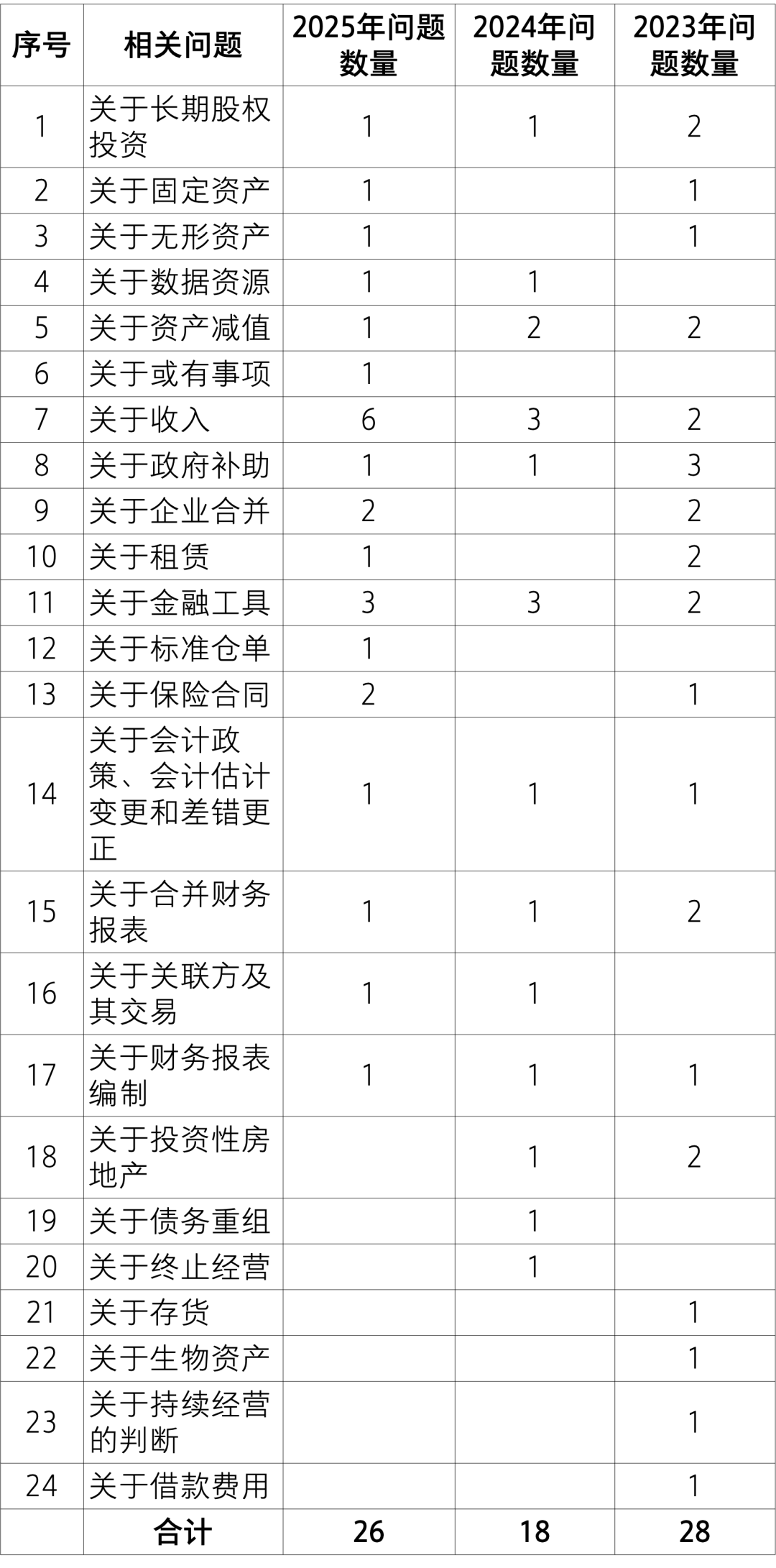
【致同提示】编制2025年年报应予关注的企业会计准则实施重点技术问题
Xin Lang Cai Jing· 2026-01-04 01:25
Core Viewpoint The article discusses the key focus areas for the implementation of accounting standards in the 2025 annual report, emphasizing the importance of adhering to specific guidelines set forth by regulatory bodies to ensure accurate financial reporting. Group 1: Key Focus Areas for Accounting Standards - The 2025 annual report will particularly emphasize the judgment of business combinations, especially when the acquired entity's main assets are equity interests in joint ventures, which should not be directly recognized as a business solely based on the nature of the joint venture [2] - Companies must consider credit risk, payment delay risk, and interest rate risk when determining whether to derecognize endorsed or discounted bills [2] - Financial instruments with interest rate step-up clauses must be assessed against market rates to determine if the capped rate exceeds the average rate of similar instruments in the industry [2] Group 2: Long-term Equity Investments - Companies should comprehensively assess all relevant facts when determining significant influence over investees, avoiding arbitrary changes based solely on individual actions like appointing directors [4][5] - The judgment of significant influence should not vary across accounting periods without substantial changes in ownership structure or decision-making power [6] Group 3: Fixed Assets - Fixed assets must be recognized and depreciated promptly once they are ready for use, regardless of whether completion reports have been finalized [7][9] - The cost of fixed assets includes all necessary expenditures to bring the asset to a usable state, and depreciation should be based on reasonable estimates of useful life and residual value [8] Group 4: Intangible Assets - Companies must accurately categorize R&D expenditures and distinguish between research and development phases, ensuring that only qualifying development costs are capitalized [10][11] - Expenditures that do not meet the criteria for capitalization should not be included in R&D costs, particularly if they do not pass feasibility verification [14][15] Group 5: Data Resources - Companies must adhere to the definitions and recognition criteria for data resources as outlined in the relevant accounting standards, ensuring that only qualifying data resources are recognized as assets [16][24] - Internal data resource expenditures must be managed and accounted for separately, and previously expensed data resources cannot be re-capitalized [17][20] Group 6: Asset Impairment - Companies are required to assess impairment for various long-term assets, including fixed assets and goodwill, based on reliable internal and external information [25][26] - Goodwill must undergo annual impairment testing regardless of whether there are indications of impairment, and the recoverable amount should be determined based on the higher of fair value less costs to sell and value in use [27][28]

重庆啤酒支付1亿元了结旧账
Shen Zhen Shang Bao· 2025-12-16 23:34
Group 1 - The core point of the article is that Chongqing Brewery has reached a settlement agreement with Jiawei during the second trial phase, which, if successful, will conclude the litigation process [1] - The settlement agreement includes a one-time payment of 100 million yuan (excluding tax) by the company or its subsidiaries to Jiawei for all price difference settlements due by December 31, 2025 [1] - The agreement also outlines the cooperation terms for product distribution between the company and Jiawei from 2026 to 2028, including provisions for dividends [1] Group 2 - Following the settlement, Chongqing Brewery's subsidiary, Carlsberg Chongqing Brewery Co., Ltd., plans to reverse a previously recognized estimated liability of approximately 254 million yuan based on the first-instance judgment [1] - The company intends to recognize a new liability of about 217 million yuan for the one-time payment and other related costs, which is in line with the principle of prudence [1] - These accounting adjustments are expected to increase the company's total profit for 2025 by approximately 37.11 million yuan and the net profit attributable to shareholders by about 19.08 million yuan [1] Group 3 - In the past two years, Chongqing Brewery has experienced a continuous decline in performance, with financial data indicating a decrease in both revenue and net profit last year [2]

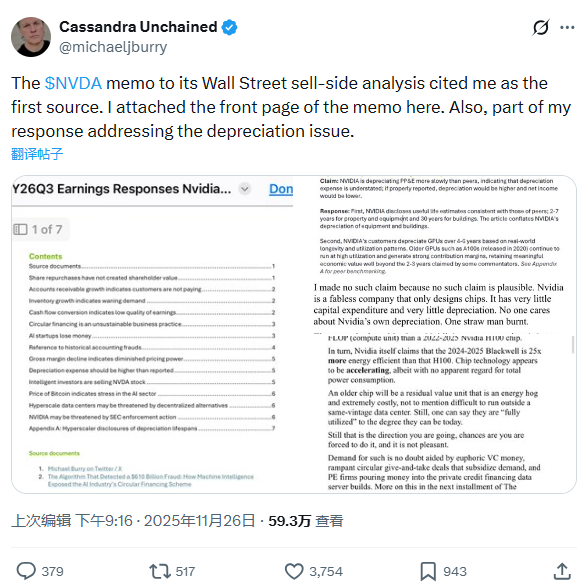
“大空头 vs 英伟达”论战继续,“大空头”逐条反驳英伟达回应:不敢相信这来自全球市值最高公司
3 6 Ke· 2025-11-28 10:14
Core Viewpoint - The ongoing conflict between Michael Burry, known as the "Big Short," and Nvidia is intensifying, with Burry criticizing Nvidia's internal memo as disappointing and filled with "straw man arguments" [1][4]. Group 1: Burry's Critique - Burry expressed disbelief that a company of Nvidia's stature would respond to criticism with what he perceives as a misleading memo, which he described as reading "almost like a scam" [1]. - He continues to hold put options against Nvidia and Palantir, signaling his bearish outlook on these AI companies [3][9]. - Burry argues that Nvidia's memo misrepresents his criticisms, particularly regarding the depreciation policies of their fixed assets, which he claims are not the focus of his critique [4][6]. Group 2: Nvidia's Defense - Nvidia distributed a seven-page memo to Wall Street analysts to counter accusations of accounting fraud, circular financing, and an AI bubble, asserting that their financial reporting is robust and transparent [11]. - The company clarified that its customers typically depreciate GPUs over four to six years, countering claims that AI chips have a lifespan of only two to three years [11]. - Nvidia emphasized that its strategic investments in the third quarter were only $3.7 billion, a small fraction of its revenue, dismissing the notion of circular financing as unfounded [11]. Group 3: Market Reaction and Context - Following Burry's warnings and the release of earnings reports, Nvidia's stock has declined approximately 14% from its peak on November 3, indicating a shift in investor sentiment towards AI-related companies [2][10]. - Palantir's stock has also dropped 20% from recent highs, despite significant gains year-to-date, reflecting growing concerns about the sustainability of AI valuations [10].

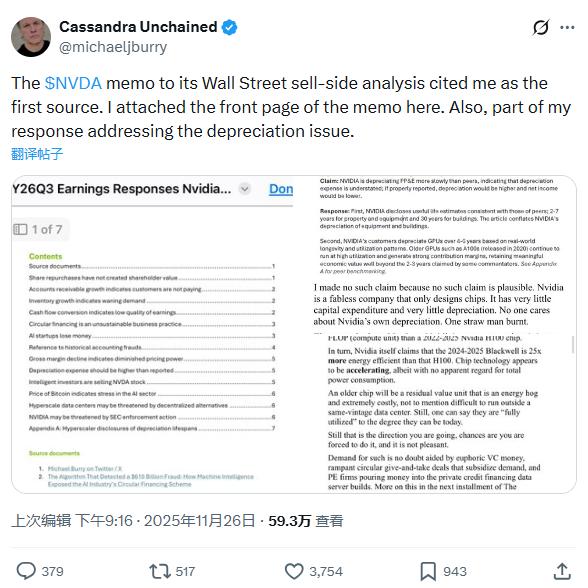
“大空头 vs 英伟达”论战继续!“大空头”逐条反驳英伟达回应:不敢相信这来自全球市值最高公司
Hua Er Jie Jian Wen· 2025-11-27 01:08
Core Viewpoint - The ongoing conflict between Michael Burry, known as the "Big Short," and NVIDIA is intensifying, with Burry criticizing NVIDIA's internal memo as disappointing and filled with straw man arguments [1][3]. Group 1: Burry's Critique - Burry claims that NVIDIA's memo misrepresents his criticisms, addressing points he never made, particularly regarding the company's depreciation policies [5]. - He emphasizes that he has never questioned NVIDIA's fixed asset depreciation policy, stating that the company is primarily a chip designer with minimal capital expenditure [5]. - Burry warns that the rapid technological advancement in AI chips could lead to significant asset write-down risks for companies extending depreciation periods [8]. Group 2: Market Reaction and Positioning - Following Burry's criticisms, NVIDIA's stock has declined approximately 14% from its peak on November 3, indicating a shift in investor sentiment towards AI-related companies [2][11]. - Burry continues to hold put options against NVIDIA and Palantir, signaling his bearish outlook on these AI companies [3][10]. - The market has shown increased scrutiny of AI companies, with Palantir's stock also dropping 20% from recent highs, despite significant year-to-date gains [11]. Group 3: NVIDIA's Defense - In response to the criticisms, NVIDIA distributed a seven-page memo to Wall Street analysts, aiming to refute allegations of accounting fraud and circular financing [12]. - The company asserts that its depreciation practices align with industry standards, with customers typically depreciating GPUs over 4-6 years [14]. - NVIDIA emphasizes its leading position in the AI market, claiming to be the only company capable of running all AI models across various computing scenarios [12].
经营租赁、融资租赁和融资性售后回租的税会处理(20251026)
Sou Hu Cai Jing· 2025-10-26 03:07
Concept - Operating lease refers to the business activity of transferring the use of tangible or intangible assets to others for a specified period without changing the ownership of the leased property. It can be categorized into tangible asset operating leases and real estate operating leases [2] - Financing lease is defined as a leasing activity that has financing characteristics and ownership transfer features, where the lessor purchases the asset based on the lessee's specifications and the ownership remains with the lessor during the lease term [5] - Financial sale-leaseback refers to a business activity where the lessee sells an asset to a financing leasing company for financing purposes and then leases it back from the same company [6] Tax Treatment - For operating leases, the tax category is sales service under modern services, and the tax obligation arises when the rental service is provided [8] - Financing leases also have tax obligations that arise when the taxable behavior occurs and payment is received [9] - For financial sale-leaseback, the tax category is sales service under financial services, and the tax obligation arises similarly to operating leases [10] Tax Rates - The general tax rate for tangible asset leasing is 13%, while for real estate leasing, it is 9% [11] - Small-scale taxpayers can choose a simplified tax rate of 3% for tangible asset leasing and 5% for real estate leasing [11][12] Tax Incentives - Approved financing leasing companies can benefit from a VAT refund policy if their actual tax burden exceeds 3% [15] - Small-scale taxpayers are not eligible for the immediate refund policy [16] Corporate Income Tax and Accounting Treatment - For operating leases, rental expenses can be deducted evenly over the lease term according to the Corporate Income Tax Law [24] - Under new accounting standards, lessees must recognize right-of-use assets and lease liabilities, leading to potential tax and accounting differences [30][32] - For financing leases, the lessee can deduct depreciation expenses based on the value of the leased asset, while the lessor cannot deduct depreciation for leased assets [39][40] Case Studies - A case study illustrates the accounting treatment for a company leasing an office building, highlighting the differences in tax treatment under old and new standards [28][29] - Another case study demonstrates the financial sale-leaseback process, showing how the lessee retains the asset on their balance sheet while recognizing a financial liability [48][50]

蔚来遭指控虚增收入,真相是→
Jin Rong Shi Bao· 2025-10-20 03:31
Core Viewpoint - Singapore's Government Investment Corporation (GIC) has accused NIO of inflating revenue and profits through its partnership with Wuhan Weinan Battery Asset Co., leading to investment losses for GIC, which has drawn market attention [1] Group 1: Stock Market Reaction - On October 16, NIO's Hong Kong stock price initially dropped nearly 13%, closing down 8.99%. The following day, NIO's stock opened over 5% higher and ultimately closed up 2.17% at HKD 50.35 per share, with a total market capitalization of HKD 122.9 billion [1] - NIO's U.S. stock opened down nearly 8% on the same day but quickly rebounded, closing up 0.15% [1] Group 2: Background of the Allegations - The lawsuit initiated by GIC is not related to NIO's recent operational performance but traces back to a short-selling report by Grizzly Research published in June 2022 [2] - The report accused NIO of exaggerating revenue and net profits through Wuhan Weinan, claiming that NIO misrepresented the number of battery asset management business (BaaS) orders [2] Group 3: NIO's Response and Support from Financial Institutions - NIO responded promptly to the allegations in the Grizzly report, stating that the claims lacked factual basis and contained misleading conclusions. An independent internal review was conducted, confirming that all allegations were unfounded [3] - Major financial institutions, including Deutsche Bank, Morgan Stanley, JP Morgan, and Daiwa Capital, released reports supporting NIO, stating that Grizzly's concerns were based on misunderstandings of the BaaS model [3] Group 4: GIC's Litigation History - GIC, managing over USD 100 billion, has a history of initiating lawsuits against publicly listed companies, claiming investment losses. Notable companies previously sued by GIC include Qualcomm, Merck, and BP [3]

部分上市公司2024年财报存在会计处理或财务信息披露错误
Ren Min Wang· 2025-08-19 05:40
Core Viewpoint - The China Securities Regulatory Commission (CSRC) released a report indicating that while listed companies generally comply with accounting standards and financial disclosure rules, there are still issues related to accounting treatment and financial information disclosure in certain areas [1][2]. Group 1: Financial Reporting Issues - As of April 30, 2025, a total of 5,413 listed companies in the A-share market disclosed their 2024 annual financial reports, including 3,185 from the main board, 1,377 from the ChiNext, 586 from the Sci-Tech Innovation Board, and 265 from the Beijing Stock Exchange [1]. - Among the companies that disclosed their reports, 192 received non-standard audit opinions, including 56 with unqualified opinions containing emphasis of matter, 35 with unqualified opinions containing going concern issues, and 72 with qualified opinions [1]. Group 2: Revenue Recognition Issues - The report identified that some companies improperly recognized revenue and costs using the time period method, miscalculated sales revenue under point pricing models, and inadequately handled sales rebates and contract fulfillment costs [2]. Group 3: Long-term Investments and Mergers - Issues were noted in the areas of long-term equity investments and business combinations, including incorrect judgments on the scope of consolidated financial statements and improper recognition of goodwill from step acquisitions of businesses under common control [2]. Group 4: Financial Instruments and Asset Impairment - The report highlighted problems with the recognition and measurement of financial instruments, such as inappropriate provisions for expected credit losses and misclassification of equity investments [2]. - Additionally, some companies failed to appropriately recognize inventory impairment and did not accurately measure the recoverable amount of assets [2]. Group 5: Disclosure and Regulatory Actions - The CSRC plans to continue monitoring the accounting information disclosure issues identified in the report, enhance the regulatory framework for financial reporting, and provide practical guidance on accounting issues that are of market concern [3].
金斯瑞生物科技2024年扭亏为盈,收益5.945亿美元增长6.1%,但持续经营业务增长仅2.9%存疑虑
Jin Rong Jie· 2025-08-18 05:59
Core Viewpoint - King’s Ray Biotechnology achieved a significant turnaround in profitability for 2024, reporting a net profit of approximately $2.962 billion, compared to a loss of $95.477 million in 2023, primarily due to accounting changes and a one-time gain from the merger cancellation with Legend Biotech [1][3] Financial Performance - The company reported revenues of approximately $594.5 million for 2024, a 6.1% increase from $560.5 million in the previous year [1] - Adjusted net profit from ongoing operations was approximately $59.8 million, reflecting a modest growth of 2.9% compared to $58.1 million in the prior year [3] Business Segments - The life sciences segment, which constitutes about 75.8% of total revenue, saw a revenue increase of 10.2%, driven by enhanced brand presence in Europe and the U.S. and the introduction of new competitive services and products [4] - The biopharmaceutical development services segment underperformed, with external revenue accounting for 14.8% of total revenue, declining by 13.2% to approximately $95.0 million, and adjusted operating losses widening by 46.1% to about $43.4 million [5] Financial Structure - The company's debt-to-asset ratio improved significantly from 39.65% to 18.09%, indicating a stronger financial structure [7] - The current ratio decreased from 4.76 to 2.72, remaining at a relatively safe level [7] Cash Flow and Management - The company reported a negative cash flow per share of -$0.61, worsening from $0.20 in the previous year, while operating cash flow per share improved slightly from -$0.14 to $0.04 [7] - The accounts receivable conversion cycle improved from 69 days to 59 days, indicating better management of customer payments, although the accounts payable conversion cycle decreased significantly from 21 days to 12 days, potentially straining cash flow management [7]


证监会:提高信披质量 明确收入等会计处理细则
Zheng Quan Shi Bao· 2025-07-18 17:11
Group 1 - The core viewpoint of the news is that the China Securities Regulatory Commission (CSRC) has issued the "Guidance on the Application of Regulatory Rules - Accounting Category No. 5" to clarify accounting issues related to income, financial instruments, and long-term equity investments, aiming to promote consistent and effective implementation of accounting standards in the capital market [1][4] Group 2 - Regarding the accounting treatment of government subsidies for the dismantling of waste electrical and electronic products, companies are required to estimate the potential subsidy amounts reasonably based on income standards and government subsidy policies, and recognize them as income when the conditions for income recognition are met [1] - The CSRC pointed out that if a company renegotiates the contract price with a customer after fulfilling the contract and recognizing receivables, the accounting treatment should consider the specific contractual agreements and whether the price reduction is related to the company's performance activities [2] - Companies must analyze whether subsequent changes in intellectual property licensing contracts form a new authorization contract and handle the accounting accordingly [3] - The CSRC emphasized the need for companies to improve the quality of accounting information disclosure in light of new industries and business models emerging in the capital market, and will monitor the implementation of Accounting Category No. 5 [4]