质量可靠性

Search documents
2025年燃油车测评:满意度维持历史最高水平,百辆新车故障次数下降
Zhong Guo Qi Che Bao Wang· 2025-10-17 13:05
Core Insights - The 2025 China Automotive Customer Satisfaction Index (CACSI) score is 81, maintaining the historical high level achieved in 2024 [1] - Brand recognition and perceived value are key factors supporting the satisfaction index [1] - User complaint rate has decreased to 9%, and loyalty score has reached 79, both marking the best performance in nearly a decade [1] Group 1: Product Quality - The reliability score reached 80.5, the highest in the last ten years, with the number of faults per 100 new vehicles decreasing to 179, a reduction of 9 from the previous year [3] - Faults are increasingly concentrated in three major systems: intelligent cockpit, intelligent driving assistance, and interior, which account for 72% of total faults, an increase of 16 and 25 percentage points compared to 2024 and 2023 respectively [3][4] - The top ten faults include issues such as "gesture control failure" and "fingerprint recognition failure" [4] Group 2: Service Quality - Sales service satisfaction score is 80, down 1 point year-on-year, with the most significant declines in delivery process, online services, and test drives [5] - After-sales service satisfaction score is 79, down 2 points, with service attitude and maintenance quality rated relatively high, while service charge satisfaction remains low [5] - The industry needs to focus on ensuring reasonable service charges and improving after-sales service efficiency [5] Group 3: User Experience and Preferences - User experience with intelligent connected features shows strengths and weaknesses, with driving assistance features being more positively received than intelligent cockpit features [6] - The importance of "quality reliability" in purchasing decisions has risen, moving from third to second place, while "brand recognition" has decreased by 6 percentage points compared to 2023 [8] - The proportion of new car buyers in 2025 has decreased by 3 percentage points year-on-year, with a growing preference for German brands and a heightened focus on quality reliability [8]


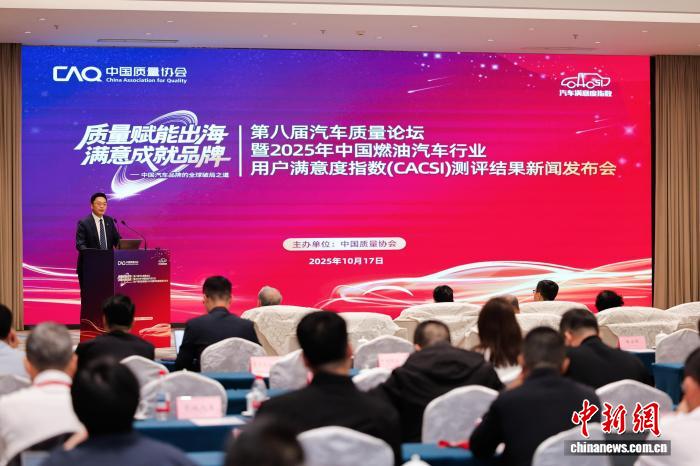
今年中国燃油汽车行业用户满意度指数发布,得分维持历史最高水平
Zhong Guo Xin Wen Wang· 2025-10-17 11:46
Core Insights - The 2025 China Fuel Vehicle Industry Customer Satisfaction Index (CACSI) remains at a historical high of 81 points, unchanged from the previous year, supported by high brand recognition and perceived value [1][3] Group 1: Customer Satisfaction Metrics - The complaint rate among users has decreased to 9%, and loyalty score has reached 79 points, both marking the best performance in nearly a decade [1][3] - Product quality reliability has improved, scoring 80.5 points, a 2-point increase year-on-year, with the number of faults per 100 new vehicles dropping to 179, a reduction of 9 faults [3] - Sales service satisfaction has decreased to 80 points, down 1 point year-on-year, with the most significant declines in delivery process, online services, and test drives [3][5] Group 2: Fault Distribution and User Experience - Faults are increasingly concentrated in three systems: intelligent cockpit, intelligent driving assistance, and interior, which account for 72% of issues, an increase of 16 and 25 percentage points compared to 2024 and 2023 respectively [3][4] - The top ten faults reported include issues with gesture control, fingerprint recognition, and excessive interior odor, indicating areas needing improvement [3] Group 3: User Preferences and Market Trends - User preferences have shifted, with "good performance," "high reliability," and "high comfort" being the top three considerations for purchasing vehicles, while the importance of "high brand recognition" has declined by 6 percentage points since 2023 [5][6] - The influence of brand image on customer satisfaction has weakened, with perceived quality now being the primary driver of satisfaction for the first time since 2017, indicating a stabilization in the fuel vehicle market [5] Group 4: Survey Methodology and Coverage - The CACSI survey, conducted by the China Quality Association since 2002, covered 149 leading brands and models, with a sample size of 23,489 collected from 101 major cities across five regions from May 1 to August 30, 2025 [6]