
质量红利策略

Search documents
日涨幅超2.6%彰显进攻性!中证红利质量ETF(159209)单日揽金超2000万创近期新高
Sou Hu Cai Jing· 2026-01-06 01:36
Core Viewpoint - The A-share market showed positive performance, particularly highlighted by the strong performance of the CSI Dividend Quality ETF (159209), which rose over 2.6% in a single day and attracted a net inflow of over 20 million yuan, marking a recent single-day inflow record [1][3]. Group 1: ETF Performance - The CSI Dividend Quality ETF has seen continuous net inflows for 14 consecutive trading days, with a total net inflow exceeding 140 million yuan [1][3]. - The ETF's unique "quality dividend" strategy distinguishes it from traditional dividend indices by incorporating assessments of corporate profitability, growth quality, and financial stability alongside high dividend yield selection [3]. Group 2: Market Trends - The "quality dividend" strategy aligns with the current market's demand for high-quality companies with stable cash flows, good governance structures, and sustainable profitability, especially during the economic growth structural transition [3]. - In a market environment where styles are becoming more balanced and risk-free interest rates remain low, the "quality dividend" strategy is emerging as a significant direction for medium to long-term capital allocation [3].

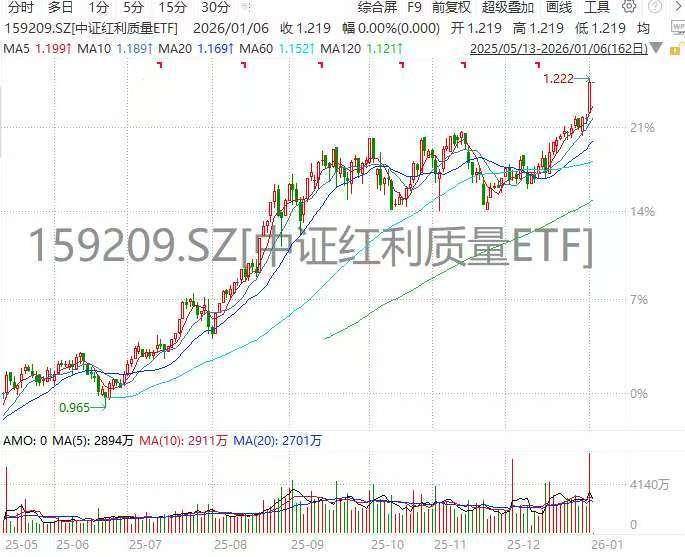
年内第49次新高,连续13日吸金!中证红利质量ETF(159209)年内领涨A股红利ETF
Sou Hu Cai Jing· 2025-12-31 02:39
Group 1 - The A-share market is experiencing a year-end rally, with the "quality dividend" strategy becoming a focal point for capital allocation, as evidenced by the China Securities Quality Dividend ETF (159209) reaching a new high for the 49th time this year and achieving over 20% cumulative returns [1][3] - The ETF tracks the China Securities Quality Dividend Index, which integrates "high dividend" and "high quality" factors, representing an upgrade from traditional dividend strategies by selecting companies with stable dividend records while also assessing profitability, financial stability, and growth potential [3] - The recent rebalancing has positioned Kweichow Moutai as the largest weighted stock in the ETF, indicating a focus on leading companies across various industries [3] Group 2 - The current market environment highlights the value of this strategy, as stable dividends provide foundational returns and downside protection, while the emphasis on quality growth companies offers stronger price elasticity during periods of increased market risk appetite [4] - The ETF features the lowest fee rate in the market (0.20% total) and a monthly dividend assessment mechanism, aligning with investors' desire for a favorable long-term holding experience [4] - The strong performance and continuous capital inflow into the China Securities Quality Dividend ETF signify that the upgraded dividend strategy, which balances returns and quality, is becoming a key allocation direction for mainstream capital in the context of declining risk-free interest rates and a pursuit of certainty in growth [4]
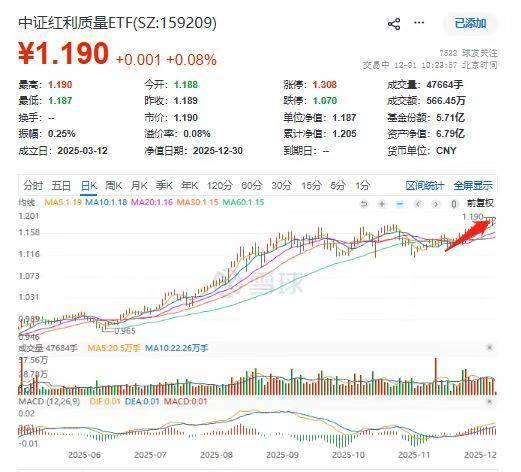
A股红利“领头雁”,中证红利质量ETF(159209)再度走强,盘中连续第12日获增仓
Sou Hu Cai Jing· 2025-12-30 05:53
Core Viewpoint - The A-share market continues to strengthen, with the "quality dividend" strategy becoming a highlight for capital pursuit, as evidenced by the performance of the CSI Dividend Quality ETF (159209) which has seen significant inflows and strong stock performance [1][2]. Group 1: Market Performance - As of December 30, the CSI Dividend Quality ETF (159209) rose by 0.51%, with its constituent stock Shimao Energy hitting the daily limit up, and other stocks like Yun Aluminum also experiencing gains [1]. - The fund has achieved an annual increase of nearly 20%, leading all dividend ETFs in the A-share market, and has seen net inflows for 12 consecutive trading days, indicating sustained market enthusiasm [1]. Group 2: Investment Strategy - Analysts indicate that as market risk appetite increases, investors are seeking more flexible investment tools. The CSI Dividend Quality Index combines "high dividend" and "high quality" factors to accurately capture opportunities [2]. - This index focuses on companies with stable dividends, strong profitability, sound finances, and growth potential, making it attractive for concentrated capital allocation in a positive market environment [2]. - The index provides a robust choice for investors during periods of rising risk appetite, showcasing price elasticity and upside potential beyond a simple high-dividend strategy [2]. Group 3: Product Design - The CSI Dividend Quality ETF (159209) features a cost structure of "0.15% + 0.05%", which is the lowest in the market, offering significant cost advantages for long-term holders [2]. - The fund employs a monthly dividend assessment mechanism, better meeting investors' cash flow needs and enhancing the holding experience [2].
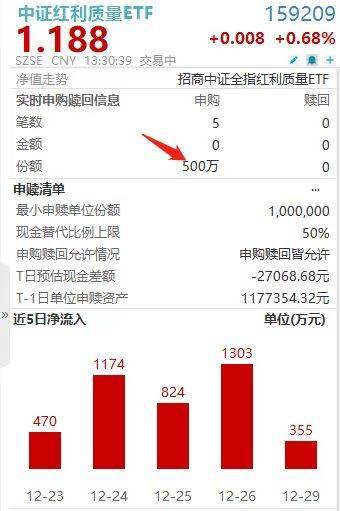
年内领涨A股红利!中证红利质量ETF(159209)获资金连续爆买12日!世茂能源盘中10CM封板
Sou Hu Cai Jing· 2025-12-30 05:47
Group 1 - The A-share market showed a strong performance after initial declines, with the CSI Dividend Quality ETF (159209) rising by 0.51% as of 13:20 on December 30, 2023 [1] - Key stocks contributing to the ETF's performance included Shimao Energy, which hit the daily limit, along with Yun Aluminum, Tianshan Aluminum, Yuntianhua, 37 Interactive Entertainment, and China National Offshore Oil Corporation, all showing significant gains [1] - The ETF has seen a year-to-date increase of over 20%, leading the A-share dividend ETFs, with continuous net inflows for 12 consecutive days [1] Group 2 - Unlike typical dividend strategies, the ETF tracks the CSI Dividend Quality Index, which emphasizes not only dividend yield but also the stability of earnings, growth potential, and financial quality, aligning with a value investment philosophy of buying quality companies at reasonable prices [2] - After rebalancing in December, Kweichow Moutai became the largest weighted stock in the ETF, alongside other quality companies like Midea Group and Dong-E E-Jiao, known for their sustainable dividend capabilities and profit growth [2] - Historical data indicates that this index has significantly outperformed the CSI 300 Index over the long term, with its total return index leading its peers this year, making the "quality dividend" strategy an important allocation direction for investors seeking both dividend income and long-term growth in a declining risk-free yield environment [2]

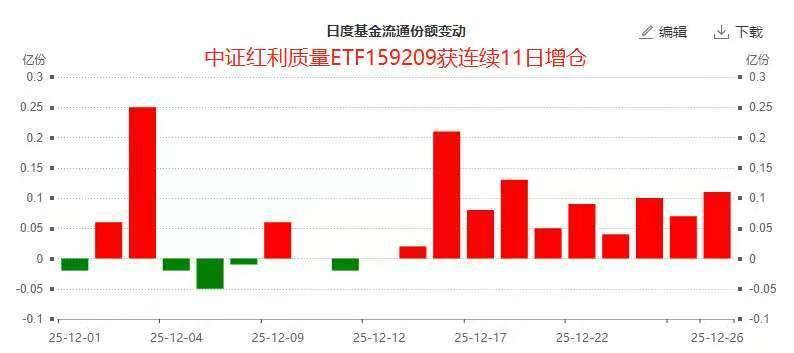
根本停不下来!年内领涨A股红利,中证红利质量ETF(159209)获连续11日增仓
Sou Hu Cai Jing· 2025-12-29 06:29
Core Insights - The China Securities Dividend Quality ETF (159209) has outperformed traditional dividend strategies in 2025, achieving over 20% growth year-to-date and reaching a price high since its inception nine months ago [1][2] - The ETF has experienced continuous net inflows for 11 consecutive trading days, indicating strong investor interest [1] Group 1: ETF Performance - The ETF's unique "high dividend + high quality" dual selection logic has contributed to its strong performance amidst a challenging market for traditional dividend strategies [1] - The ETF has led the market in the dividend ETF category, showcasing its resilience and appeal to investors [1] Group 2: Investment Strategy - Unlike typical dividend strategies, the ETF tracks the China Securities Dividend Quality Index, which emphasizes not only dividend yield but also the stability, growth, and financial quality of companies [2] - The investment philosophy aligns with value investing, focusing on acquiring quality companies at reasonable prices [2] Group 3: Portfolio Composition - Following a rebalancing in December, Kweichow Moutai has become the largest weighted stock in the ETF, alongside other quality companies like Midea Group and Dong-E E-Jiao, which have consistent dividend capabilities and profit growth [2] - Historical data indicates that the index has significantly outperformed the CSI 300 Index over the long term, with its total return index leading its peers this year [2] Group 4: Market Context - In a market environment where risk-free returns are declining, the "quality dividend" strategy is emerging as an important allocation direction for investors seeking both dividend income and long-term growth [2]
量化大势研判:当成长只有预期在扩张
Minsheng Securities· 2025-09-03 09:32
Quantitative Models and Construction Methods Model Name: Quantitative Market Trend Analysis Framework - **Model Construction Idea**: The model aims to solve the systematic rotation problem of styles by conducting a bottom-up quantitative market trend analysis. It identifies the dominant asset characteristics that represent the future market's mainstream style through a comprehensive comparison of assets[1][5] - **Model Construction Process**: - The model considers five style stages based on the asset's industry lifecycle: external growth, quality growth, quality dividend, value dividend, and bankruptcy value[1][5] - The priority for asset comparison is based on the sequence: growth (g) > return on equity (ROE) > dividend (D)[1][5] - The model uses the spread of asset advantage differences to capture the trend changes of top assets, similar to factor timing[20] - **Model Evaluation**: The framework has shown good explanatory power for past A-share style rotations, achieving an annualized return of 27.25% since 2009[15] Model Backtesting Results - **Quantitative Market Trend Analysis Framework**: - 2009: Asset Comparison Strategy 133%, Wind All A 82%, Excess Return 51%[18] - 2010: Asset Comparison Strategy 7%, Wind All A -7%, Excess Return 14%[18] - 2011: Asset Comparison Strategy -33%, Wind All A -22%, Excess Return -11%[18] - 2012: Asset Comparison Strategy 5%, Wind All A 5%, Excess Return 0%[18] - 2013: Asset Comparison Strategy 41%, Wind All A 5%, Excess Return 36%[18] - 2014: Asset Comparison Strategy 48%, Wind All A 52%, Excess Return -4%[18] - 2015: Asset Comparison Strategy 55%, Wind All A 38%, Excess Return 16%[18] - 2016: Asset Comparison Strategy -14%, Wind All A -13%, Excess Return -1%[18] - 2017: Asset Comparison Strategy 32%, Wind All A 5%, Excess Return 27%[18] - 2018: Asset Comparison Strategy -21%, Wind All A -28%, Excess Return 7%[18] - 2019: Asset Comparison Strategy 41%, Wind All A 33%, Excess Return 8%[18] - 2020: Asset Comparison Strategy 69%, Wind All A 26%, Excess Return 44%[18] - 2021: Asset Comparison Strategy 47%, Wind All A 9%, Excess Return 38%[18] - 2022: Asset Comparison Strategy 44%, Wind All A -19%, Excess Return 62%[18] - 2023: Asset Comparison Strategy 5%, Wind All A -5%, Excess Return 10%[18] - 2024: Asset Comparison Strategy 62%, Wind All A 10%, Excess Return 52%[18] - 2025 (Aug): Asset Comparison Strategy 27%, Wind All A 23%, Excess Return 4%[18] Quantitative Factors and Construction Methods Factor Name: Expected Growth (gf) - **Factor Construction Idea**: The factor focuses on the highest analyst forecasted growth rates, regardless of the cycle stage[6] - **Factor Construction Process**: - The factor is constructed by selecting industries with the highest expected growth rates as forecasted by analysts[6] - The spread of expected growth advantage differences (Δgf) is used to capture the trend changes in top assets[20] - **Factor Evaluation**: The factor has shown significant excess returns since 2019, with notable performance in 2014-2015[34] Factor Name: Actual Growth (g) - **Factor Construction Idea**: The factor focuses on industries with the highest actual growth rates, particularly during transition and growth periods[6] - **Factor Construction Process**: - The factor is constructed by selecting industries with the highest actual growth rates (Δg)[6] - The spread of actual growth advantage differences (Δg) is used to capture the trend changes in top assets[24] - **Factor Evaluation**: The factor has shown significant excess returns in growth-dominant environments[36] Factor Name: Profitability (ROE) - **Factor Construction Idea**: The factor focuses on industries with high ROE and low valuation under the PB-ROE framework, concentrated in mature periods[6] - **Factor Construction Process**: - The factor is constructed by selecting industries with high ROE and low PB-ROE residuals[6] - The spread of ROE advantage differences is used to capture the trend changes in top assets[26] - **Factor Evaluation**: The factor has shown significant excess returns from 2016 to 2020, with weaker performance since 2021[39] Factor Name: Quality Dividend (DP+ROE) - **Factor Construction Idea**: The factor focuses on industries with the highest DP+ROE scores, concentrated in mature periods[6] - **Factor Construction Process**: - The factor is constructed by selecting industries with the highest DP+ROE scores[6] - The spread of DP+ROE advantage differences is used to capture the trend changes in top assets[42] - **Factor Evaluation**: The factor has shown significant excess returns in 2016, 2017, and 2023[43] Factor Name: Value Dividend (DP+BP) - **Factor Construction Idea**: The factor focuses on industries with the highest DP+BP scores, concentrated in mature periods[6] - **Factor Construction Process**: - The factor is constructed by selecting industries with the highest DP+BP scores[6] - The spread of DP+BP advantage differences is used to capture the trend changes in top assets[45] - **Factor Evaluation**: The factor has shown significant excess returns in 2009, 2017, and 2021-2023[46] Factor Name: Bankruptcy Value (PB+SIZE) - **Factor Construction Idea**: The factor focuses on industries with the lowest PB+SIZE scores, concentrated in stagnation and recession periods[6] - **Factor Construction Process**: - The factor is constructed by selecting industries with the lowest PB+SIZE scores[6] - The spread of PB+SIZE advantage differences is used to capture the trend changes in top assets[48] - **Factor Evaluation**: The factor has shown significant excess returns in 2015-2016 and 2021-2023[49] Factor Backtesting Results - **Expected Growth (gf)**: - Cable: 12 stocks, largest weight stock Zhongtian Technology, average market cap 21.791 billion yuan, 3-month performance 49.62%[34] - Cement: 19 stocks, largest weight stock Conch Cement, average market cap 17.929 billion yuan, 3-month performance 12.71%[34] - Glass Fiber: 6 stocks, largest weight stock China Jushi, average market cap 26.657 billion yuan, 3-month performance 63.67%[34] - Rare Earth and Magnetic Materials: 17 stocks, largest weight stock Northern Rare Earth, average market cap 31.018 billion yuan, 3-month performance 98.77%[34] - White Goods III: 10 stocks, largest weight stock Midea Group, average market cap 113.675 billion yuan, 3-month performance -1.21%[34] - **Actual Growth (g)**: - Integrated Circuits: 104 stocks, largest weight stock Cambricon-U, average market cap 45.058 billion yuan, 3-month performance 42.93%[37] - PCB: 38 stocks, largest weight stock Shenghong Technology, average market cap 27.163 billion yuan, 3-month performance 112.10%[37] - Tungsten: 4 stocks, largest weight stock Xiamen Tungsten, average market cap 30.523 billion yuan, 3-month performance 69.26%[37] - Lithium Battery Equipment: 12 stocks, largest weight stock Lead Intelligent, average market cap 11.731 billion yuan, 3-month performance 60.15%[37] - Weapons and Equipment III: 12 stocks, largest weight stock Great Wall Military Industry, average market cap 21.307 billion yuan, 3-month performance 80.22%[37] - **Profitability (ROE)**: - Beer: 7 stocks, largest weight stock Tsingtao Brewery, average market cap 26.758 billion yuan, 3-month performance -3.94%[39] - Liquor: 20 stocks, largest weight stock Kweichow Moutai, average market cap 162.722 billion yuan, 3-month performance 4.12%[39] - Non-dairy Beverages: 7 stocks, largest weight stock Eastroc Beverage, average market cap 32.754 billion yuan, 3-month performance -4.45%[39] - Network Connection and Tower Setup: 19 stocks, largest weight stock Zhongji Xuchuang, average market cap 64.299 billion yuan, 3-month performance 202.29%[39] - Building Decoration III: 28 stocks, largest weight stock Gold Mantis, average market cap 3.436 billion yuan, 3-month performance 4.42%[39] - **Quality Dividend (DP+ROE)**: - Automotive Motor Control: 15