
贩卖焦虑

Search documents
中国官方要求网站平台坚决遏制“贩卖焦虑”等违规行为
Zhong Guo Xin Wen Wang· 2025-10-24 11:42
Core Points - The Chinese Ministry of Education has issued measures to strengthen mental health work for primary and secondary school students, emphasizing the need for online platforms to curb harmful content and anxiety-inducing practices [1][2] Group 1: Regulatory Measures - Online platforms are required to optimize algorithm recommendation mechanisms and prevent the dissemination of harmful information to students [1][2] - The measures aim to alleviate students' anxiety related to exams and reduce excessive homework burdens, including strict controls on written assignments and the introduction of "no homework days" [1] Group 2: Examination and Training Regulations - The measures call for standardized exam management, including reducing the frequency of tests and avoiding ranking students based on exam scores [1] - Continued regulation of extracurricular academic training is mandated, particularly for compulsory education stages, with a focus on preventing hidden variations in academic training [1] Group 3: Student Well-being and Environment - The measures stress the importance of adequate sleep for students, enforcing sleep management regulations to prevent excessive study hours and competition that encroaches on sleep time [1] - Specific initiatives are proposed to promote healthy internet usage habits among students, including restrictions on electronic devices in classrooms and the promotion of a "minor mode" for online content [2]
张雪峰全网账号被封 但他才不是真正的输家
Xin Lang Cai Jing· 2025-09-25 07:33
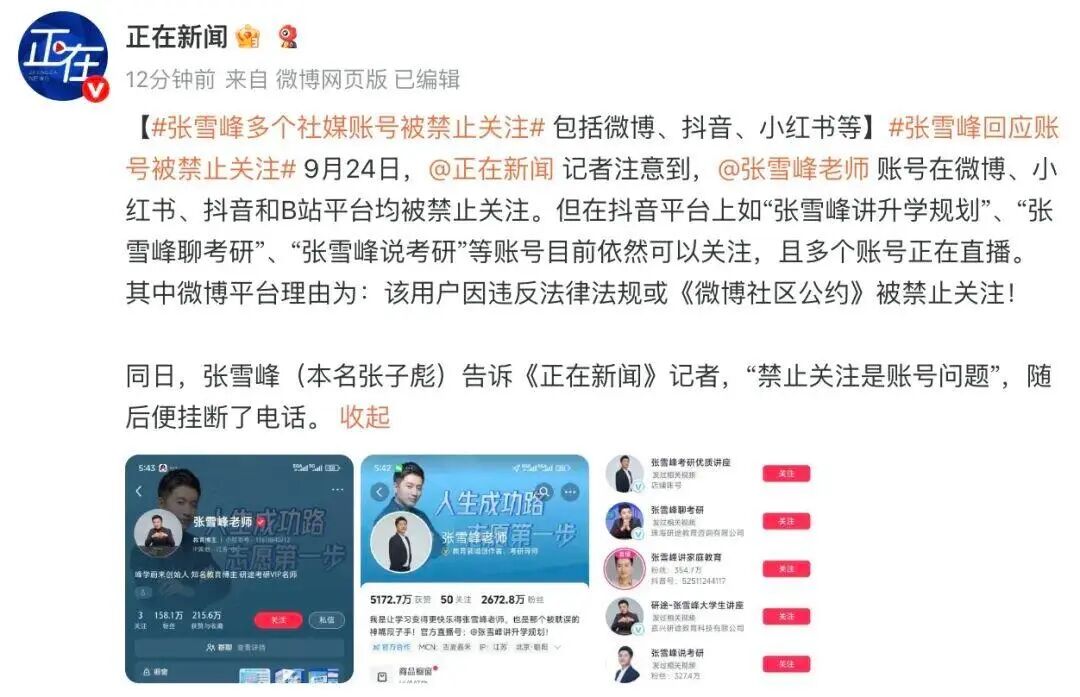
Core Viewpoint - Zhang Xuefeng's accounts on multiple social media platforms have been collectively banned, indicating a significant shift in his public perception from a controversial figure to a recognized social risk due to his potential for social mobilization [3][4]. Group 1: Background and Context - Zhang Xuefeng's rise to fame began in 2016 with his controversial statements about various academic programs, which he used to promote his educational services [4][22]. - His business model relies heavily on creating anxiety around educational choices, leading to increased demand for his high-priced services, such as the "Dream Card" priced at 12,999 yuan [4][18]. Group 2: Controversial Actions - Zhang has faced backlash for his statements that demean certain academic disciplines, which he uses to market his services, creating a narrative of "wrong choices" in education [4][22]. - His public declarations of financial support for national causes have been criticized as opportunistic, linking personal donations to national events in a way that commodifies patriotism [5][7]. Group 3: Impact on Society - Zhang's rhetoric has fostered a divisive environment among students and parents, promoting a hierarchy of academic disciplines that undermines the value of liberal arts and other fields [20][22]. - The consequences of his actions disproportionately affect lower-income families who invest heavily in his services, often at the expense of their financial stability [18][25]. Group 4: Conclusion and Implications - The banning of Zhang's accounts may not significantly impact his wealth or business operations, as he has already established a substantial financial foundation [23]. - However, the real victims of this situation are the families who have invested their hopes and savings into his educational promises, leaving them vulnerable and without recourse [25].

指纹识别水杯热销 谁在贩卖焦虑?
Mei Ri Shang Bao· 2025-09-04 22:28
Core Viewpoint - The rise in popularity of fingerprint recognition water bottles is driven by parental concerns over child safety, despite the low probability of actual threats occurring [1][2][3]. Group 1: Product Features and Market Demand - Fingerprint recognition water bottles are marketed as a solution to prevent potential dangers such as bullying and contamination, appealing to parents' fears [1][2]. - Sales data indicates that these products are among the top-selling items on e-commerce platforms, with prices ranging from over 100 to 400 yuan [1]. - The marketing strategy exploits parental anxiety, suggesting that without such a product, children are at risk of harm [2]. Group 2: Psychological and Social Implications - The use of fingerprint recognition technology may foster distrust among peers, leading to a defensive mindset in children [3][4]. - Encouraging children to rely on such security measures could hinder their emotional development and ability to trust others in a competitive society [3][4]. - The emphasis on security through technology may create an unrealistic perception of safety, potentially isolating children from normal social interactions [4].