
贸易竞争力

Search documents
华东师大吴信如:我国已过依赖本币贬值刺激出口的阶段
Sou Hu Cai Jing· 2026-01-08 07:06
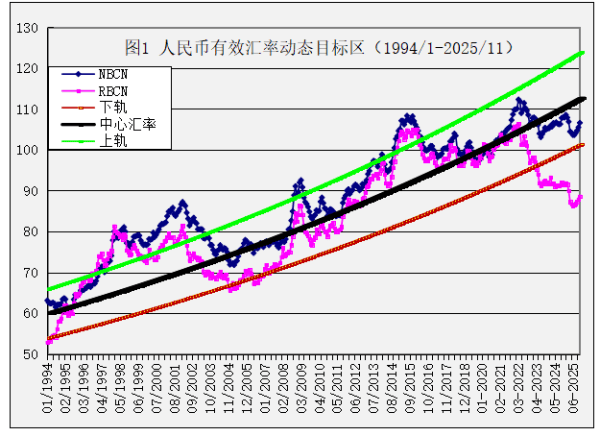
Core Viewpoint - The evaluation of the Renminbi (RMB) exchange rate should not be limited to its value against the US dollar but should consider a basket of currencies and the actual effective exchange rate, as the RMB's competitiveness is increasingly driven by industrial upgrades and import substitution rather than currency depreciation [1][4]. Group 1: RMB Exchange Rate Trends - The RMB has transitioned from a one-way appreciation to a two-way fluctuation since early 2014, with significant volatility observed post the "8-11 exchange rate reform" in 2015, where the RMB experienced fluctuations of 10%-15% [2]. - During the pandemic, the RMB depreciated to 7.19 against the USD but rebounded to around 6.3 in 2022 due to China's effective pandemic control and its role in the global supply chain [2]. - Over the past year, the RMB has shown an overall appreciation of approximately 5%, decreasing from a high of 7.4 to around 7.0 [2]. Group 2: Effective Exchange Rate Assessment - The RMB exchange rate index has shown a weakening trend, despite a 5% appreciation against the USD in the first half of the year, indicating that the nominal effective exchange rate is not the sole indicator of currency strength [3][4]. - The actual effective exchange rate (REER) is crucial for assessing export competitiveness, as it reflects the true value of the currency against a basket of currencies [3][4]. Group 3: Trade Competitiveness and Currency Management - China's export competitiveness has improved significantly over the past thirty years, with recent strong performance in the electric vehicle sector and enhanced import substitution capabilities, indicating a reduced reliance on currency depreciation for export stimulation [10]. - The RMB's nominal effective exchange rate has increased by 40% from 2005 to 2025, aligning closely with the projected annual appreciation rate of 2% based on the Balassa-Samuelson effect [6]. - The historical analysis shows that the RMB's effective exchange rate is currently undervalued by approximately 24%, primarily due to inflation differentials between China and Western countries [9]. Group 4: International Balance of Payments and Exchange Rate Dynamics - The relationship between the exchange rate and international balance of payments is bidirectional; while the exchange rate is influenced by the balance of payments, it also affects it [12]. - Recent trends indicate that changes in RMB exchange rate expectations have led to significant shifts in capital flows, with a surplus in currency conversion reflecting a positive outlook on the RMB's value [12].

越南引导越南盾贬值以应对美国关税威胁 或创14年来最大年度跌幅
Xin Hua Cai Jing· 2025-09-19 04:34
Core Insights - Vietnam is adopting currency devaluation as a strategy to gain a competitive edge among Southeast Asian countries in response to U.S. President Trump's trade tariff policies [1] - The Vietnamese dong has been steadily guided to weaken, with the daily reference exchange rate against the U.S. dollar rising approximately 3.5% in 2025, marking the largest annual increase since 2011 [1] - Analysts predict further depreciation of the dong as the central bank maintains a weak currency stance, with a forecasted exchange rate of 27,000 VND to 1 USD by the end of 2025 [1] Currency Strategy - The State Bank of Vietnam is actively managing the exchange rate to enhance trade competitiveness in the U.S. market [1] - The dong is currently trading near historical lows reached in August, indicating ongoing pressure on the currency [1] - BMI's Asia-Pacific country risk director suggests that gradual devaluation will help Vietnam regain trade competitiveness in the U.S. market [1]
越南引导越南盾贬值以应对美国关税威胁,或创14年来最大年度跌幅
Sou Hu Cai Jing· 2025-09-19 04:27
Core Viewpoint - Vietnam is adopting currency devaluation as a strategy to gain a competitive advantage among Southeast Asian countries in response to U.S. President Trump's trade tariff policies [1] Group 1: Currency Devaluation Strategy - The State Bank of Vietnam has been steadily guiding the Vietnamese dong to weaken throughout the year [1] - The daily reference exchange rate of the U.S. dollar to the Vietnamese dong has increased by approximately 3.5% in 2025, expected to mark the largest annual increase since 2011 [1] - The current trading price of the Vietnamese dong is close to the historical low reached in August, with analysts predicting further devaluation as the central bank maintains a weak exchange rate policy [1] Group 2: Market Competitiveness - Darren Tay, the Asia-Pacific country risk head at Fitch Solutions' BMI, stated that the gradual devaluation of the Vietnamese dong will help Vietnam regain trade competitiveness in the U.S. market [1] - BMI forecasts that by the end of 2025, the exchange rate of the Vietnamese dong will drop to 27,000 dong per U.S. dollar [1]