资本公积转增注册资本

Search documents
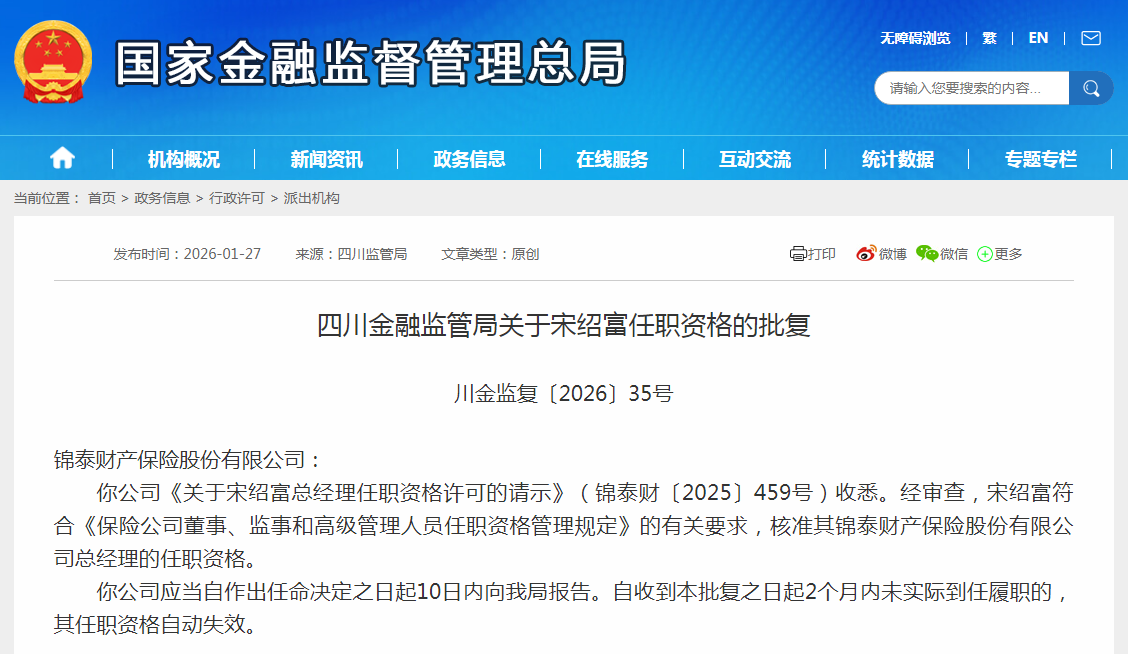
空缺两年半后,锦泰财险新任总经理就位
Guo Ji Jin Rong Bao· 2026-01-27 11:49
Group 1 - The new general manager of Jintai Property Insurance, Song Shaofu, has been approved after a vacancy of two and a half years [1][4] - Song Shaofu has extensive experience in the insurance industry, having held various positions within Jintai Property Insurance since its establishment in 2011 [5] - Jintai Property Insurance was founded in January 2011 with a registered capital of 3.188 billion yuan and is controlled by the Chengdu State-owned Assets Supervision and Administration Commission [5] Group 2 - Jintai Property Insurance has focused on capital increase and expansion, with a recent announcement confirming the subscription of 1.279 billion new shares, raising a total of 2.098 billion yuan [6] - The company plans to increase its registered capital from 1.1 billion yuan to 2.379 billion yuan, which was approved in June 2024 [6] - In July 2025, Jintai Property Insurance was approved to increase its registered capital from 2.379 billion yuan to 3.188 billion yuan through capital reserve conversion [7] Group 3 - Since its establishment, Jintai Property Insurance has seen its premium scale grow from 154 million yuan in 2011 to 2.962 billion yuan in 2024 [9] - The company achieved a net profit of 52 million yuan in 2024, marking continuous profitability since 2014 [9] - In the fourth quarter of 2025, Jintai Property Insurance reported an insurance business income of 3.25 billion yuan, a year-on-year increase of 9.75%, and a net profit of 6.8 million yuan, a nearly 30% increase [9] Group 4 - The comprehensive cost ratio for Jintai Property Insurance in the fourth quarter of 2025 was 109.11%, indicating pressure on the underwriting side [9] - The company aims to achieve accelerated growth through differentiated competition, focusing on agricultural insurance, credit guarantee insurance, liability insurance, and health insurance as key business areas [9][10] - The short-term health insurance premium income has doubled over three years, reaching 762 million yuan in 2024, although it has incurred cumulative losses of 189 million yuan [11]

神州数码集团股份有限公司第十一届董事会第二十二次会议决议公告
Shang Hai Zheng Quan Bao· 2025-11-21 19:01
证券代码:000034 证券简称:神州数码 公告编号:2025-171 神州数码集团股份有限公司第十一届董事会第二十二次会议决议公告 本公司及董事会全体成员保证公告内容的真实、准确和完整,没有虚假记载、误导性陈述或者重大遗 漏。 一、董事会会议召开情况 神州数码集团股份有限公司(以下简称"公司")第十一届董事会第二十二次会议通知于2025年11月20日 以电子邮件方式向全体董事发出,会议以传签方式于2025年11月21日形成决议。会议应当参加表决的董 事7名,实际参加表决的董事7名。本次会议的召开和表决程序符合《公司法》和《公司章程》等有关规 定。 二、董事会会议审议情况 (一)审议通过《关于控股子公司资本公积转增注册资本暨放弃权利的议案》 公司控股子公司合肥神州数码信创控股有限公司(以下简称"信创控股")拟将先前溢价融资形成的资本 公积部分转增为注册资本。公司全资子公司北京神州数码有限公司放弃参与本次转增的权利,转增完成 后,其持有信创控股的股权由79.21%变更为51%,信创控股仍为公司控股子公司。 具体内容详见同日登载于《证券时报》、《上海证券报》和巨潮资讯网(www.cninfo.com.cn)的《关 ...

“另类”增资获批,锦泰保险将位仍空缺,寻求突围靠什么
Bei Jing Shang Bao· 2025-07-10 13:32
Core Viewpoint - The recent capital increase of Jintai Insurance through capital reserve conversion signals a shift in funding strategies among insurance companies, highlighting the need for self-sustaining growth amid market challenges [1][3][4]. Group 1: Capital Increase Details - Jintai Insurance's registered capital has been approved to increase from 2.379 billion to 3.188 billion yuan through capital reserve conversion, maintaining existing shareholder ratios [3][4]. - The company plans to convert part of its capital reserve formed from stock premium issuance and asset appreciation into registered capital, with a proposed share increase of 808 million shares [3][4]. - This method of capital increase does not involve external funding but rather adjusts the internal financial structure, which is simpler and suitable for short-term capital needs [4][5]. Group 2: Financial Performance and Management Challenges - Jintai Insurance has experienced a decline in net profit, from 78 million yuan in 2023 to 52 million yuan in 2024, primarily due to deferred tax impacts [6][8]. - The company has been without a general manager for two years, which may affect operational efficiency and strategic execution [6][7]. - The comprehensive cost ratio for Jintai Insurance reached 102.68% in Q1 2025, indicating that premium income is not covering expenses, which poses risks to its solvency [8][9]. Group 3: Market Position and Strategic Focus - Jintai Insurance is focusing on diversifying its product offerings, with non-auto insurance premiums now exceeding 50% of total premiums, driven by growth in health, liability, and accident insurance [10][11]. - The company aims to enhance its competitive edge by optimizing its business structure and leveraging technology for better risk management and operational efficiency [11][12]. - Jintai Insurance is committed to a differentiated development strategy, targeting specific market segments to capture untapped opportunities while maintaining compliance and internal controls [11][12].

增资而不募资频频上演,险企“补血”模式何以生变?
Bei Jing Shang Bao· 2025-05-29 13:16
Core Viewpoint - Insurance companies are increasingly opting for capital reserve conversion to registered capital as a means of capital increase, amidst a challenging environment characterized by "capital shortages" and difficulties in equity financing [1][5]. Group 1: Capital Increase Methods - Jintai Insurance plans to convert part of its capital reserve formed from premium stock issuance into registered capital, increasing its registered capital from 2.379 billion to 3.188 billion yuan, with a total of 809 million shares to be converted [3]. - Dinghe Property Insurance has announced a similar move, increasing its registered capital from 4.643 billion to 6 billion yuan, totaling 1.357 billion yuan in capital increase [3]. - The method of capital reserve conversion differs from traditional equity financing, which typically involves new shareholder investments or additional investments from existing shareholders, leading to new capital inflows and potential changes in shareholder structure [4]. Group 2: Reasons for Choosing Capital Reserve Conversion - The capital reserve conversion method is simpler and quicker compared to traditional financing, as it does not require external fundraising [5]. - This approach helps enhance the solvency ratio and risk resistance capabilities of insurance companies, meeting regulatory requirements in a competitive and strictly regulated environment [5]. - It also improves the company's brand image and market recognition, signaling enhanced capital strength to the outside world, which can aid in business expansion and increase customer trust [5]. Group 3: Market Environment and Challenges - The current complex market environment has affected investor confidence in the insurance industry, making it difficult to attract new shareholders [6]. - Existing shareholders may face challenges in increasing their investments due to personal financial situations, making capital reserve conversion a viable alternative [6]. - However, this method tests the "self-sustaining" capabilities of insurance companies, as capital reserves are crucial equity reserves, necessitating that companies have sufficient internal resources [6].