
综合成本率

Search documents
保险行业周报(20260323-20260327):25年报综述:全年业绩向好,Q4受投资扰动-20260329
Huachuang Securities· 2026-03-29 11:29
Investment Rating - The insurance sector is rated as "Recommended," with expectations for the industry index to outperform the benchmark index by over 5% in the next 3-6 months [23]. Core Insights - The insurance sector showed overall profit growth in 2025, with a total net profit of 455.5 billion yuan from seven domestic listed insurance companies, marking a year-on-year increase of 26% [1]. - The fourth quarter was impacted by investment volatility, with only China Pacific Insurance achieving profit growth, while others faced declines [1]. - The dividend distribution varied among companies, with a total of 94.3 billion yuan in dividends, a 19% increase year-on-year, and most companies maintaining stable per-share dividends [2]. - New business value (NBV) for life insurance grew generally over 20%, driven by network expansion and improved value rates [3]. - The combined ratio (COR) for property insurance improved, although Sunshine Insurance was affected by credit insurance business [3]. - Net investment returns were influenced by declining interest rates, but equity assets positively impacted overall investment returns [4]. - The insurance sector is currently undervalued, with attractive dividend yields, and is recommended for continued attention [4]. Summary by Sections Annual Performance Overview - In 2025, the total net profit for seven listed insurance companies reached 455.5 billion yuan, with notable growth rates from China Taiping (+221%) and China Life (+44%) [1]. - The fourth quarter saw significant performance disparities, with only China Pacific Insurance reporting profit growth [1]. Dividend Distribution - Total dividends for the seven major insurance companies and China Property Insurance amounted to 94.3 billion yuan, reflecting a 19% year-on-year increase [2]. - Most companies achieved stable growth in per-share dividends, with varying dividend payout ratios [2]. New Business Value and Growth - The new business value for life insurance companies showed robust growth, with China Life at +35.7% and Ping An at +29.3% [3]. - The growth in new business value was supported by network expansion and the integration of individual insurance and health insurance [3]. Investment Returns - Net investment returns were affected by a downward trend in interest rates, but equity investments helped boost overall returns [4]. - The total investment return rates varied among companies, with China Life achieving a 6.09% return, an increase of 0.59 percentage points [4]. Market Outlook - The insurance sector is viewed as undervalued with attractive dividend yields, suggesting a favorable investment environment [4].




【华西非银】中国平安2025年报点评:OPAT实现双位数增长,资负两端表现稳健
Xin Lang Cai Jing· 2026-03-29 09:29
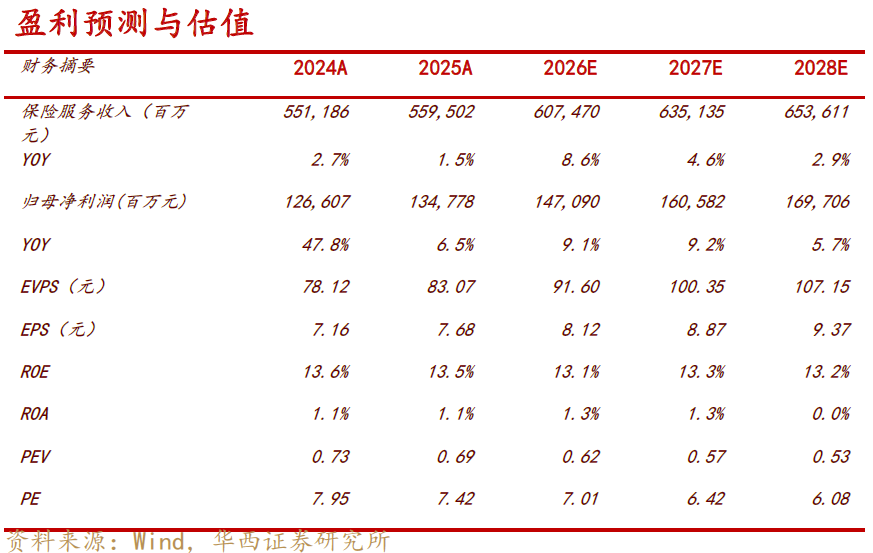
Summary of Key Points Core Viewpoint - Ping An Insurance reported a solid performance in 2025, with a notable increase in operating profit and new business value, despite challenges in the fourth quarter due to market volatility and one-time project impacts [1][2]. Financial Performance - The group achieved a parent operating profit (OPAT) of CNY 134.415 billion, up 10.3% year-on-year, with a Q4 increase of 35.3% [1]. - The net profit attributable to the parent company was CNY 134.778 billion, reflecting a year-on-year growth of 6.5%, but a significant decline of 74.1% in Q4 [1]. - The new business value (NBV) for life and health insurance reached CNY 36.897 billion, up 29.3% year-on-year [1][3]. - The combined ratio (COR) for property insurance improved to 96.8%, a 1.5 percentage point enhancement year-on-year [1][4]. Business Segments - Life and Health Insurance: - Operating profit was CNY 99.752 billion, a 2.9% increase year-on-year, driven by a 55.5% rise in investment service performance [3]. - The NBV growth was attributed to a significant increase in value rate, with the NBVM rising by 4.9 percentage points to 23.4% [3]. - The agent channel's NBV grew by 10.4%, while the bank insurance channel saw a remarkable increase of 138.0% [3]. - Property Insurance: - Operating profit reached CNY 16.923 billion, up 13.2% year-on-year, with stable growth in insurance service revenue of CNY 338.912 billion, a 3.3% increase [4]. - The overall cost ratio improved due to optimized expenses and profitability in the auto insurance segment [4]. Investment Performance - The total investment income increased by 13.5%, with a comprehensive investment return of 6.3%, up 0.5 percentage points year-on-year [5]. - The investment portfolio exceeded CNY 6.49 trillion, reflecting a 13.2% increase from the beginning of the year [5]. Dividend Distribution - The company proposed a cash dividend of CNY 1.75 per share at the end of 2025, leading to a total annual cash dividend of CNY 2.70 per share, a 5.9% increase year-on-year [1]. Future Projections - The company maintains its revenue forecasts for 2026-2027 at CNY 607.47 billion and CNY 635.135 billion, respectively, with an additional forecast for 2028 at CNY 653.611 billion [6]. - The net profit projections for 2026-2027 are set at CNY 147.09 billion and CNY 160.582 billion, with a new forecast for 2028 at CNY 169.706 billion [6].

中国财险(02328):承保利润翻倍,分红率保持稳定
Soochow Securities· 2026-03-27 09:23
Investment Rating - The investment rating for the company is "Buy" (maintained) [1] Core Insights - The company reported a significant increase in underwriting profit, which doubled, and maintained a stable dividend payout ratio [1] - The total revenue for 2025 is projected to be 550.93 billion yuan, with a year-on-year growth of 6.03% [1] - The net profit attributable to shareholders is expected to reach 40.37 billion yuan in 2025, reflecting a year-on-year increase of 25.48% [1] - The book value per share (BVPS) is projected to be 12.86 yuan, with a price-to-book (P/B) ratio of 1.03 at the current price [1] Financial Performance Summary - Total revenue (in million yuan) for 2024A is 519,570, with a projected increase to 550,926 in 2025A [1] - Net profit attributable to shareholders (in million yuan) is forecasted to grow from 32,173 in 2024A to 40,370 in 2025A [1] - The company’s comprehensive cost ratio improved to 97.5% in 2025, a decrease of 1.3 percentage points year-on-year [7] - The total investment income increased by 12.8% year-on-year, with an investment return rate of 5.8% [7][19] Business Segment Performance - The total premium income for property insurance is projected to be 555.8 billion yuan in 2025, with a year-on-year growth of 3.3% [7] - The non-auto insurance premium grew by 3.9%, with health insurance showing the fastest growth at 6.4% [7] - The auto insurance segment saw a premium increase of 2.8%, with a notable growth in new energy vehicle insurance premiums by 31.9% [7] Investment Strategy - The company has increased its allocation to bonds and equity investments, leading to a significant rise in total investment returns [7][19] - The asset allocation includes 57.6% in fixed income and 25.9% in equity, with a notable increase in the proportion of government bonds [7][19]
大家财险2025年保费破百亿,净利激增439%
Hua Er Jie Jian Wen· 2026-01-27 12:01
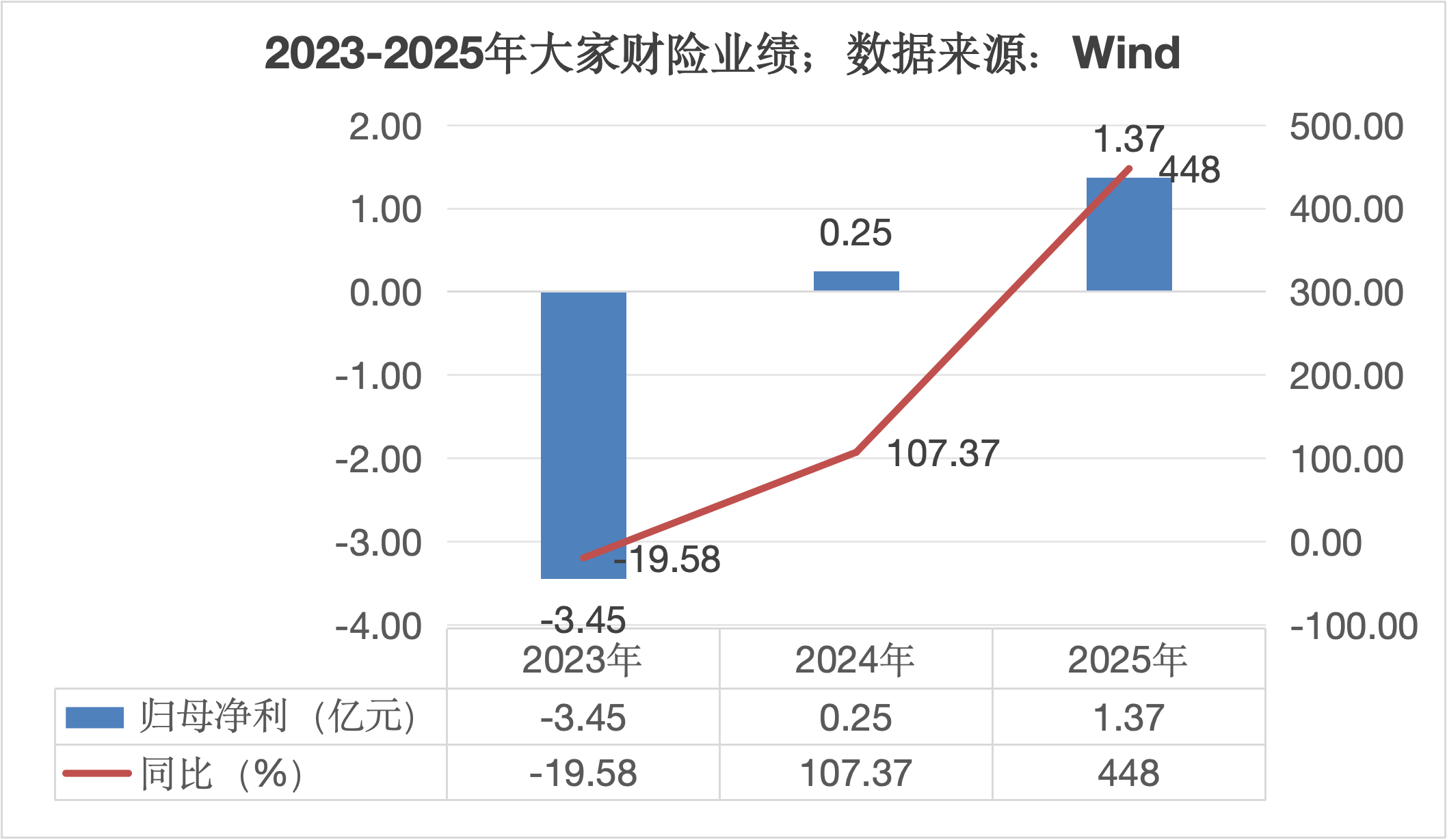
Core Insights - In 2025, Dajia Insurance achieved a significant milestone with total premiums reaching 10.648 billion yuan, marking a substantial recovery in profitability with a net profit of 137 million yuan, a 439% increase from 25.46 million yuan in 2024 [1][3] Group 1: Underwriting Performance - The company turned a profit in underwriting, reducing its combined cost ratio from 102.99% in 2024 to 99.83% in 2025, indicating a shift towards self-sustaining operations rather than relying solely on investment income [3] - The combined loss ratio improved from 62.75% to 61.03%, while the combined expense ratio was controlled at 38.81%, showcasing effective cost management amidst competitive pressures in the non-auto insurance sector [3] Group 2: Premium Growth - Dajia Insurance reported a total signed premium of 10.573 billion yuan in 2025, with auto insurance premiums accounting for 6.518 billion yuan, approximately 61.6% of the total, remaining a key revenue driver [5] - Non-auto insurance business also showed growth, with the top five non-auto insurance products generating a total premium of 1.823 billion yuan, reflecting significant year-on-year improvement [5] Group 3: Investment Performance - The financial investment yield for 2025 was 2.74%, an increase from 2.01% in 2024, but the overall investment return rate declined from 3.92% to 2.71%, indicating challenges in asset utilization efficiency [5] - Total assets reached 15.14 billion yuan, but the company needs to enhance the efficiency of fund utilization, especially given the slim profit margins from underwriting [5] Group 4: Cash Flow Situation - Although the net cash flow from operating activities turned positive in Q4 2025, the total net cash flow for the year was still negative at -190 million yuan, although this was an improvement from -790 million yuan in 2024 [6][7] - The ongoing negative cash flow indicates that the company's financial reserves are still in a recovery phase [7] Group 5: Future Outlook - 2025 is seen as a pivotal year for Dajia Insurance, crossing the survival threshold, but the management's challenge will be to effectively utilize nearly 3 billion yuan in net assets to achieve a dual-driven growth model in both investment and underwriting for 2026 [8]
业务发展步入“瓶颈期”,燕赵财险调整领导班子求变
Bei Jing Shang Bao· 2026-01-13 14:05
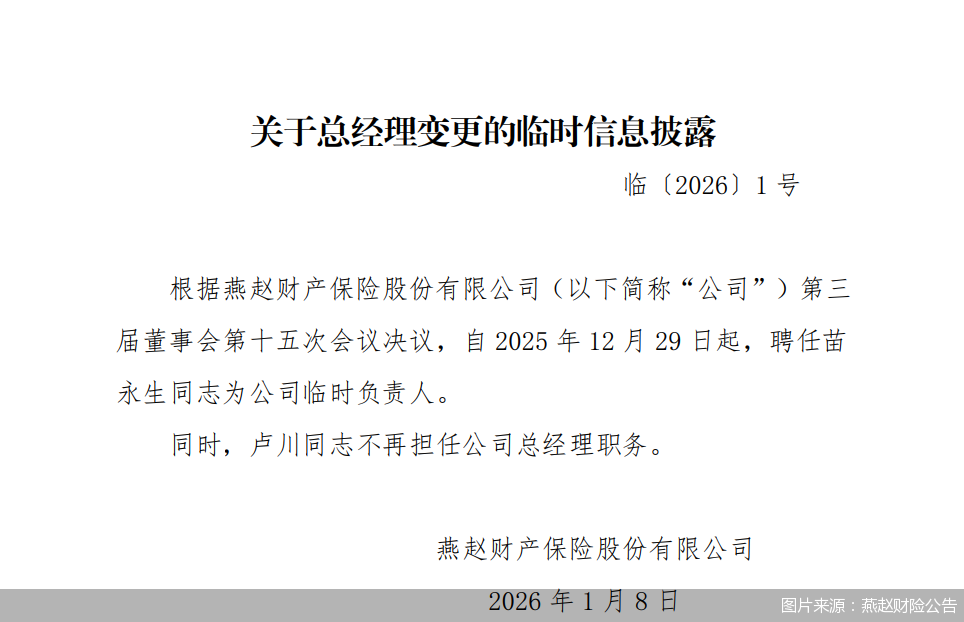
Core Viewpoint - The recent management restructuring at Yanzhao Property Insurance marks the end of the uncommon practice of having the same individual serve as both chairman and general manager, which may signal a shift towards improved corporate governance and operational efficiency [4][5]. Group 1: Management Changes - Yanzhao Property Insurance appointed Miao Yongsheng as the temporary head, replacing Lu Chuan as general manager, following a decision by the company's board [4]. - Lu Chuan previously held both the chairman and general manager positions, a practice that has been criticized for potentially weakening board oversight [5]. - The change in leadership is seen as a potential turning point for the company, which has struggled with profitability and growth [3][5]. Group 2: Company Background - Established ten years ago, Yanzhao Property Insurance is the first and only national insurance entity in Hebei Province, with a registered capital of 2.025 billion yuan [6]. - The company has significant state-owned enterprise backing, with shareholders including Hebei Construction Investment Group and Hebei Steel Group [6]. Group 3: Financial Performance - Yanzhao Property Insurance has faced challenges in achieving significant profitability, with net profits from 2019 to 2024 remaining below 0.1 billion yuan, and some years reporting losses [7]. - In the first three quarters of 2025, the company reported a net profit of 3.68 million yuan, a 51% increase year-on-year, but insurance business revenue declined by 13.67% to 1.693 billion yuan [7]. - The company's combined cost ratio was reported at 103.04%, indicating that its underwriting operations are currently unprofitable [7]. Group 4: Growth Challenges - Yanzhao Property Insurance has attempted to raise capital to expand its operations, with a failed attempt to raise 3 billion yuan in 2020 [8]. - The company currently operates only two provincial branches, limiting its market reach and growth potential [8]. - The external economic environment and increasing market competition pose significant challenges for the company in maintaining cash flow and achieving operational efficiency [8].
没出险续保却“涨了超千元” 消费者遭遇车险保费“逆向”调价
Shang Hai Zheng Quan Bao· 2026-01-05 18:28
Core Viewpoint - The recent increase in car insurance premiums, even for claim-free drivers, is attributed to regulatory changes aimed at reducing aggressive price competition among insurers, which may lead to dissatisfaction among "good drivers" [2][5][7] Group 1: Premium Increases - Many drivers, including those in regions like Hunan and Sichuan, have reported significant increases in their car insurance premiums despite having no claims, breaking the previous norm where premiums would typically decrease for claim-free drivers [2][3] - For example, one driver experienced a premium increase of approximately 46.28%, with the coverage amount decreasing from about 170,000 yuan to 150,000 yuan [3][4] - Insurers are now applying a higher pricing coefficient for car insurance, which affects all drivers regardless of their claim history, leading to a general rise in premiums [4][6] Group 2: Industry Factors - The rise in premiums is influenced by industry-wide measures to prevent excessive low-price competition, which has led to a reduction in discount offerings for car insurance [5][6] - Regulatory changes have also tightened the requirements for insurers regarding commission practices, further limiting their ability to offer competitive pricing [5][6] - The overall cost ratio for the car insurance industry is approximately 97.9%, indicating that many insurers are operating at a loss, particularly smaller firms [6] Group 3: Consumer Impact - The increase in premiums may lead some consumers to forgo purchasing comprehensive insurance, opting only for mandatory liability insurance instead [7][8] - There is a concern that the uniform increase in premiums could undermine the incentive structure for safe driving, potentially leading to a loss of trust in the insurance system [7][8] - Industry experts suggest that clearer communication regarding discounts and pricing structures could help alleviate consumer concerns and maintain confidence in the insurance market [8]
中国财险(02328):承保投资皆优秀,后续承保催化剂较多
Hua Yuan Zheng Quan· 2025-11-07 13:19
Investment Rating - The investment rating for the company is "Buy" (maintained) [4] Core Views - The company has demonstrated excellent underwriting performance, with a comprehensive cost ratio (COR) improving by 2.1 percentage points year-on-year to 96.1% for the first three quarters of 2025. Total investment income increased by 33% year-on-year to 35.9 billion yuan, contributing to a net profit growth of 50.5% to 40.3 billion yuan [5][7] - The company’s original premium income grew by 3.5% year-on-year to 443.2 billion yuan, maintaining a steady performance. The underwriting profit for Q3 2025 was approximately 1.85 billion yuan, a significant improvement from a loss of 2.56 billion yuan in the same period last year [7] - The company’s total investment income for the first three quarters was 35.9 billion yuan, with Q3 alone contributing 18.6 billion yuan, surpassing the total for the first half of 2025 [7] - Future underwriting performance is expected to improve due to regulatory changes and adjustments in pricing for new energy vehicles, which may enhance underwriting profits [7] Summary by Sections Financial Performance - For the first three quarters of 2025, the company achieved a net profit of 40.3 billion yuan, a 50.5% increase year-on-year. The total investment income reached 35.9 billion yuan, with a quarterly total of 18.6 billion yuan [5][7] - The company’s comprehensive cost ratio improved to 96.1%, and the annualized total investment return increased by 0.6 percentage points to 5.4% [5][7] Future Outlook - The company is expected to benefit from new regulatory measures that will lower the comprehensive cost ratio for non-auto insurance products. Additionally, the implementation of differentiated pricing for new energy vehicles is anticipated to enhance profitability [7] - Forecasted net profits for 2025-2027 are 46.8 billion yuan, 52.4 billion yuan, and 57.6 billion yuan, with year-on-year growth rates of 45.5%, 12.0%, and 9.8% respectively [7]
赚麻了!五大上市保险公司日赚15.6亿元,三季报何以狂飙?
Feng Huang Wang Cai Jing· 2025-11-07 10:46
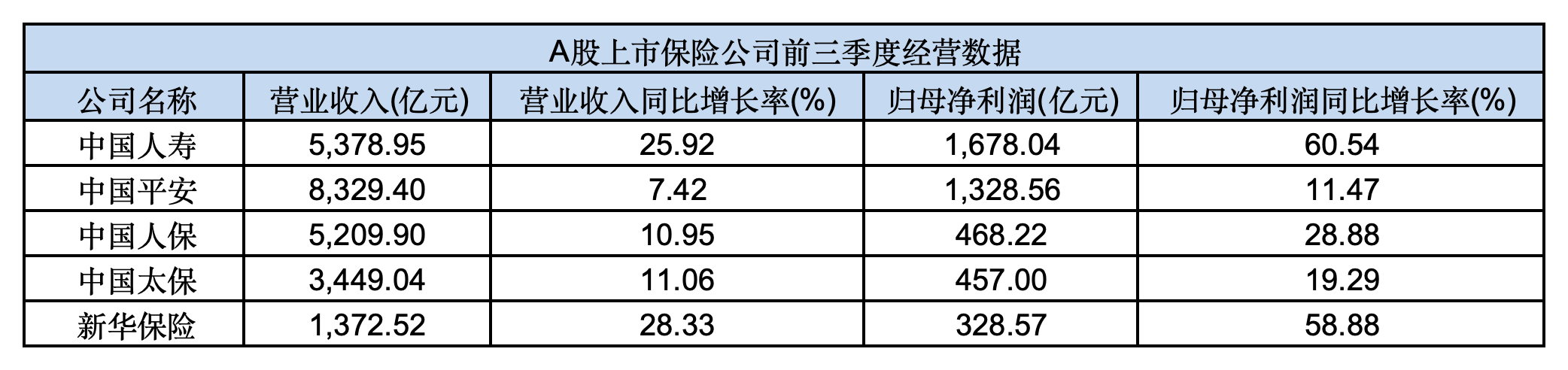
Core Insights - The five major listed insurance companies in China reported significant profit growth in the first three quarters, with all companies achieving a year-on-year increase in net profit exceeding double digits, the highest being 60.5% [1][2]. Financial Performance - Total operating revenue for the five insurance companies reached 23,739.81 billion yuan, a year-on-year increase of 13.6% [1]. - Combined net profit for these companies was 4,260.39 billion yuan, reflecting a year-on-year growth of 33.54%, equivalent to an average daily profit of 1.56 billion yuan [1]. - China Life led with a net profit of 1,678.04 billion yuan, marking a 60.54% increase, while China Ping An followed with 1,328.56 billion yuan, up 11.47% [2]. Investment Performance - Investment income surged, with China Life reporting total investment income of 3,685.51 billion yuan, a 41.0% increase, and an investment return rate of 6.42% [4]. - The recovery of the capital market, particularly in equity markets, significantly contributed to the increase in investment income, with the Shanghai Composite Index and Shenzhen Component Index rising by 15.84% and 29.88%, respectively [4]. Liability Management - The new business value in life insurance showed substantial growth, with China Life and New China Life reporting increases of 41.8% and 50.6%, respectively [5]. - The comprehensive cost ratio for property insurance companies generally decreased, with China Property & Casualty Insurance achieving a cost ratio of 96.1%, down 2.1 percentage points [6]. Market Dynamics - The performance of the five major insurance companies indicates a clear improvement in the overall industry fundamentals, although there is noticeable differentiation among companies [8]. - China Life solidified its position as the leader in life insurance, while PICC Property & Casualty showed the highest optimization in cost ratio, indicating a potential for continued leadership in the property insurance sector [9][10]. Future Outlook - The upcoming implementation of the "fourth life table" in 2026 presents both challenges and opportunities for insurance companies in terms of pricing and product innovation [13]. - The anticipated sales surge in certain insurance products before the life table transition may provide short-term growth opportunities for insurers [13].

上市险企财险业务前三季度向好:车险“压舱石”稳固 非车险质效提升
Jin Rong Shi Bao· 2025-11-05 09:23
Core Insights - The three major property insurance companies in China, namely PICC Property and Casualty, Ping An Property and Casualty, and Taiping Property and Casualty, reported a total original insurance premium income of 859.635 billion yuan for the first three quarters of 2025, reflecting a year-on-year growth of 3.85% [1] Group 1: Premium Income Growth - The core driver of premium income remains the auto insurance sector, which continues to show stable growth, accounting for a significant portion of total premiums [2] - Specifically, PICC's auto insurance premium income reached 220.119 billion yuan, a year-on-year increase of 3.1%, representing 49.67% of its total premium income; Ping An's auto insurance premium was 166.116 billion yuan, up 3.5%, making up 64.83%; Taiping's auto insurance premium was 80.461 billion yuan, with a growth of 2.9%, accounting for 50.22% [2] - Non-auto insurance premium performance varied among the three companies, with PICC and Ping An showing positive growth, while Taiping experienced a decline due to proactive business structure adjustments [2] Group 2: Non-Auto Insurance Trends - The health insurance sector is experiencing rapid growth, driven by product innovation and adaptability to internet channels, contributing significantly to premium income [3] - For instance, PICC's accident and health insurance premiums totaled 98.826 billion yuan, marking an 8.4% increase, the highest among all insurance types; corporate property insurance premiums were 14.869 billion yuan, up 5.1%; while agricultural insurance premiums fell by 3.1% to 52.191 billion yuan [3] Group 3: Improvement in Comprehensive Cost Ratio - The comprehensive cost ratio, a key indicator of underwriting profitability, has shown improvement across the three major companies [4] - PICC's comprehensive cost ratio was 96.1%, down 2.1 percentage points year-on-year; Ping An's was 97.0%, down 0.8 percentage points; and Taiping's was 97.6%, down 1.0 percentage point [4] - The decline in the comprehensive cost ratio has led to PICC achieving an underwriting profit of 14.865 billion yuan, a significant year-on-year increase of 130.7% [4] Group 4: Regulatory Environment and Future Outlook - Despite the increasing contribution of non-auto insurance to premium income, its overall profitability remains lower than that of auto insurance, posing a challenge for the industry [5] - The regulatory authority has mandated stricter rate management and adherence to approved insurance terms and rates for non-auto insurance, which is expected to lead to a reduction in expense ratios starting November 1 [5] - The anticipated implementation of these regulations is expected to maintain a positive trend in the comprehensive cost ratio for the year, thereby supporting performance growth for the three major companies [5]
车险“压舱石”稳固 非车险质效提升
Jin Rong Shi Bao· 2025-11-05 00:59
Core Insights - The overall premium income of the three major property insurance companies in China reached 859.635 billion yuan in the first three quarters of 2025, reflecting a year-on-year growth of 3.85%, indicating a steady growth trend [1][2] Group 1: Premium Income Growth - The auto insurance business remains a key driver for premium income, with all three companies showing positive growth in this segment, accounting for a significant portion of total premiums [2] - Specifically, China People's Insurance Company (CPIC) reported auto insurance premium income of 220.119 billion yuan, up 3.1% year-on-year, representing 49.67% of its total premium income; Ping An Property & Casualty reported 166.116 billion yuan, up 3.5%, accounting for 64.83%; and China Pacific Insurance reported 80.461 billion yuan, up 2.9%, making up 50.22% [2] - Non-auto insurance performance varied among the three companies, with CPIC and Ping An showing positive growth, while China Pacific experienced a decline due to proactive business restructuring [2][3] Group 2: Non-Auto Insurance Trends - The health insurance segment is growing rapidly, driven by product innovation and adaptability to internet channels, contributing significantly to premium income [3] - For CPIC, the premium income from accident and health insurance reached 98.826 billion yuan, growing 8.4% year-on-year, the highest among all insurance types; corporate property insurance grew by 5.1% to 14.869 billion yuan; while agricultural insurance saw a decline of 3.1% [3] Group 3: Improvement in Combined Cost Ratio - The combined cost ratio, a key indicator of underwriting profitability, showed improvement across all three companies [4] - CPIC's combined cost ratio was 96.1%, down 2.1 percentage points year-on-year; Ping An's was 97.0%, down 0.8 percentage points; and China Pacific's was 97.6%, down 1.0 percentage point [4] - The decrease in combined cost ratio led to CPIC achieving an underwriting profit of 14.865 billion yuan, a significant increase of 130.7% year-on-year [4] Group 4: Regulatory Changes and Future Outlook - Despite the increasing contribution of non-auto insurance to premium income, its overall profitability remains lower than that of auto insurance, posing a challenge for the industry [5] - The regulatory authority has mandated stricter rate management and adherence to approved insurance terms and rates for non-auto insurance, effective November 1, which is expected to lower industry expense ratios and support performance growth for the three major companies [6]