资本开支传导路径

Search documents
从海外云巨头财报看AI发展趋势——CAPEX激增下的增长逻辑与传导路径
Sou Hu Cai Jing· 2025-11-18 09:28
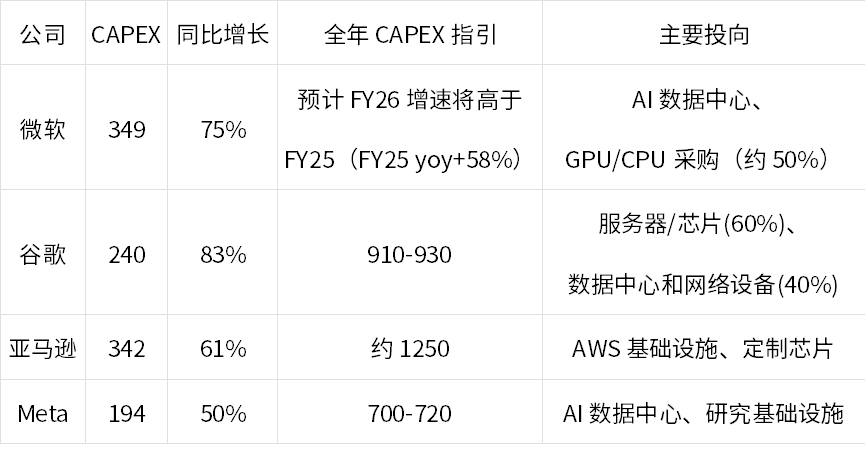
Group 1: Capital Expenditure Analysis - In Q3 2025, the four major cloud service providers (CSPs) - Amazon (AWS), Microsoft (Azure), Google (GCP), and Meta - experienced unprecedented capital expenditure (CAPEX) expansion driven by AI, with a total CAPEX nearing $120 billion, reflecting a year-on-year growth rate exceeding 50% [1] - Microsoft led with a CAPEX of $34.9 billion, a 75% increase year-on-year, focusing on AI data centers and GPU/CPU procurement [1] - Google followed with $24 billion in CAPEX, an 83% increase, with 60% directed towards servers and chips [1] Group 2: CAPEX to Revenue Transmission Path - The transformation of cloud business capital expenditure into revenue is a multi-stage, non-linear process involving capacity construction, revenue conversion, and profit optimization [2] Group 3: Capacity Building Phase - The initial phase focuses on building physical infrastructure, with investments concentrated on data center construction, AI chip procurement, and high-speed network deployment [3] - Key indicators in this phase are physical capacity metrics rather than financial data, highlighting the urgency of AI computing power demand [3] Group 4: Revenue Conversion Phase - Once capacity is built, the monetization phase begins, converting available capacity into revenue through traditional cloud services, AI infrastructure services, and AI application services [4][5] - The efficiency in this phase is determined by capacity utilization and revenue conversion rates [4] Group 5: Scale Effect Phase - The third phase focuses on maximizing profits through scale effects, achieved by diluting fixed costs, increasing the share of high-margin services, and optimizing pricing strategies [6][7] - The overall logic chain of cloud business CAPEX transmission is "capital investment → capacity formation → efficient monetization" [7] Group 6: Cloud Business Performance - In Q3 2025, cloud business growth was strong, with Microsoft reporting $30.9 billion in intelligent cloud revenue, a 28% year-on-year increase, driven by increased capacity and large client orders [8][10] - Google Cloud's revenue reached $15.2 billion, a 33.5% increase, with a significant improvement in operating profit margin to 23.7% [8][10] - Amazon AWS achieved $33 billion in revenue, a 20% increase, with a notable order backlog of $20 billion [9][11] Group 7: Challenges in AI Cloud Services - The industry faces a severe supply-demand imbalance, with AI computing power demand growing exponentially while infrastructure development lags [12] - Profitability pressures are increasing, with varying operating profit margins among CSPs, highlighting concerns over the sustainability of high capital expenditures [13] - Two strategic paths have emerged among leading AI cloud providers: "full-stack self-research" and "cloud + ecosystem," each with distinct advantages and challenges [14] Group 8: Conclusions and Insights - The global cloud computing industry is transitioning from "scale-driven" to "quality-driven," with AI significantly enhancing growth elasticity while testing capital efficiency [18] - Short-term focus should be on AI conversion efficiency and profitability structure, while long-term considerations should include technology routes and strategic resilience [17][18] - Future investment logic will favor companies with strong capital discipline and clear commercialization paths [18]