GCP

Search documents
AI资本开支恐慌见顶?科技巨头或进入"兑现周期"
美股研究社· 2026-03-05 13:50
Core Viewpoint - The article emphasizes that significant capital expenditures often lead to market panic, but historical trends indicate that true turning points in technology industries emerge after the "most expensive investment phase" [1][3]. Group 1: Capital Expenditure Surge - The four major tech giants—Amazon, Alphabet, Meta, and Microsoft—reported a staggering 66% year-on-year increase in capital expenditures, surpassing $200 billion in total [6][3]. - This surge in capital spending is primarily directed towards data center construction, GPU server procurement, power system upgrades, and network infrastructure expansion [6][3]. - For instance, Meta raised its 2025 capital expenditure guidance from $30 billion to $40 billion, resulting in a drop in free cash flow from 35% to 18% [7]. Group 2: Historical Context and Market Reactions - Historical examples, such as the fiber optic construction cycle around 2000 and the mobile internet boom post-2010, show that initial market concerns about overcapacity often give way to significant long-term growth [9][8]. - The current anxiety in the market is reminiscent of past cycles, where initial high capital expenditures led to skepticism about demand matching supply [9][8]. Group 3: Transition to Profitability - The article suggests that the market's focus will shift from "who spends the most" to "who earns the fastest" as capital expenditure growth begins to slow [12][19]. - Analysts believe that the AI arms race is currently in a phase of infrastructure development rather than profitability, indicating that the true commercial value will be realized once the foundational investments are in place [9][10]. Group 4: Future Investment Dynamics - As the infrastructure for AI becomes established, the investment logic will transition from hardware to software and services, marking a shift from "selling shovels" to "gold mining" [15][14]. - Companies like Apple are maintaining financial flexibility by avoiding massive data center investments, while also leveraging AI capabilities through device upgrades and subscription services [16]. Group 5: Key Indicators for Investment - The article highlights the importance of identifying efficiency turning points, such as when AI service revenue growth surpasses capital expenditure growth, as critical indicators for the next investment phase [22][21]. - The transition from the first phase of explosive capital spending to the second phase of revenue realization is anticipated to occur within the next 12-24 months [19][20].



今夜 科技股大涨 白银暴涨
Zhong Guo Ji Jin Bao· 2026-02-09 16:16
Market Performance - US stock indices opened lower but rebounded, with the Dow Jones turning positive, the Nasdaq rising approximately 0.8%, and the S&P 500 increasing about 0.5% [1] - Following a significant drop in tech stocks due to AI concerns, technology companies rebounded, contributing to the market's rise ahead of key economic data releases that will influence Federal Reserve policy outlook [2] Company Highlights - Nvidia's stock surged over 3%, while Oracle's stock saw an increase of over 10% [2] - Oracle's stock rise was primarily driven by an upgrade in rating from D.A. Davidson [4] - Applovin Corporation's stock increased by 12.36%, while other notable tech stocks like AMD, Broadcom, and Microsoft also saw gains [3] Capital Expenditure Insights - UBS's Chief Investment Officer David Lefkowitz noted negative market reactions to Amazon and Alphabet's capital expenditure guidance, which was "significantly above" market expectations, overshadowing their strong cloud business growth [5] - Nvidia's CEO Jensen Huang highlighted the "extremely strong" demand for computing power, indicating that the tech industry is justifiably increasing investments in AI infrastructure [5] - Analysts believe that capital expenditures for large-scale cloud providers still have room for growth, with Morgan Stanley reporting that the growth in token processing volume is accelerating cloud revenue for GCP, AWS, and Azure [5] Precious Metals - Spot silver surged over 6%, while spot gold rose nearly 2% [5]






2026 年软件展望:静候岸边,乘 AI 浪潮而起-26 Software Playbook – Waiting Patiently on Shore to Ride the AI Waves
2026-01-08 10:42
Summary of Software Equity Research Conference Call Industry Overview - The software sector is currently experiencing a deceleration in growth, lagging behind other sectors such as semiconductors. The recommendation is to stay underweight in software investments as AI monetization is expected to be gradual, with significant growth contributions needed to alleviate fears of AI disintermediation [1][2][14]. Key Companies and Recommendations Mega Cap - **Microsoft (MSFT)**: Rated Buy with a price target of $675. Expected to benefit from strong AI tailwinds and backlog growth, with potential EPS exceeding $22 by FY28 [54]. - **Meta (META)**: Rated Buy with a price target of $910. Anticipated to outperform due to AI investments and potential revenue growth from WhatsApp and other platforms [58]. Large Cap - **Amazon (AMZN)**: Rated Buy with a price target of $300, up from $275. Expected to recover from underperformance in 2025, with AWS sales accelerating due to improved AI capabilities [55]. - **Oracle (ORCL)**: Rated Buy with a price target of $400. Positioned to benefit from AI workloads and a significant backlog, despite concerns over AI-related debt [67]. Mid Cap - **Intuit (INTU)**: Rated Buy with a price target of $850. Strong historical performance and potential for growth in tax and small business software [61]. - **Unity (U)**: Rated Buy with a price target of $55. Expected to leverage AI for ad targeting, with significant growth potential [70]. Small Cap - **Upwork (UPWK)**: Rated Buy with a price target of $27. Anticipated topline acceleration after several negative quarters, supported by AI project tailwinds [73]. Core Insights - The software sector is expected to see a rotation from infrastructure to application software in the second half of 2026, with improved sentiment anticipated for application software [2][14]. - AI spending is a critical theme, with expectations that 2026 will see more AI projects moving to production, leading to tangible ROI [44][45]. - The overall sector valuation has returned to historical averages, indicating potential for multiple expansions as AI monetization begins to lift growth [41]. Additional Notable Points - Concerns about AI spending bubbles and debt funding needs have emerged, particularly in the second half of the year [28]. - M&A activity in the software sector is expected to accelerate, driven by low multiples and interest rates [18]. - The sentiment around application software is currently negative but is expected to improve as AI-driven monetization becomes more evident [45]. Conclusion - The software sector is in a transitional phase, with a focus on AI and infrastructure. Investors are advised to be selective, favoring large-cap companies with strong positions in AI and infrastructure while remaining cautious about application software until sentiment improves.


国联民生证券:从全球科技巨头最新财报看AI泡沫论
Xin Lang Cai Jing· 2025-12-01 11:20
Core Viewpoint - The Chicago Federal Reserve President Goolsbee warns of signs of speculative bubbles in the AI investment frenzy, highlighting a significant gap between capital expenditures (CapEx) and AI revenue growth among leading tech companies [3]. Group 1: AI Investment and CapEx Trends - Leading tech companies are experiencing accelerated capital expenditures, with a combined CapEx exceeding $100 billion in Q3 2025, and expectations for continued growth into 2026 [4][7]. - Major companies like Google and Meta have revised their 2025 CapEx guidance upwards, indicating strong investment in AI infrastructure [7]. - The anticipated CapEx for Amazon in 2025 is approximately $125 billion, with expectations for further increases in 2026 [7]. Group 2: AI Revenue Growth and Business Impact - AI is significantly enhancing the cloud, e-commerce, and advertising sectors for leading tech companies, with Meta reporting a 30% increase in Instagram usage and a 14% reduction in cost per lead for advertisers using AI tools [9]. - Microsoft has seen a three-digit percentage increase in commercial orders, with AI functionalities reaching 900 million monthly active users [9]. - Google's AI-related product revenue has surged by over 200% year-on-year, while Amazon's AWS revenue growth has reached its highest level in 11 quarters at 20.2% [9]. Group 3: Concerns Over AI Bubble and ROI - Market concerns regarding an AI bubble stem from the mismatch between accelerating CapEx and lagging revenue recovery, with CapEx serving as a leading indicator [5][11]. - The analysis suggests that as initial CapEx investments materialize, AI revenue is beginning to accelerate, with a focus on the "scissors difference" between AI revenue and depreciation [11][12]. - Key observation points for the future include the transition from infrastructure to application realization, particularly in areas like Google Cloud Platform (GCP), Microsoft Azure, and Amazon AWS [12]. Group 4: Investment Outlook - The outlook for AI remains positive, with expectations of continued revenue acceleration among the top four tech companies, and ongoing improvements in technology and efficiency [6][13]. - The investment community is encouraged to focus on specific companies such as Google, NVIDIA, Broadcom, and LITE as potential beneficiaries of the AI growth trend [6].


Ellerbroek: "So Many Strengths" in GOOGL A.I., AMZN "Most Underappreciated" Play
Youtube· 2025-11-25 23:00
Core Insights - The discussion centers around the implications of Meta's potential acquisition of Google's Tensor Processing Units (TPUs) and its impact on the AI chip market, particularly concerning competitors like Nvidia and AMD [2][3][4][8]. Group 1: Meta and Google's Deal - Access to Google's AI accelerator chips is seen as beneficial for Meta, as it could provide a cost-effective alternative to Nvidia's chips, despite slightly lower performance [2][3]. - The deal poses a greater threat to AMD than to Nvidia, as AMD holds a weaker position in the market compared to Nvidia [3][7][8]. - Google's recent tripling of Nvidia chip purchases indicates its recognition of Nvidia's superior performance, yet the TPUs remain valuable for specific applications like inferencing [8]. Group 2: Market Dynamics and Competitors - Microsoft's stock has been negatively impacted by concerns regarding OpenAI's competitive position against Google's Gemini, which is reportedly outperforming OpenAI's latest model [10][12]. - Oracle's stock has also suffered due to its strong ties with OpenAI, leading to a significant decline in its stock price [13]. - Despite recent stock declines, Microsoft's overall market position and revenue growth remain strong, particularly in its Azure and software businesses [12][18]. Group 3: Alphabet's Performance - Alphabet's stock has surged approximately 92% over the last six months, nearing a $4 trillion market cap, making it a standout performer among major tech companies [14][15]. - The company's strengths in AI, including leading foundation models and unmatched consumer market distribution, have been increasingly recognized by the market [16][18]. - Alphabet's growth was previously underestimated due to regulatory challenges, but these have since been resolved, leading to a significant stock rally [18]. Group 4: Amazon's Position - Amazon is viewed as an underappreciated player in the AI and cloud computing space, similar to Alphabet's previous position before resolving legal issues [19][20]. - The company has developed its own internal chip program and leads in cloud computing for businesses and government [20][21]. - Amazon's retail business is experiencing rapid growth, supported by automation and robotics, positioning it as a strong AI winner with attractive valuations [21][22].

从海外云巨头财报看AI发展趋势——CAPEX激增下的增长逻辑与传导路径
Sou Hu Cai Jing· 2025-11-18 09:28
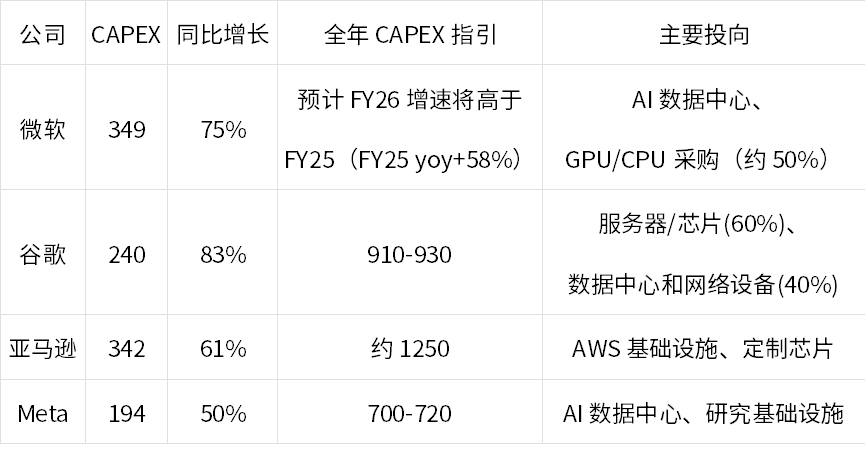
Group 1: Capital Expenditure Analysis - In Q3 2025, the four major cloud service providers (CSPs) - Amazon (AWS), Microsoft (Azure), Google (GCP), and Meta - experienced unprecedented capital expenditure (CAPEX) expansion driven by AI, with a total CAPEX nearing $120 billion, reflecting a year-on-year growth rate exceeding 50% [1] - Microsoft led with a CAPEX of $34.9 billion, a 75% increase year-on-year, focusing on AI data centers and GPU/CPU procurement [1] - Google followed with $24 billion in CAPEX, an 83% increase, with 60% directed towards servers and chips [1] Group 2: CAPEX to Revenue Transmission Path - The transformation of cloud business capital expenditure into revenue is a multi-stage, non-linear process involving capacity construction, revenue conversion, and profit optimization [2] Group 3: Capacity Building Phase - The initial phase focuses on building physical infrastructure, with investments concentrated on data center construction, AI chip procurement, and high-speed network deployment [3] - Key indicators in this phase are physical capacity metrics rather than financial data, highlighting the urgency of AI computing power demand [3] Group 4: Revenue Conversion Phase - Once capacity is built, the monetization phase begins, converting available capacity into revenue through traditional cloud services, AI infrastructure services, and AI application services [4][5] - The efficiency in this phase is determined by capacity utilization and revenue conversion rates [4] Group 5: Scale Effect Phase - The third phase focuses on maximizing profits through scale effects, achieved by diluting fixed costs, increasing the share of high-margin services, and optimizing pricing strategies [6][7] - The overall logic chain of cloud business CAPEX transmission is "capital investment → capacity formation → efficient monetization" [7] Group 6: Cloud Business Performance - In Q3 2025, cloud business growth was strong, with Microsoft reporting $30.9 billion in intelligent cloud revenue, a 28% year-on-year increase, driven by increased capacity and large client orders [8][10] - Google Cloud's revenue reached $15.2 billion, a 33.5% increase, with a significant improvement in operating profit margin to 23.7% [8][10] - Amazon AWS achieved $33 billion in revenue, a 20% increase, with a notable order backlog of $20 billion [9][11] Group 7: Challenges in AI Cloud Services - The industry faces a severe supply-demand imbalance, with AI computing power demand growing exponentially while infrastructure development lags [12] - Profitability pressures are increasing, with varying operating profit margins among CSPs, highlighting concerns over the sustainability of high capital expenditures [13] - Two strategic paths have emerged among leading AI cloud providers: "full-stack self-research" and "cloud + ecosystem," each with distinct advantages and challenges [14] Group 8: Conclusions and Insights - The global cloud computing industry is transitioning from "scale-driven" to "quality-driven," with AI significantly enhancing growth elasticity while testing capital efficiency [18] - Short-term focus should be on AI conversion efficiency and profitability structure, while long-term considerations should include technology routes and strategic resilience [17][18] - Future investment logic will favor companies with strong capital discipline and clear commercialization paths [18]
十月AI行业复盘:云商仍在追加CapEx投入,模型商业化有望加速,全面看好国内AI产业链
Changjiang Securities· 2025-11-10 15:21
Investment Rating - The report maintains a "Positive" investment rating for the software and services industry [11]. Core Insights - Major overseas cloud service providers (CSPs) continue to increase capital expenditures (CapEx) to meet strong downstream demand, with expectations of sustained AI computing power demand through 2026 [3][19]. - The report expresses a comprehensive positive outlook on the domestic AI industry chain, highlighting the internet sector as a key player and domestic computing power as a flexible direction [3][9]. Summary by Sections Financial Performance of Major CSPs - In Q3 2025, major CSPs reported robust revenue growth, with Microsoft achieving $77.7 billion in revenue (YoY +18%), Google at $102.3 billion (YoY +16%), Meta at $51.2 billion (YoY +26%), and Amazon at $180.2 billion (YoY +13%) [6][20]. - The overall revenue for the four major CSPs reached approximately $411.4 billion, a 16% increase YoY, with a net profit of about $86.6 billion, growing 6% YoY [20]. Capital Expenditure Trends - CSPs are significantly increasing their CapEx, with Microsoft at $34.9 billion (YoY +75%), Google at $24.0 billion (YoY +83%), Meta at $19.4 billion (YoY +111%), and Amazon at approximately $35.1 billion (YoY +55%) in Q3 2025 [7][26]. - The total CapEx for the four major CSPs is expected to exceed $360 billion in 2025, reflecting a nearly 60% YoY growth [28]. AI Model Commercialization - Anthropic has raised its revenue forecast for the year by approximately 26% to $4.7 billion (about 33.5 billion yuan), with a projected 1134% YoY growth [8]. - OpenAI is accelerating its commercialization efforts, focusing on creating an AI operating system and maximizing computing power infrastructure [8][9]. Investment Recommendations - The report suggests focusing on leading domestic computing power chains and internet giants poised for a second surge driven by AI [9].
海外AI落地加速,软件侧全球共振正当时
Guotou Securities· 2025-11-02 07:08
Investment Rating - The industry investment rating is "Outperform the Market - A" and the rating is maintained [6] Core Insights - The report highlights that overseas AI implementation is accelerating, with a global resonance in the software sector [1] - IDC's leading orders have reached a historical high, with plans to double capacity by 2029 to meet the demand of over 900MW retail and xScale customers [1] - North American cloud providers are showing positive Capex guidance, with significant growth in cloud business [2][3][4] - ServiceNow's performance exceeded expectations, with AI contracts projected to reach $1 billion by 2026 [4] Summary by Sections Industry Insights - In Q3 2025, Equinix reported revenue of $2.32 billion, a year-on-year increase of 5%, with total bookings reaching a historical high of $394 million [1] - Google reported Q3 2025 revenue of $31.2 billion, a 9% year-on-year increase, with cloud revenue growing by 34% [2] - Microsoft achieved Q1 FY26 revenue of $77.7 billion, an 18% year-on-year increase, with cloud revenue exceeding $49 billion [2] - Amazon's Q3 2025 revenue was $180.2 billion, a 12% increase, with AWS revenue growing by 20.2% [3] - Meta's Q3 2025 revenue reached $51.2 billion, a 26% increase, driven by advertising revenue growth [3] Performance Metrics - ServiceNow's Q3 2025 subscription revenue was $2.599 billion, a 21.5% year-on-year increase, with cRPO at $11.35 billion [4] - The report suggests focusing on AI-related stocks in the US market, such as Salesforce, Vertiv, and Coreweave [4][16] Market Review - The report notes that the computer sector outperformed the Shanghai Composite Index by 2.55% this week [17] - The computer sector index increased by 2.66% year-to-date, significantly outperforming the overall market [18]
'Fast Money' traders react to Amazon Q3 results
Youtube· 2025-10-30 21:37
Core Insights - Amazon's recent performance has exceeded expectations, particularly in its AWS segment, which has shown a 17% year-over-year growth, indicating operational improvements and market resilience [6][7][8] - The company's operating margin has improved significantly, reaching 12%, which reflects effective management and strategic positioning [1][8] - Despite being a laggard compared to the S&P 500 and NASDAQ 100, Amazon is now positioned to catch up, as it has cleared previous highs in stock performance [3][10][13] AWS Performance - AWS has demonstrated faster-than-expected growth, alleviating concerns about competition from Google and Microsoft [5][7] - The cloud segment's growth is crucial for Amazon, especially in the context of ongoing discussions about AI and its market implications [4][5] - AWS maintains a larger market share compared to its competitors, despite their faster growth rates [7] Advertising Business - Amazon's advertising segment has been a significant contributor to its margins, but there are concerns about future pressures from competitors like OpenAI [8][9] - The potential increase in Prime subscription fees in 2026 could provide additional revenue streams, enhancing operational efficiencies [6] Market Positioning - Amazon's stock has underperformed relative to broader market indices over the past four years, with a 30% increase compared to the S&P's 100% and NASDAQ's 150% [10][12] - The current market dynamics suggest a potential for Amazon to regain some of its lost ground, as it is now seen as a better performer following recent earnings [10][13]

AWS Outage Exposes Cracks in Amazon's Cloud Lead
Youtube· 2025-10-24 19:32
Core Insights - Amazon is no longer the sole leader in cloud computing, facing credible competition from Oracle and Google, in addition to Microsoft [1] - Amazon's market share in traditional cloud computing has decreased to approximately 38%, down from nearly 50% five or six years ago [2] - The emergence of competitors offering similar services has commoditized some of Amazon's pioneering offerings [2] Competitive Landscape - Companies like Microsoft, Google Cloud Platform (GCP), and Oracle are making significant inroads into Amazon's market share [2] - The partnership with Anthropic, a key AI customer, highlights the competitive dynamics, as Anthropic is co-developing AI technology with Amazon [3] - The potential for Anthropic to shift towards Google due to better technology results poses a risk to Amazon's business [4]