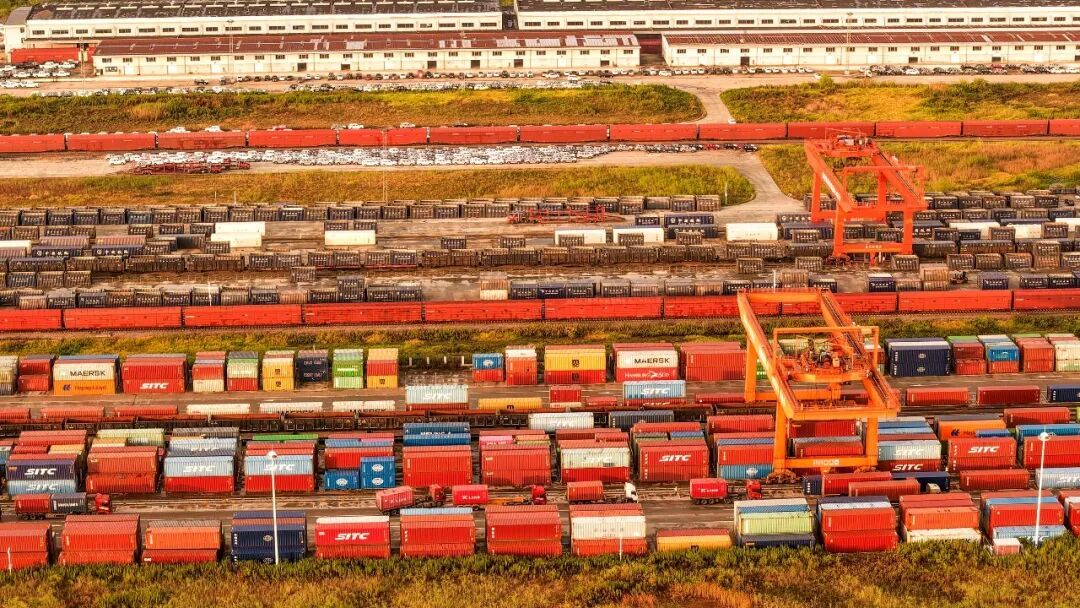
跨境物流运输

Search documents
前11月国家铁路发送货物37.27亿吨 同比增长2.7%
Ren Min Ri Bao· 2025-12-19 22:02
Core Insights - The national railway has shown a steady increase in freight transportation, with a total of 3.727 billion tons of goods sent from January to November, marking a year-on-year growth of 2.7% [1] - The logistics services have improved significantly, with a total of 1,578,900 TEUs (Twenty-foot Equivalent Units) of container cargo transported via rail-water intermodal services, reflecting a 15.4% increase [1] - Cross-border freight transport remains stable, with the China-Europe (Asia) freight trains operating 31,200 times, a 9.0% increase year-on-year, and the China-Laos railway sending 4.98 million tons of goods, up 15% [1] Logistics Efficiency - The average daily loading of goods reached 187,000 cars, which is a 3.7% increase compared to the previous year [1] - The logistics service quality has been enhanced, with 1.4 billion tons of logistics package contracts signed, and a significant number of vehicles (178,000) participating in the rail-road intermodal logistics platform [1] - The "one order" logistics product for rail-water intermodal services has seen 34,000 TEUs booked [1] Key Material Transport - The transportation of key materials has been robust, with the volume of metallurgical materials and grain increasing by 8.5% and 10.0% respectively [2] - As of the end of November, coal supplies for power plants have been maintained at a high level, with power plants having less than 15 days of coal supply achieving dynamic clearance [2]
波兰关闭通道,中欧班列停摆13天,中国商人上演“极限操作”
Mei Ri Jing Ji Xin Wen· 2025-09-29 11:53
Core Points - The "Yiwu-Madrid" China-Europe Railway Express resumed operations after the reopening of the Poland-Belarus border, marking the first train to head towards Europe since the closure due to military exercises [1][3] - Approximately 350 China-Europe trains were stranded during the 13-day closure, with estimates suggesting it could take three to four weeks for operations to return to normal at the Malaszewicze border [1][4] - The closure significantly impacted cross-border trade, with many businesses facing inventory shortages and supply chain disruptions [4][12] Industry Impact - The reopening of the Malaszewicze border is seen as a major relief for foreign trade operators, who are eager for the China-Europe Railway Express to return to normal operations [2][3] - The closure of the border was an unexpected event that disrupted a critical logistics route, as Poland is a key hub for approximately 90% of China-Europe trains [4][12] - Companies are adapting by offering alternative shipping methods such as air and sea freight to mitigate the impact of the border closure [6][8] Logistics Adjustments - Businesses are exploring various transportation options, with air freight being significantly more expensive (approximately three times the cost of rail) and sea freight taking longer (20-30 days more than rail) [9][10] - The logistics industry is also considering alternative rail routes to maintain supply chain efficiency, with the southern route being less preferred due to higher risks [11][14] - The introduction of new shipping routes, such as the Arctic Northeast route, is being closely monitored for its potential to enhance logistics efficiency [10][15] Future Outlook - Despite the recent disruptions, there is confidence in the long-term viability of the China-Europe Railway Express, as it plays a crucial role in cross-border e-commerce logistics [14] - The logistics sector is preparing for a potential increase in demand as businesses adjust their supply chains and seek reliable transportation options [12][14] - The development of new rail connections, such as the China-Kyrgyzstan-Uzbekistan railway, is expected to further optimize logistics costs and reduce transit times [15]