跨境资金管理政策

Search documents
上级动态 | 中国人民银行 国家外汇管理局发布《关于境内企业境外上市资金管理有关问题的通知》
Xin Lang Cai Jing· 2025-12-31 16:00
Core Viewpoint - The People's Bank of China and the State Administration of Foreign Exchange have issued a notification to facilitate domestic enterprises in raising funds efficiently in overseas financial markets, aligning with the spirit of the 20th Central Committee's Fourth Plenary Session of the Communist Party of China [1][2][3] Summary by Sections Unified Foreign Currency Management Policy - The notification standardizes foreign currency management policies, allowing funds raised from overseas listings, share reductions, or transfers to be repatriated in either foreign currency or RMB. Dividends for H-share "full circulation" listed entities must be distributed in RMB within the domestic market [1][3] Facilitation of Fund Usage and Risk Management - It clarifies that funds raised from overseas listings can be repatriated in foreign currency for autonomous use, and listed entities can independently choose methods for managing exchange rate risks [1][3] Simplification of Management Procedures - The notification simplifies management procedures and relaxes registration time limits, enabling banks to directly assist enterprises with overseas listing registrations and easing the timelines for issuance, additional offerings, and share reductions [1][3] Regulation of Fund Management - It specifies that funds raised from overseas listings and proceeds from share reductions or transfers should generally be repatriated to the domestic market. Any surplus funds from shareholders due to increased holdings or failed transactions should be promptly returned to the domestic market. Certain qualifying enterprises are allowed to retain raised funds for use abroad [1][3] Future Financial Support - The People's Bank of China and the State Administration of Foreign Exchange will continue to enhance financial support for the real economy, optimize cross-border fund management policies, and improve the convenience of cross-border investment and financing to support high-quality economic development [2][3]
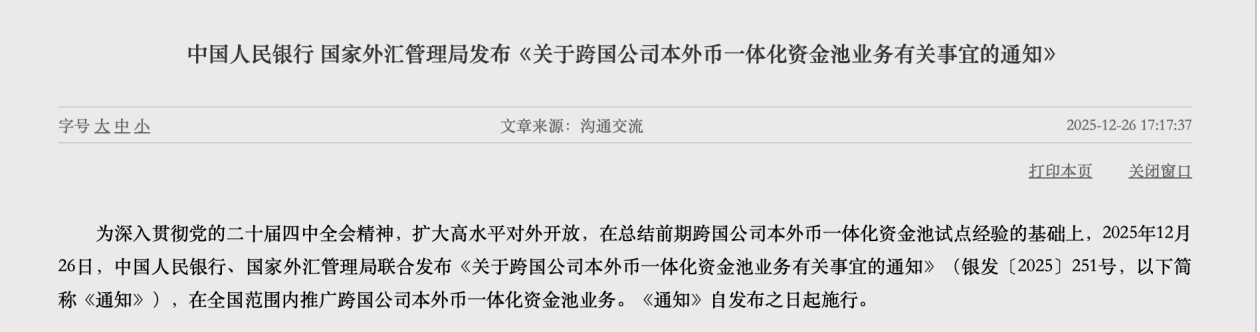
两部门联合发文 推广跨国公司本外币一体化资金池业务
Huan Qiu Wang· 2025-12-27 00:54
Core Viewpoint - The new integrated foreign and domestic currency fund pool policy aims to enhance cross-border fund management for multinational companies by focusing on account integration, simplified processes, and strengthened overall management [2] Group 1: Key Highlights of the Policy - Centralized management of cross-border funds allows multinational companies to consolidate domestic and foreign currency funds for unified management and usage [2] - Flexible adjustment of borrowing limits enables multinational companies to borrow up to 3.5 times and 0.8 times their equity in the fund pool for foreign debt and overseas lending, respectively [2] - Facilitation of current account business allows multinational companies to manage centralized receipts and payments or netting settlements through the main enterprise based on operational needs [2] - Simplification of business procedures shifts more operations from pre-approval to post-management, reducing institutional transaction costs for enterprises while maintaining risk control [2] Group 2: Future Directions - The People's Bank of China and the State Administration of Foreign Exchange will continue to optimize cross-border fund management policies for multinational companies, enhancing the convenience of cross-border trade and investment financing [2]

央行、外汇局:境外上市募集资金以外币调回的可自主结汇使用
Zheng Quan Ri Bao Wang· 2025-12-26 14:24
Core Viewpoint - The People's Bank of China and the State Administration of Foreign Exchange have issued a notification to facilitate domestic enterprises in raising funds efficiently in overseas financial markets, aligning with the spirit of the 20th National Congress of the Communist Party of China [1] Summary by Sections Unified Foreign Currency Fund Management Policy - The notification clarifies that funds raised from overseas listings, as well as proceeds from share reductions or transfers, can be repatriated in either foreign currency or RMB. Dividends for H-share "full circulation" listed entities must be distributed in RMB to domestic shareholders [2] Convenience for Enterprises in Domestic Fund Usage and Exchange Rate Risk Management - It is specified that funds raised from overseas listings can be autonomously converted for use in the domestic market. Listed entities can independently choose methods for managing exchange rate risks [2] Simplified Management Procedures - The notification supports banks in directly handling the registration of domestic enterprises for overseas listings and relaxes the time limits for registration related to issuance, additional issuance, and share reductions [2] Further Regulation of Fund Management - It is emphasized that funds raised from overseas listings and proceeds from share reductions or transfers should generally be repatriated to the domestic market. Any surplus funds from shareholders' contributions for additional purchases should be promptly returned to the domestic market. Certain qualified enterprises are allowed to retain raised funds for use outside of China [2] Future Directions - The People's Bank of China and the State Administration of Foreign Exchange will continue to enhance financial support for the real economy, optimize cross-border fund management policies, and improve the convenience of cross-border investment and financing to support high-quality economic development [2]
央行、外汇局,最新发文!
券商中国· 2025-03-13 12:20
Core Viewpoint - The People's Bank of China and the State Administration of Foreign Exchange have decided to expand the pilot program for multinational companies' integrated currency pool business in various provinces and cities to enhance cross-border fund management and support high-quality economic development [1] Summary by Sections Expansion of Pilot Program - The pilot program will be expanded in Tianjin, Hebei, Inner Mongolia, Heilongjiang, Anhui, Fujian, Shandong, Hubei, Hunan, Guangxi, Chongqing, Sichuan, Guizhou, Yunnan, Xinjiang, and Xiamen [1] Key Measures - Multinational companies are allowed to determine the concentration ratio of external debt and overseas loans based on macro-prudential principles [1] - Multinational companies can handle the centralized receipt and payment of foreign and domestic currencies for overseas subsidiaries through domestic main accounts [1] - Further facilitation for multinational companies to conduct cross-border receipts and payments in RMB [1] - Banks can directly handle capital project changes that do not involve external debt and overseas loan quotas [1] Future Directions - The People's Bank of China and the State Administration of Foreign Exchange will enhance the institutional opening in the foreign exchange sector and accelerate the improvement and expansion of cross-border fund management policies for multinational companies [1] - The aim is to continuously improve the convenience of cross-border trade and investment financing, better serving the high-quality development of the real economy [1]