跨年小躁动行情

Search documents
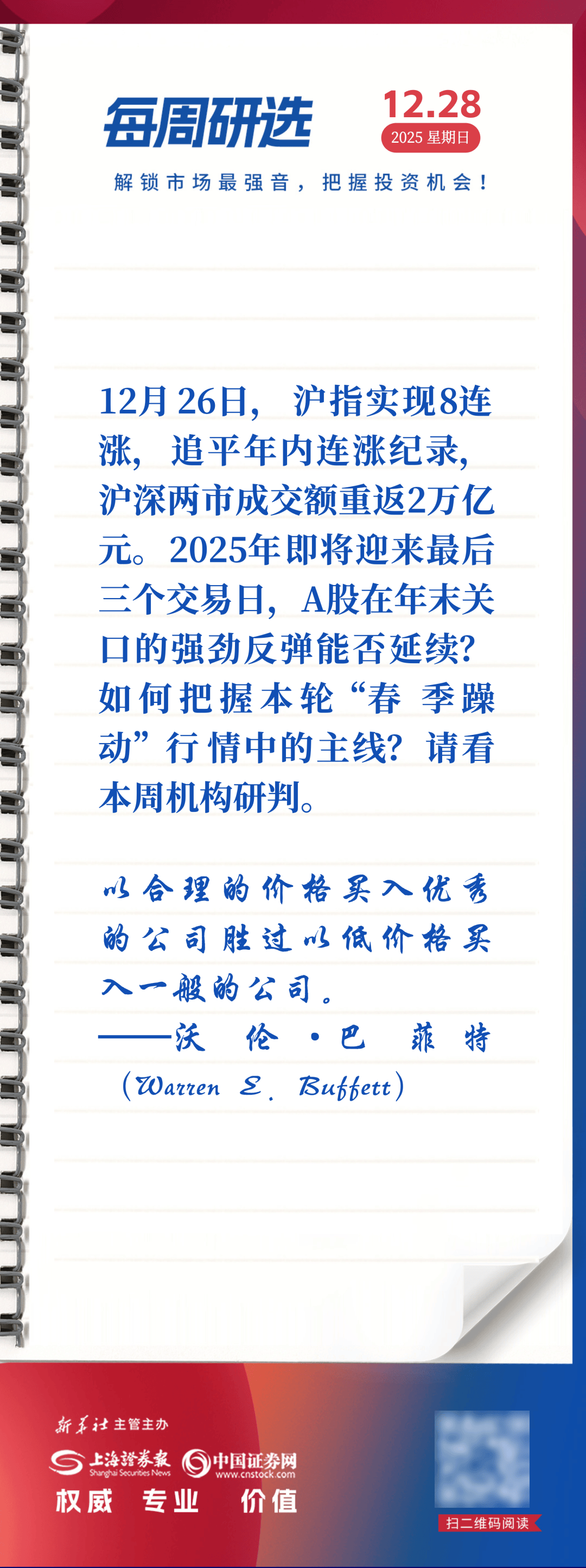
年末关口的强劲反弹能否延续?丨每周研选
Sou Hu Cai Jing· 2025-12-28 16:13
Core Viewpoint - The A-share market is experiencing a strong year-end rebound, with the Shanghai Composite Index achieving an eight-day consecutive rise, and trading volume in the Shanghai and Shenzhen markets returning to 2 trillion yuan, indicating a potential "spring rally" in the near future [4][6]. Group 1: Market Trends - The A-share market is showing signs of a "small rally" as it approaches the year-end, with significant trading volume and a notable rise in sectors such as non-ferrous metals, lithium mining, and commercial aerospace [8]. - The recent upward movement in the index is primarily driven by cyclical sectors, particularly non-ferrous metals, reflecting a recovery in market risk appetite [9]. - The current market environment is characterized by a "bottom consolidation" phase, preparing for a potential rally before the Spring Festival, rather than a full-blown upward trend [9]. Group 2: Capital Flow and Investment Strategies - Institutional buying power is expected to strengthen, driven by favorable policy expectations and a stable economic backdrop, with a notable increase in inflows into stock ETFs [10]. - The weak dollar and the appreciation of the RMB are enhancing the attractiveness of Chinese assets, leading to increased foreign investment [10]. - There is a strong willingness among various funds to enter the market, particularly as the new year approaches, indicating a potential continuation of the "spring rally" [11]. Group 3: Sector Focus and Investment Opportunities - High-growth sectors such as optical modules, PCB, and short-term supply-constrained areas like optical chips and high-speed copper cables are recommended for investment [12]. - The "price increase" narrative is acting as a catalyst for the current rally, with significant inflows into broad-based ETFs and a focus on sectors like chemicals and new energy materials [13]. - The consumption sector is also highlighted as a potential area for investment, given its relative underperformance this year and the supportive policy environment [16].