
软件盗版

Search documents
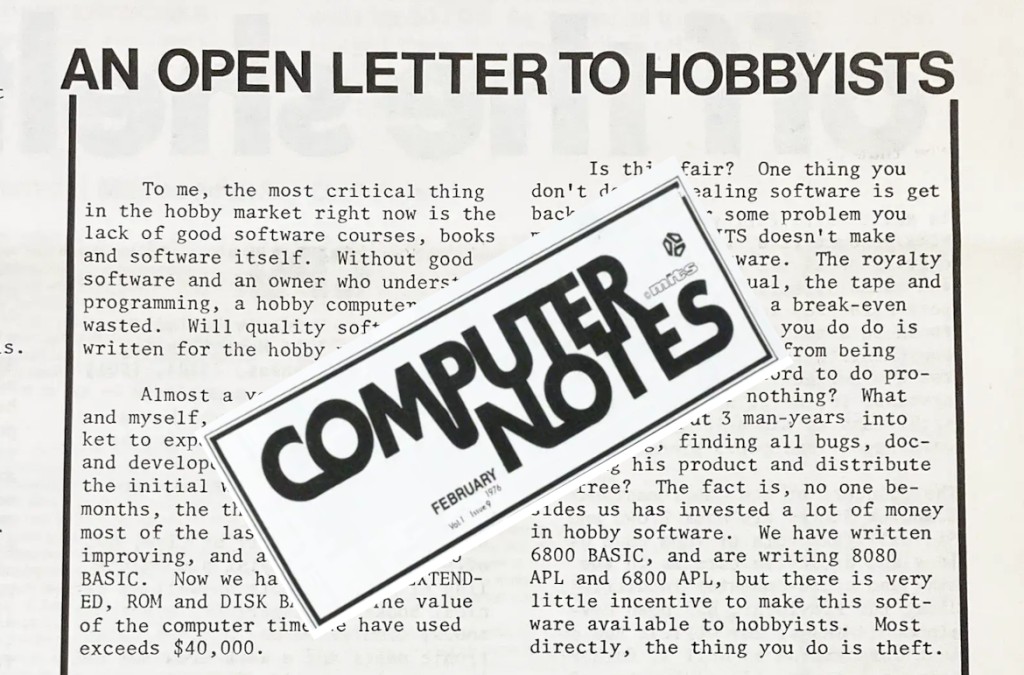
“你们都在偷软件,”50年前比尔·盖茨炮轰盗版软件的公开信曝光:硬件要钱,软件就该被“白嫖”?
3 6 Ke· 2026-02-05 11:26
Core Viewpoint - The 50th anniversary of Bill Gates' open letter addressing software piracy highlights ongoing discussions about software value and developer compensation in the tech industry [3][10][15]. Background and Context - The Altair 8800, released in 1975, marked the beginning of the personal computer revolution, leading to the formation of early PC communities and ecosystems [5]. - Bill Gates and Paul Allen developed a BASIC interpreter for the Altair 8800, which led to the founding of their company, Micro-Soft [7]. Software Development and Piracy Issues - Gates, Allen, and programmer Monte Davidoff developed Altair BASIC, which took over a year to refine, with development costs exceeding $40,000 [8][13]. - The software's source code was stolen and distributed for free, reflecting a culture of sharing among early computer enthusiasts, which lacked awareness of software copyright [9][10]. Gates' Open Letter and Its Impact - In February 1976, Gates published a letter criticizing the widespread software piracy, stating that most enthusiasts were stealing software and undermining the development of quality software [10][14]. - Gates expressed frustration over the lack of compensation for developers, noting that their earnings from software sales were insufficient to cover development costs [13][14]. Ongoing Relevance and Discussion - The letter sparked significant debate in 1976, with some defending the hacker culture of sharing, while others began to reconsider the relationship between software value and developer compensation [14][15]. - Fifty years later, the letter has resurfaced in discussions, with commentators reflecting on Microsoft's evolution in addressing software piracy and the broader implications for the software industry [15][16].


你的盗版Windows,可能一夜之间“失效”了,微软正式封杀KMS38,“白嫖时代”或将走向终点
3 6 Ke· 2025-11-18 00:23
Core Points - Microsoft has officially blocked the KMS38 activation method, leading to a significant number of users losing access to their activated Windows and Office products overnight [1][3] - KMS38 was widely regarded as a safe and easy way to activate Windows and Office without cost, allowing users to receive official updates [2][3] - The blocking of KMS38 is part of Microsoft's broader strategy to tighten control over its software ecosystem and push users towards Windows 11 [5][6] Group 1 - KMS38 was an open-source activation tool developed by the Massgrave team, known for its simplicity and safety, allowing users to activate Windows and Office without modifying system files [2][3] - Following the latest Patch Tuesday update, all devices relying on KMS38 have lost activation, prompting users to purchase legitimate licenses, with Windows 11 keys starting at approximately $10 and Office 2021 Pro at around $39 [3][4] - Microsoft has removed the main activation option from KMS38 and suggested users consider alternative activation methods like HWID or TSforge, which are still operational [4] Group 2 - The timing of Microsoft's decision to block KMS38 is speculated to be influenced by the retirement of Windows 10, pushing users to upgrade to Windows 11, which has stringent hardware requirements [5][6] - Microsoft has been tightening its policies, having previously blocked offline installation methods for Windows 11, indicating a shift towards a more controlled and cloud-centric ecosystem [6] - The rise of counterfeit versions of KMS38 and associated security risks has prompted Microsoft to take action, as popular tools can easily be mimicked and infected with malware [6][7] Group 3 - As Windows 11 becomes more restrictive, there is a growing interest in alternative operating systems like Linux, with users considering migration due to hardware limitations and the desire to avoid licensing fees [7][8] - The development of Linux desktop systems has accelerated, with improved gaming capabilities and user experiences, leading to a potential shift in user preferences away from Windows [7][8] - While Linux and ChromeOS may not replace Windows overnight, they present viable options for users unwilling to pay for licenses or comply with stringent account management [8]