载人绕月任务

Search documents
美国载人绕月任务一再推迟背后的困局
Xin Hua She· 2026-02-25 00:50
Core Viewpoint - The "Artemis 2" manned lunar mission by NASA has faced multiple delays due to technical issues and budget cuts, raising concerns about the future of the mission and the agency's capabilities [1][4]. Technical Challenges - The "Artemis 2" mission is set to use the Space Launch System (SLS) and Orion spacecraft to send four astronauts into lunar orbit. Recent rehearsals revealed significant technical problems, including a liquid hydrogen leak in the rocket's core stage and a helium supply interruption to the upper stage [2]. - The liquid hydrogen leak, which occurred during the first rehearsal, led to the postponement of the February launch window to March. This issue had previously been encountered during the "Artemis 1" mission, raising doubts about NASA's technical control [2]. - The second rehearsal faced a helium supply disruption, which, while not catastrophic, could affect propellant management and safety margins. Any single point anomaly must be thoroughly resolved before proceeding with manned deep space missions [2]. - The Orion spacecraft's heat shield has also been a point of contention, with concerns about its performance during re-entry. Anomalies observed during the "Artemis 1" mission have prompted calls for a deeper investigation into its structural integrity [3]. Budget Cuts Impact - The political environment and uncertainty surrounding budget allocations have added further complications to the manned lunar mission. The Trump administration proposed significant budget cuts for NASA in the FY 2026 budget draft, affecting key projects like the SLS and Orion spacecraft [4]. - These budget adjustments are expected to impact the overall funding and progress of the Artemis program, with potential "catastrophic" consequences for U.S. space science and global technological competitiveness [4]. - Analysts express concern that the current budget framework has diminished the priority of space initiatives, which were previously emphasized during Trump's first term [4]. Policy Instability - The long-term nature of space engineering projects requires stable policy support. Frequent changes in budget size and priorities can disrupt project management and supply chain predictability, ultimately slowing progress [6]. - The development history of the U.S. lunar return plan has been marked by contradictions and political maneuvering, leading to a decline in NASA's overall capabilities and oversight [6]. - The delays in the manned lunar mission are attributed not only to technical failures but also to the dual pressures of engineering risks and financial constraints. Budget instability may weaken NASA's supply chain coordination and personnel stability, extending execution timelines [6].
新闻分析丨美国载人绕月任务一再推迟背后的困局
Xin Hua Wang· 2026-02-24 14:16
Core Viewpoint - The "Artemis 2" manned lunar mission has faced multiple delays due to technical issues and budget cuts, raising concerns about NASA's ability to manage the project effectively [1][4]. Technical Issues - The "Artemis 2" mission plans to use the Space Launch System (SLS) and Orion spacecraft to send four astronauts into lunar orbit. Recent rehearsals revealed significant technical problems, including a liquid hydrogen leak at the rocket's core propellant interface during the first rehearsal, leading to the postponement of the launch window from February to March [2] - A second rehearsal encountered a helium supply interruption to the rocket's upper stage, prompting NASA to return the rocket and spacecraft to the assembly building for repairs, further delaying the March launch [2] - The Orion spacecraft's heat shield has raised concerns due to performance issues during the "Artemis 1" mission, where material unexpectedly detached, indicating potential structural problems that require thorough investigation [3] Budget Cuts Impact - The Trump administration's proposed budget cuts for NASA in the fiscal year 2026 threaten to impact key projects, including the SLS, Orion spacecraft, and the Lunar Gateway, potentially disrupting the overall funding and progress of the Artemis program [4] - The American Astronomical Society warned that budget reductions could have "catastrophic impacts" on U.S. space science and weaken the country's global technological competitiveness [4] - Analysts express concern that the current political climate has diminished the priority of space exploration, which could lead to further delays in the Artemis program and affect the U.S.'s deep space exploration strategy [4][6] Policy Instability - The long-term nature of space engineering projects requires stable policy support, and frequent changes in budget and priorities can disrupt project management and supply chain predictability, ultimately slowing progress [6] - The history of the U.S. lunar return program has been marked by contradictions and political maneuvering, leading to concerns about NASA's overall capability and oversight [6] - The delays in the manned lunar mission are attributed not only to technical failures but also to the dual pressures of engineering risks and financial constraints, which may hinder NASA's operational stability and decision-making processes [6]
新闻分析|美国载人绕月任务一再推迟背后的困局
Xin Hua She· 2026-02-24 14:06
Core Viewpoint - The repeated delays of the Artemis II manned lunar mission highlight both technical challenges and underlying political and budgetary issues affecting NASA's operations [1][4]. Technical Challenges - The Artemis II mission, which aims to send four astronauts into lunar orbit using the Space Launch System (SLS) and Orion spacecraft, has faced multiple technical issues during recent rehearsals [2]. - In the first rehearsal, a liquid hydrogen leak occurred at the rocket's core stage, leading to a suspension of operations and a postponement of the launch window from February to March [2]. - The second rehearsal revealed a disruption in the helium supply to the rocket's upper stage, necessitating a return to the assembly building for repairs, further delaying the March launch [2]. - The Orion spacecraft's heat shield has raised concerns due to material loss during the Artemis I mission, indicating potential structural issues that require thorough investigation [3]. Budgetary and Political Factors - The Trump administration's proposed budget cuts for NASA in the fiscal year 2026 threaten funding for key projects, including the SLS, Orion spacecraft, and lunar Gateway, which could disrupt the overall funding and progress of the Artemis program [3][4]. - The American Astronomical Society has warned that these budget cuts could have a "catastrophic impact" on U.S. space science and weaken the country's global technological competitiveness [3]. - The current political environment has led to a decrease in the prioritization of space initiatives, raising concerns among industry experts about the long-term implications for NASA's capabilities and project timelines [4][5]. Strategic Implications - The instability in budget and policy could undermine NASA's supply chain coordination and personnel stability, leading to more cautious decision-making and extended execution timelines [5][6]. - The Artemis program is not just a launch mission but a critical framework for the U.S. to re-establish its presence on the Moon and develop a deep space exploration strategy [6].
关键测试遇燃料泄漏,美载人绕月任务再推迟一个月
Huan Qiu Wang Zi Xun· 2026-02-04 23:04
Core Viewpoint - The "Artemis 2" manned lunar mission by NASA has been delayed again due to a hydrogen leak detected during a wet dress rehearsal of the Space Launch System (SLS) rocket, pushing the launch date from February 8 to March [1][3]. Group 1: Mission Details - The "Artemis 2" mission is crucial as it aims to send astronauts to the Moon using the SLS rocket and the Orion spacecraft [5]. - The mission is expected to set a new record for the farthest distance from Earth achieved by humans, while also laying the groundwork for the subsequent "Artemis 3" mission [5]. Group 2: Technical Issues - During the wet dress rehearsal, over 700,000 gallons of cryogenic fuel were injected into the SLS rocket, but a hydrogen leak was detected, leading to the suspension of fueling operations [3][4]. - The leak was identified in the cavity between the umbilical plate and the rocket, causing the fueling process to be interrupted multiple times [4]. - The repair of the hydrogen leak is complex, requiring testing under the same conditions as the launch day, which can only be conducted at the launch pad [4]. Group 3: Future Plans - NASA plans to conduct another wet dress rehearsal to address the hydrogen leak and complete the remaining objectives that were not achieved in the first rehearsal [5]. - Potential new launch windows are set for March 6, 7, 8, 9, and 11, contingent on the resolution of the current issues [5].

美“登月火箭”就位,离发射还有多远
Xin Lang Cai Jing· 2026-01-20 05:29
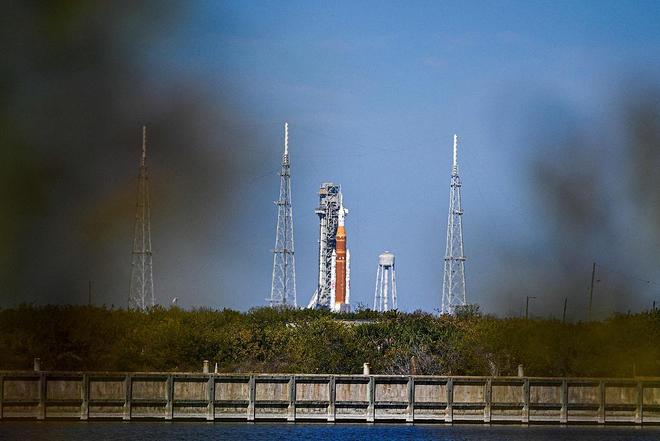
Core Viewpoint - The "Artemis 2" mission, featuring the Orion spacecraft and Space Launch System (SLS) rocket, has successfully reached the launch pad after a lengthy transport process, but the actual launch date remains uncertain due to necessary testing and evaluations [1][2]. Group 1: Transport and Arrival - The Orion spacecraft and SLS rocket combination, standing approximately 98 meters tall and weighing around 1500 tons, was transported to the launch pad using the "Crawler-Transporter 2," which weighs 3000 tons and can carry over 8000 tons [1]. - The transport process took nearly 12 hours, with the vehicle moving at a very slow speed of about 1 mile per hour, and the final approach involved climbing a sloped ramp [2]. Group 2: Testing and Preparations - Upon arrival at the launch pad, NASA engineers will conduct integration, testing, and a series of launch rehearsals, including a critical "wet dress rehearsal" where over 700,000 gallons of cryogenic liquid oxygen and hydrogen will be loaded [2]. - NASA may require multiple "wet dress rehearsals," as seen in the Artemis 1 mission, which underwent four such rehearsals before completion [2]. Group 3: Launch Timeline - After completing the necessary tests and evaluations, NASA will determine the launch date, with the launch window opening approximately every four weeks, providing 4 to 5 opportunities per window [3]. - The earliest potential launch date is set for February 6, when three American astronauts and one Canadian astronaut will embark on a 10-day lunar mission to test systems and hardware [3].
美“登月火箭”就位,离发射还有多远?美媒:尚存很多变数
Huan Qiu Shi Bao· 2026-01-19 22:46
Core Viewpoint - The "Artemis 2" mission, featuring the Orion spacecraft and Space Launch System (SLS) rocket, has successfully arrived at the launch pad after a lengthy transport process, but the actual launch date remains uncertain due to required testing procedures [1][3][4] Group 1: Transport and Arrival - The Orion spacecraft and SLS rocket combination, standing approximately 98 meters tall and weighing around 1500 tons, was transported to the launch pad using the "Crawler-Transporter 2," which weighs 3000 tons and can carry over 8000 tons [3][4] - The transport process took nearly 12 hours, with the vehicle moving at a speed of about 1 mile per hour, and included a challenging ascent up an inclined slope to reach the launch pad [3][4] Group 2: Testing and Launch Preparations - NASA will conduct rigorous checks and a series of tests on the spacecraft and rocket once they are positioned at the launch pad, including a critical "wet dress rehearsal" where over 700,000 gallons of cryogenic propellants will be loaded [4] - The launch window for "Artemis 2" will open approximately every four weeks, with the earliest potential launch date being February 6, when a crew of three American astronauts and one Canadian astronaut will embark on a 10-day lunar mission [4]