阿尔忒弥斯2号

Search documents
用尽历史遗产走捷径,美国重返月球尴尬了
Guan Cha Zhe Wang· 2026-02-24 00:29
Core Viewpoint - The article discusses the challenges and implications of the Artemis program, particularly focusing on the upcoming Artemis 2 mission, which aims to send astronauts on a lunar flyby for the first time since Apollo 17 in 1972. The mission's success is seen as critical for the future of the U.S. human spaceflight program and its ability to sustain long-term deep space exploration [1][4][16]. Group 1: Mission Overview - The Artemis 2 mission was initially scheduled for launch on February 6, 2026, but has been postponed to March due to a liquid hydrogen leak during a wet dress rehearsal [1]. - The mission represents a significant milestone as it marks the first crewed lunar mission in over five decades, highlighting the symbolic importance of U.S. leadership in space exploration [1][4]. Group 2: Engineering and Technical Challenges - The SLS (Space Launch System) rocket, which supports the Artemis program, is criticized for being a product of legacy technology rather than a new, innovative design. It relies heavily on components from the Space Shuttle era, such as the RS-25 engines and solid rocket boosters [7][8][10][12]. - The SLS's reliance on outdated technology raises concerns about its long-term sustainability and ability to meet the ambitious goals of the Artemis program [4][13]. Group 3: Cost and Schedule Issues - The estimated cost for a single Artemis mission, including the SLS and Orion spacecraft, is approximately $4 billion, excluding prior development costs. This high cost limits the frequency of launches and amplifies the impact of any technical issues [16][18]. - The Artemis 2 mission has faced significant delays, with its launch date pushed back from the original target of 2022-2023 to 2026, indicating systemic issues within the overall engineering and project management [16][19]. Group 4: Political and Financial Context - The Artemis program is highly dependent on political support and budget continuity, having faced potential cuts during previous administrations. This instability raises questions about the program's long-term viability [21][22]. - The success of Artemis 2 is seen as a critical test not only for the technical aspects of the mission but also for the U.S. government's commitment to sustaining high-cost, high-uncertainty space exploration initiatives [22].

美“登月火箭”就位,离发射还有多远?美媒:尚存很多变数
Huan Qiu Shi Bao· 2026-01-19 22:46
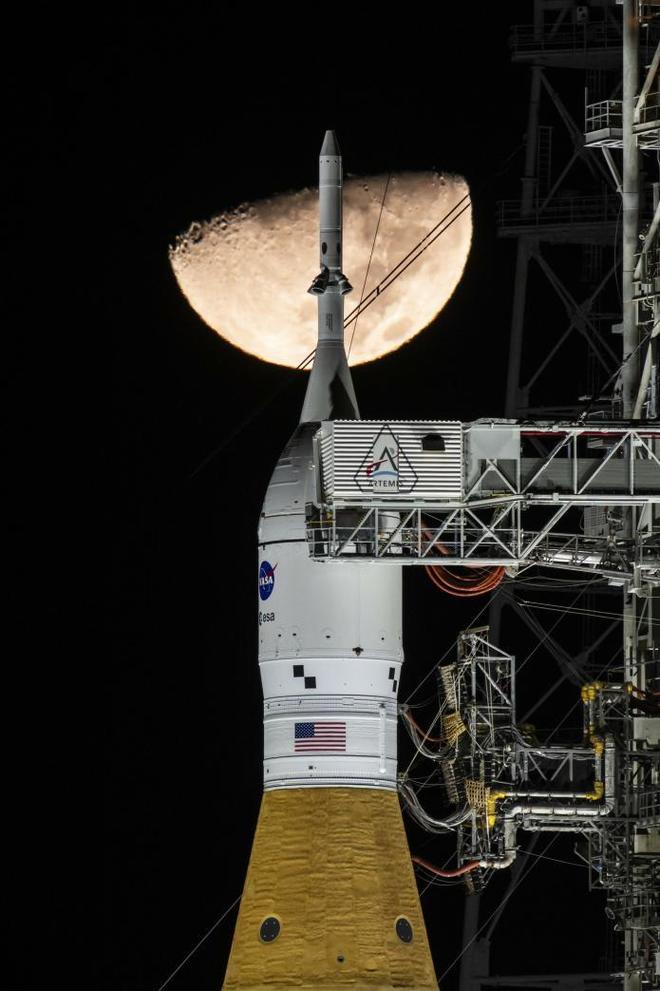
Core Viewpoint - The "Artemis 2" mission, featuring the Orion spacecraft and Space Launch System (SLS) rocket, has successfully arrived at the launch pad after a lengthy transport process, but the actual launch date remains uncertain due to required testing procedures [1][3][4] Group 1: Transport and Arrival - The Orion spacecraft and SLS rocket combination, standing approximately 98 meters tall and weighing around 1500 tons, was transported to the launch pad using the "Crawler-Transporter 2," which weighs 3000 tons and can carry over 8000 tons [3][4] - The transport process took nearly 12 hours, with the vehicle moving at a speed of about 1 mile per hour, and included a challenging ascent up an inclined slope to reach the launch pad [3][4] Group 2: Testing and Launch Preparations - NASA will conduct rigorous checks and a series of tests on the spacecraft and rocket once they are positioned at the launch pad, including a critical "wet dress rehearsal" where over 700,000 gallons of cryogenic propellants will be loaded [4] - The launch window for "Artemis 2" will open approximately every four weeks, with the earliest potential launch date being February 6, when a crew of three American astronauts and one Canadian astronaut will embark on a 10-day lunar mission [4]