递归自改进

Search documents
拆解OpenAI的AI需求后,巴克莱得出结论:AI资本开支周期仍将持续,技术突破可能在27/28年引发算力需求激增
美股IPO· 2025-11-20 16:07
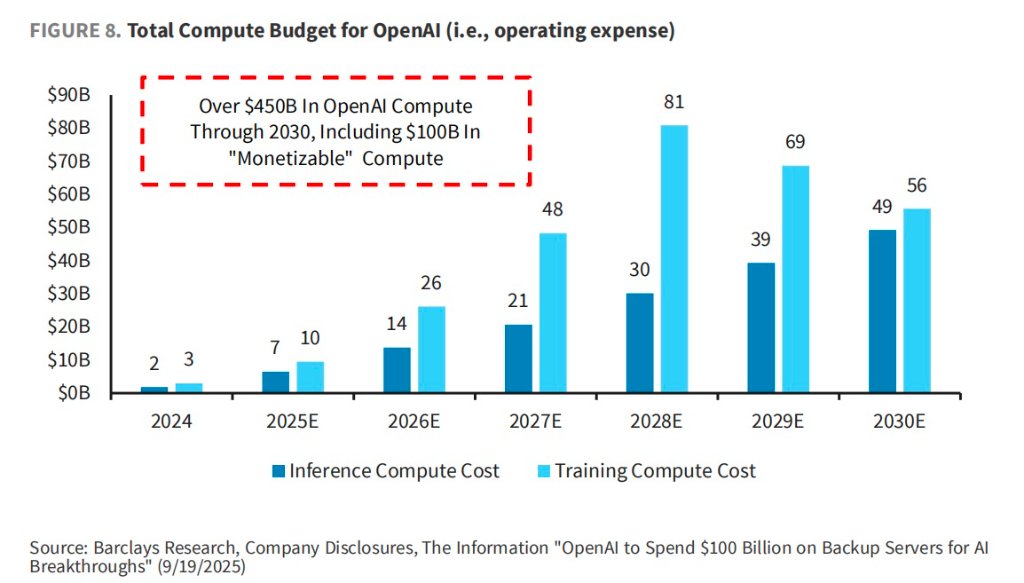
Core Insights - OpenAI's performance continues to exceed expectations, indicating that the AI capital expenditure cycle will persist in the medium to long term [1][3] - The company's revenue growth directly drives its computing investments, with significant increases in projected revenues for 2025 and 2027 [4][6] - The report suggests that the AI investment slowdown is still a long way off [5] Revenue Performance - OpenAI's revenue for 2025 is projected to be approximately 15% higher than mid-year forecasts, while the 2027 revenue estimate has been raised by 50% [6] - The total revenue forecast for 2027 has been adjusted from $60 billion to $90 billion, with computing costs increasing from $21 billion to $30 billion [6] - Weekly active users are expected to rise from 1.4 billion to 1.8 billion, and the average revenue per paid user is projected to increase from $748 to $880 [6] AI Capital Expenditure Cycle - The AI capital expenditure cycle is expected to continue, with OpenAI's computing operating expenses projected to exceed $450 billion from 2024 to 2030, peaking at around $110 billion in 2028 [7][8] - Continuous model iterations are driving up computing demands, necessitating accelerated infrastructure deployment by computing partners [8] - OpenAI anticipates that 2027-2028 will be a critical window for achieving "recursive self-improvement," further increasing computing demand [8] Partnerships and Contracts - OpenAI has signed approximately $650 billion in computing lease contracts with various partners over the next decade [9] - Major contracts include $300 billion with Oracle OCI, $250 billion with Microsoft Azure, and $40 billion with Google GCP, among others [9] Industry Competition and Strategy - The competitive landscape is intensifying, leading to an "arms race" among tech giants to expand user bases and accelerate model iterations [9] - The total capacity of global AI data centers is expected to double from 114.3 GW to 236 GW between 2024 and 2030 [9] - Tech giants are committed to high levels of investment, with founders emphasizing long-term competition in AI, even in the face of market volatility [9]


拆解OpenAI的AI需求后,巴克莱得出结论:AI资本开支周期仍将持续,技术突破可能在27/28年引发算力需求激增
Hua Er Jie Jian Wen· 2025-11-20 12:41
Core Insights - OpenAI's revenue performance significantly exceeds internal expectations, indicating rapid growth in AI demand and a sustained capital expenditure cycle in the short term [1][2] - The report suggests that the risk of a bubble burst in the AI sector remains low as long as OpenAI maintains its strong growth trajectory [1] Revenue Performance - OpenAI's actual revenue for 2025 is projected to be approximately 15% higher than mid-year forecasts, while the 2027 revenue expectation has been raised by 50% [2] - The total revenue forecast for OpenAI in 2027 has been adjusted from $60 billion to $90 billion, with computing costs increasing from $21 billion to $30 billion [2] - Weekly active users (WAU) are expected to rise from 1.4 billion to 1.8 billion, and the average revenue per paid user (ARPU) is anticipated to increase from $748 to $880 [2] - CEO Sam Altman has indicated that OpenAI aims to achieve $100 billion in annual recurring revenue (ARR) by 2027, a year earlier than previously predicted [2] AI Capital Expenditure Cycle - The sustained performance of OpenAI confirms that the AI capital expenditure cycle will continue in the medium to long term [3] - OpenAI's revenue is directly tied to computing power, with significant investments planned for computing operations, exceeding $450 billion from 2024 to 2030, peaking at around $110 billion in 2028 [3][6] - Continuous model iterations, such as GPT-6 and Sora 3, are driving up computing demands, necessitating accelerated infrastructure deployment by computing partners [6] Strategic Partnerships and Contracts - OpenAI has signed approximately $650 billion in computing power leasing contracts with various partners over the next decade [7] - Major contracts include $300 billion with Oracle OCI, $250 billion with Microsoft Azure, and additional agreements with Google GCP, Amazon AWS, and CoreWeave [7] Industry Competition and Long-term Strategy - The competitive landscape is intensifying, leading to an "arms race" among tech giants like Google and Meta to expand user bases and accelerate model iterations [7] - The global AI data center capacity is expected to double from 114.3 GW to 236 GW between 2024 and 2030, with OpenAI requiring partners to invest over $600 billion in computing clusters [7] - Tech giants are committed to long-term investments in AI, with founders emphasizing the importance of maintaining high capital expenditures despite market fluctuations [8]