
通信业发展

Search documents
多维数据传递信心 中国经济“稳+进”动能不断释放
Yang Shi Wang· 2025-12-04 06:16
Core Viewpoint - China's economy is showing a steady and progressive development trend, with various sectors indicating positive growth and stability in recent months [1]. Group 1: Logistics Industry - In November, China's logistics industry prosperity index was reported at 50.9%, reflecting a month-on-month increase of 0.2 percentage points [4]. - The business volume index across eastern, central, and western regions of China is relatively balanced, indicating stable demand in the logistics sector [4]. - The postal and express delivery industry saw a business volume index of 70.2%, with growth driven by offline entities, social e-commerce platforms, and comprehensive e-commerce platforms [4]. Group 2: Service Trade - From January to October, China's total service trade import and export amounted to 65,844.3 billion yuan, marking a year-on-year growth of 7.5% [6]. - Service exports reached 29,090.3 billion yuan, growing by 14.3%, while the service trade deficit decreased by 2,693.9 billion yuan compared to the previous year [6]. - Knowledge-intensive service trade maintained growth, with imports and exports totaling 25,121.5 billion yuan, an increase of 6.4% [6]. Group 3: Consumer Goods - From January to November, the "old-for-new" consumption policy led to sales exceeding 25,000 billion yuan, benefiting over 360 million people [9]. - The program included over 11.2 million vehicles, 12.8 million home appliances, and 9.015 million digital products being replaced under the initiative [9]. Group 4: Telecommunications Industry - The telecommunications industry in China has shown overall stability in the first ten months of 2025, with significant growth in user numbers for 5G, gigabit broadband, and the Internet of Things [10]. - By the end of October, the number of 5G mobile phone users reached 1.184 billion, accounting for 64.7% of mobile phone users [12]. - Mobile internet traffic has also seen rapid growth, exceeding 3,200 billion GB, with a year-on-year increase of 16.8% [12].


工信部:2025年前10月通信业运行总体平稳
Zhong Guo Xin Wen Wang· 2025-12-01 11:02
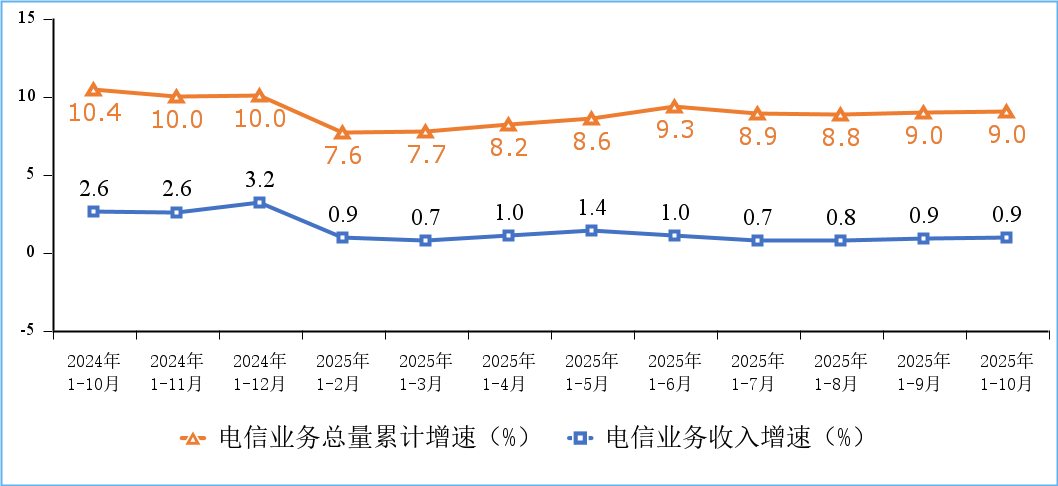
Overall Performance - The telecommunications industry has shown stable growth in business revenue, with a total revenue of 14,670 billion yuan for the first ten months of 2025, representing a year-on-year increase of 0.9%. When adjusted for last year's prices, the total business volume grew by 9% [2]. User Development - The number of fixed internet broadband users reached 697 million by the end of October, with a net increase of 27.01 million users compared to the end of last year. Users with access speeds of 100 Mbps and above accounted for 95.1% of total users, while those with speeds of 1,000 Mbps and above reached 238 million, marking a net increase of 31.13 million users and a 3.3 percentage point increase from the end of last year [4]. - The total number of mobile phone users reached 1.83 billion, with a net increase of 40.15 million users. The number of 5G mobile phone users reached 1.184 billion, with a net increase of 17 million users, accounting for 64.7% of mobile phone users [7]. - The number of mobile IoT terminal users grew rapidly to 2.89 billion, with a net increase of 23.4 million users. The number of internet TV users reached 41.2 million, with a net increase of 4.737 million users [9]. Telecommunications Usage - Mobile internet traffic maintained a rapid growth rate, with a total of 3,232 billion GB of mobile internet traffic for the first ten months, representing a year-on-year increase of 16.8%. The average monthly mobile internet access traffic per user reached 22.21 GB, a year-on-year increase of 15.7% [10]. - The total duration of mobile phone outgoing calls was 17 trillion minutes, a decrease of 5.2% year-on-year, while the duration of fixed-line outgoing calls was 56.04 billion minutes, down 14.1% year-on-year. The volume of mobile SMS services increased by 18.8%, but revenue from mobile SMS services decreased by 1.2% [10]. Communication Capability - The number of internet broadband access ports reached 1.243 billion by the end of October, with a net increase of 40.89 million ports. Fiber-to-the-home (FTTH/O) ports accounted for 96.7% of total broadband access ports, reaching 1.202 billion [11]. - The total number of 5G base stations reached 4.758 million, with a net increase of 507,000 stations, accounting for 37% of total mobile base stations, an increase of 0.4 percentage points from the previous three quarters [12]. Regional Development - The penetration rates for fixed broadband users with speeds of 1,000 Mbps and above in the eastern, central, western, and northeastern regions were 34.1%, 33.5%, 36.2%, and 27.8%, respectively, showing increases of 2.9, 2.3, 4.5, and 4.2 percentage points from the end of last year. The penetration rates for 5G mobile phone users in these regions were 64.3%, 65.4%, 64.6%, and 65.3%, with increases of 7.6, 8.2, 8.3, and 9 percentage points, respectively [13]. - The mobile internet access traffic growth rates in the eastern, central, western, and northeastern regions were 17.3%, 16.1%, 15.2%, and 25.1%, respectively, with total traffic reaching 1,357 billion GB, 761.1 billion GB, 921 billion GB, and 193.4 billion GB [13].
全国通信“账单”出炉,这些数据出乎意料
3 6 Ke· 2025-11-21 10:53
Core Insights - The Ministry of Industry and Information Technology released the "2024 Annual Statistical Data of the Telecommunications Industry," providing a comprehensive overview of the development status of China's telecommunications industry across various dimensions such as telecom users, service usage, communication capacity construction, and service levels [1] Mobile Communication - As of the end of 2024, the total number of mobile phone users in China reached 1.79 billion, with a penetration rate of 127.1 mobile phones per 100 people, indicating a highly saturated mobile communication market [2] - Among the 1.79 billion mobile users, 1.01 billion are 5G users, while 670 million are 4G users, leaving 110 million users still on 2G/3G networks [2] - The net increase in 5G users in 2024 was 192 million, significantly lower than the previous year's increase of 256 million, while 4G users decreased by 113 million, also less than the prior year's decline of 164 million [2] Provincial Insights - Shanghai has the highest mobile phone penetration rate at 193.7 per 100 people, followed by Beijing (189.9) and Zhejiang (144.5), while Tibet has the lowest at 95.5 per 100 people [3] - The average national proportion of 5G users is 56.7%, with 14 provinces above this average, including Ningxia (63.6%), Hainan (62.1%), Qinghai (61.9%), and Tibet (60.5%); Shanghai has the lowest proportion at 47.8% [3] Fixed Broadband - The household internet broadband access penetration rate in China reached 115.9%, indicating saturation in the market [5] - The trend of "100M users decreasing while 1000M users increasing" has slowed down, with a net decrease of 9.22 million users in the 100M to 1000M category in 2024, and a net increase of 43.55 million users in the 1000M category, which is only 60% of the previous year's growth [5] - Guangdong, Jiangsu, Shandong, Henan, and Sichuan lead in the number of gigabit users, while Guizhou has the highest proportion of gigabit users in its overall user base, exceeding 40% [6] Internet TV and Fixed Line - Internet TV user growth shows significant regional differences, with eastern regions experiencing a decline while central and western regions continue to grow [8] - Fixed-line telephone users remain at 166.7 million, with Qinghai and Tibet having the highest penetration rates at 27.2 and 26.3 per 100 people, respectively [8] Business Usage - In 2024, the national mobile internet access traffic grew by 11.6%, with the northeastern region showing the highest growth at 19.1% [10] - Beijing leads in SMS business volume with 281.3 billion messages sent, followed by Guangdong (227.9 billion) and Henan (134.8 billion) [13] Infrastructure Development - As of the end of 2024, China had 12.645 million mobile phone base stations, with 7.112 million being 4G and 4.251 million being 5G [15] - The net increase in 4G and 5G base stations in 2024 was nearly equal, with 817,000 4G stations and 874,000 5G stations added [15]

上半年通信业运行基本平稳 电信业务总量同比增长9.3%
Zhong Guo Chan Ye Jing Ji Xin Xi Wang· 2025-07-28 22:58
Overall Performance - The telecommunications industry maintained stable operations in the first half of 2025, with a total telecom business revenue of 905.5 billion yuan, reflecting a year-on-year growth of 1% [2] - The total telecom business volume grew by 9.3% year-on-year when adjusted for last year's prices [2] User Development - The number of fixed broadband access users reached 684 million, with a net increase of 14.26 million users compared to the end of the previous year [3] - Users with internet access speeds of 100 Mbps and above totaled 651 million, accounting for 95.1% of all fixed broadband users [3] - The number of mobile phone users reached 1.81 billion, with a net increase of 19.93 million users [3] - 5G mobile phone users reached 1.118 billion, representing 61.8% of total mobile phone users, with a net increase of 10.4 million users [3] - The number of mobile IoT terminal users grew to 2.831 billion, with a net increase of 17.5 million users [3] Business Usage - Mobile internet traffic reached 186.7 billion GB, showing a year-on-year growth of 16.4% [4] - The average mobile internet access traffic per user (DOU) was 20.75 GB per month, up 14.4% year-on-year [4] - The total duration of mobile phone outgoing calls was 1 trillion minutes, down 5.6% year-on-year [4] - The volume of mobile SMS increased by 22.3% year-on-year [4] Communication Capacity - The total length of optical cable lines reached 73.77 million kilometers, a year-on-year increase of 9.9% [5] - The number of internet broadband access ports reached 1.234 billion, with a net increase of 32.44 million ports [5] - The number of 5G base stations reached 4.549 million, with a net increase of 298,000 stations [5] Regional Development - The penetration rates for 1000 Mbps and above fixed broadband users increased across various regions, with the eastern region at 33.2% and the western region at 34% [6] - The penetration rate for 5G mobile phone users also increased, with the eastern region at 61.5% [6] - Mobile internet access traffic growth remained in double digits across all regions, with the northeastern region showing a growth of 25.8% [7]
今年前5个月通信业量收增速逐步提升
Zhong Guo Chan Ye Jing Ji Xin Xi Wang· 2025-06-30 23:23
Core Insights - The telecommunications industry in China has shown stable performance in the first five months of the year, with a total telecom business revenue of 748.8 billion yuan, reflecting a year-on-year growth of 1.4% [1] - The total telecom business volume, calculated at constant prices from the previous year, has increased by 8.6% [1] Group 1: User Growth - The number of fixed internet broadband access users reached 682 million by the end of May, with a net increase of 12.16 million users compared to the end of last year [1] - Users with access speeds of 1000 Mbps and above reached 223 million, marking a net increase of 16.35 million users, which constitutes 32.7% of the total user base [1] - The total number of mobile phone users across three major telecom companies and China Broadcasting reached 1.807 billion, with a net increase of 16.99 million users [1] - 5G mobile phone users reached 1.098 billion, with a net increase of 84.14 million users, accounting for 60.8% of mobile phone users [1] Group 2: Internet Traffic and IoT - Mobile internet traffic reached 1,537 billion GB in the first five months, showing a year-on-year growth of 16.2% [1] - The number of mobile internet users reached 1.589 billion, with a net increase of 19.14 million users [1] - The number of mobile IoT terminal users increased to 2.78 billion, with a net increase of 12.4 million users [1] Group 3: Infrastructure Development - The number of internet broadband access ports reached 1.232 billion, with a net increase of 29.84 million ports [2] - Fiber-to-the-home (FTTH/O) ports reached 1.19 billion, with a net increase of 30.12 million ports, representing 96.6% of total broadband access ports [2] - The number of 5G base stations reached 4.486 million, with a net increase of 235,000 stations, accounting for 35.3% of total mobile base stations [2]