
移动物联网

Search documents
去年我国通信业用户规模实现量质双升 电信业务收入累计完成1.75万亿元
Zhong Guo Zheng Quan Bao· 2026-01-28 23:27
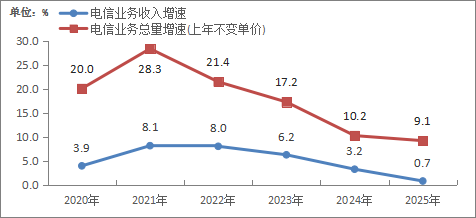
Core Insights - The Ministry of Industry and Information Technology reported that the telecommunications industry in China achieved a total revenue of 1.75 trillion yuan in 2025, marking a 0.7% increase from the previous year, with a year-on-year growth of 9.1% when adjusted for last year's prices [1] Group 1: Telecommunications Revenue and User Growth - The total number of telephone users in China reached 1.987 billion by the end of 2025, with a net increase of 30.91 million users throughout the year [1] - The number of mobile phone users reached 1.827 billion, with a net increase of 37.25 million users, resulting in a penetration rate of 130 users per 100 people, an increase of 2.9 users per 100 people from the previous year [1] - The number of 5G mobile phone users reached 1.204 billion, accounting for 65.9% of mobile phone users, an increase of 9.2 percentage points from the previous year [1] Group 2: Internet and Data Services - Fixed internet broadband access revenue reached 289.6 billion yuan in 2025, a 5.9% increase from the previous year, contributing to a rise in overall telecommunications revenue by 0.9 percentage points [1] - Mobile internet access traffic reached 3,958 billion GB, a 17.3% increase year-on-year, with mobile internet users totaling 1.61 billion, a net increase of 39.65 million users [2] - Monthly average mobile internet traffic per user reached 20.74 GB, a 14.1% increase from the previous year [2] Group 3: Emerging Business Growth - Revenue from emerging businesses, including cloud computing, big data, mobile IoT, and data centers, reached 450.8 billion yuan, a 4.7% increase from the previous year, accounting for 25.7% of total telecommunications revenue [2] - Revenue from cloud computing, big data, and mobile IoT grew by 2.9%, 7.8%, and 4.9% respectively [2] Group 4: Infrastructure Development - The total length of newly built optical cable lines reached 2,113,000 kilometers, with a total optical cable length of 74,990,000 kilometers by the end of 2025 [3] - The number of fixed internet broadband access ports reached 1.251 billion, with a net increase of 48.77 million ports [3] - The total number of mobile phone base stations reached 12.87 million, with 4.838 million being 5G base stations, which accounted for 37.6% of all mobile phone base stations, an increase of 4 percentage points from the previous year [3]
工信部:2025年我国电信业务收入累计完成1.75万亿元 比上年增长0.7%
智通财经网· 2026-01-28 06:36
Industry Overview - In 2025, China's telecommunications business revenue reached 1.75 trillion yuan, a year-on-year increase of 0.7%. The total telecommunications business volume, calculated at last year's prices, grew by 9.1% year-on-year [4][5][7]. Fixed Internet Broadband Access - Fixed internet broadband access revenue in 2025 was 289.6 billion yuan, up 5.9% from the previous year, increasing its share of total telecommunications revenue from 15.9% to 16.5%, contributing 0.9 percentage points to overall revenue growth [5][6]. Mobile Data Traffic - Mobile data traffic revenue in 2025 was 609.7 billion yuan, a decline of 3.1% compared to the previous year, with its share of total telecommunications revenue decreasing from 36.2% to 34.8% [7]. Emerging Business Growth - Revenue from emerging businesses, including cloud computing, big data, mobile IoT, and data centers, reached 450.8 billion yuan in 2025, growing by 4.7% year-on-year. This segment's share of total telecommunications revenue increased from 25% to 25.7%, contributing 1.2 percentage points to overall revenue growth. Specific growth rates included cloud computing at 2.9%, big data at 7.8%, and mobile IoT at 4.9% [8][9]. Voice Business Revenue - Revenue from fixed and mobile voice services was 16.09 billion yuan and 109.2 billion yuan, respectively, with fixed voice revenue increasing by 2.3% and mobile voice revenue decreasing by 1.7%. Together, these services accounted for 7.2% of total telecommunications revenue, a decrease of 0.1 percentage points from the previous year [12]. User Development - By the end of 2025, the total number of telephone users in China reached 1.987 billion, with a net increase of 30.91 million users. Mobile phone users totaled 1.827 billion, with a net increase of 37.25 million users, achieving a penetration rate of 130 per 100 people, an increase of 2.9 per 100 people from the previous year. The number of 5G mobile phone users reached 1.204 billion, accounting for 65.9% of mobile phone users, an increase of 9.2 percentage points [13][18]. Fixed Broadband Access Users - By the end of 2025, the total number of fixed internet broadband access users reached 691 million, with a net increase of 20.99 million users. Users with access speeds of 100 Mbps and above totaled 659 million, with a net increase of 22.99 million users, representing 95.3% of total users [18][20]. Mobile IoT User Growth - By the end of 2025, the number of mobile IoT terminal users reached 2.888 billion, with a net increase of 232 million users, surpassing the number of mobile phone users [21]. Internet TV User Growth - By the end of 2025, the total number of internet TV (IPTV, OTT) users reached 408 million, with a net increase of 590,000 users [22]. Mobile Internet Traffic Growth - In 2025, mobile internet access traffic reached 3.958 trillion GB, a year-on-year increase of 17.3%. The average monthly data usage per mobile internet user was 20.74 GB, up 14.1% from the previous year [23][26]. Network Infrastructure Development - In 2025, the total length of optical cable lines reached 74.99 million kilometers, with 2.113 million kilometers of new lines built. The number of fixed internet broadband access ports reached 1.251 billion, with a net increase of 48.77 million ports [30][31]. 5G Network Expansion - By the end of 2025, the total number of mobile phone base stations reached 12.87 million, with 4.838 million being 5G base stations, accounting for 37.6% of all mobile phone base stations, an increase of 4 percentage points from the previous year [31]. Regional Development - In 2025, the telecommunications business revenue shares for the eastern, central, western, and northeastern regions were 50.9%, 19.7%, 24.3%, and 5.1%, respectively. The telecommunications revenue shares for the Beijing-Tianjin-Hebei and Yangtze River Delta regions were 9.1% and 23.2% [35].




工信部:2025年电信业务收入累计完成1.75万亿元 比上年增长0.7%
2 1 Shi Ji Jing Ji Bao Dao· 2026-01-28 06:12
Core Insights - The Ministry of Industry and Information Technology released the 2025 telecommunications industry statistical bulletin, indicating that the total telecommunications business revenue reached 1.75 trillion yuan, a year-on-year increase of 0.7% [1] - The total telecommunications business volume, calculated at last year's prices, grew by 9.1% year-on-year [1] Revenue Breakdown - Fixed internet broadband access business revenue amounted to 289.6 billion yuan, reflecting a year-on-year growth of 5.9%, increasing its share of total telecommunications revenue from 15.9% to 16.5%, contributing 0.9 percentage points to overall revenue growth [1] - Mobile data traffic business revenue was 609.7 billion yuan, showing a decline of 3.1%, with its share of total telecommunications revenue decreasing from 36.2% to 34.8% [1] - Revenue from emerging businesses such as cloud computing, big data, mobile IoT, and data centers reached 450.8 billion yuan, a year-on-year increase of 4.7%, raising its share of total telecommunications revenue from 25% to 25.7%, contributing 1.2 percentage points to overall revenue growth [1] - Specifically, revenue from cloud computing, big data, and mobile IoT grew by 2.9%, 7.8%, and 4.9% respectively compared to the previous year [1]
截至11月末,我国5G基站总数达483万个
Xin Hua She· 2025-12-26 00:08
Core Insights - The overall operation of China's telecommunications industry remained stable in the first 11 months of the year, with significant growth in 5G infrastructure and user adoption [1] Group 1: Telecommunications Industry Performance - As of the end of November, the total number of 5G base stations reached 4.83 million, an increase of 579,000 compared to the end of the previous year [1] - The cumulative telecom business revenue for the first 11 months was 1,609.6 billion yuan, reflecting a year-on-year growth of 0.9% [1] - The total number of fixed internet broadband access users among the three major telecom operators reached 697 million, with a net increase of 27.12 million users since the end of the previous year [1] Group 2: User Growth Metrics - The three major telecom operators developed 2.9 billion mobile IoT terminal users, marking a net increase of 24.4 million users since the end of the previous year [1] - The number of internet television (IPTV, OTT) users reached 415 million [1] - The total number of mobile phone users, including those from China Broadcasting Network, reached 1.828 billion, with a net increase of 38.54 million users since the end of the previous year [1] - Among mobile phone users, 5G mobile phone users reached 1.193 billion, with a net increase of 17.9 million users, accounting for 65.3% of total mobile phone users [1]
“十四五”期间我国信息化发展取得显著成就
Yang Shi Wang· 2025-12-25 12:19
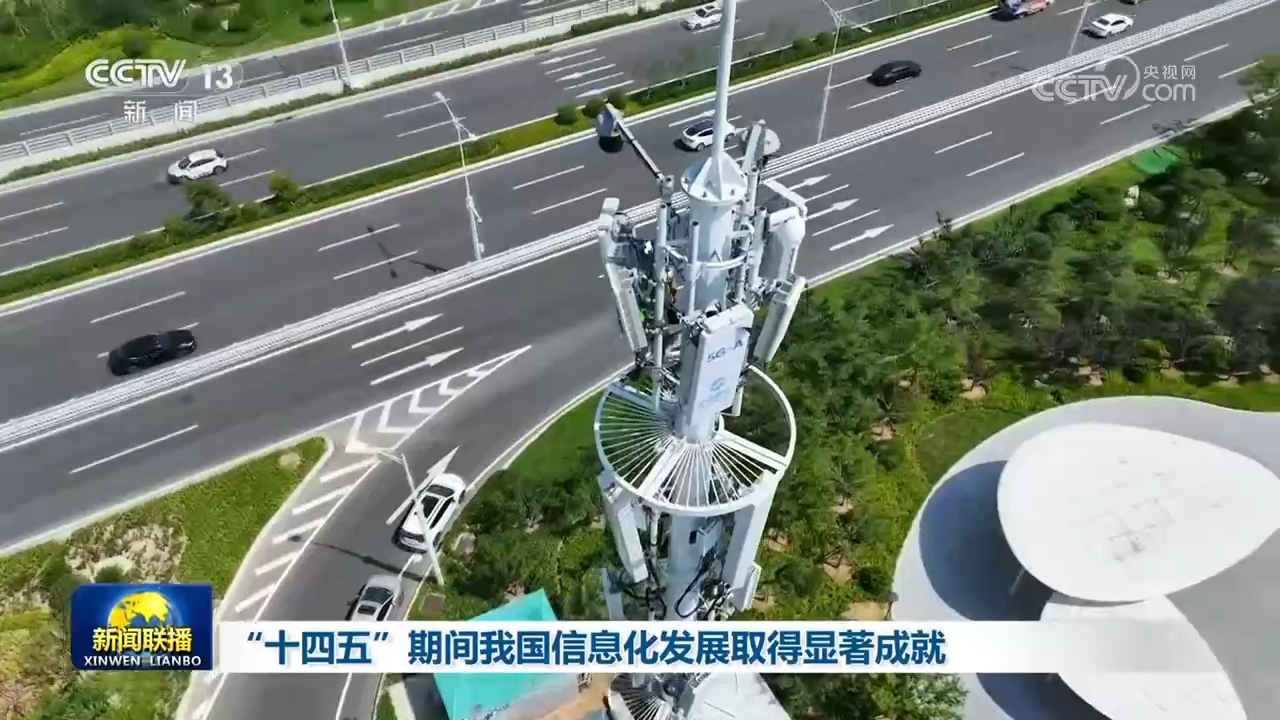
Core Insights - During the "14th Five-Year Plan" period, China has made significant achievements in information technology development, transitioning from breakthroughs in key areas to comprehensive empowerment across various sectors [1]. Group 1: Information Infrastructure - The penetration rate of 5G users in China increased from 15% to 83.9% [3]. - The number of gigabit broadband users rose from 6.4 million to 239 million [3]. - Mobile IoT users expanded from 1.136 billion to 2.9 billion [3]. Group 2: Digital Economy - The value added by the core industries of the digital economy increased from 7.8% to 10.4% of GDP, maintaining China's position as the second-largest digital economy globally [5]. - Key technologies such as integrated circuits, artificial intelligence, and foundational software have seen accelerated breakthroughs, with over 1.19 billion products equipped with the open-source Harmony operating system [5]. - Research and standardization of 6G technology are progressing steadily, with the first phase of technical testing completed and over 300 key technology reserves established [5]. Group 3: E-Government Development - A national government service "one network" has been established, with 92.5% of provincial administrative licensing matters processed online and under the "one trip at most" policy [7]. - The informatization rate of agricultural production increased from 22.5% to over 30% [7]. - By 2024, the national rural online retail sales are expected to exceed 2.5 trillion yuan, representing a 43% increase compared to the end of the "13th Five-Year Plan" [7]. - Telemedicine service networks now cover all cities and counties, accelerating the bridging of the urban-rural digital divide [7].
工信部:2025年前10月通信业运行总体平稳
Zhong Guo Xin Wen Wang· 2025-12-01 11:02
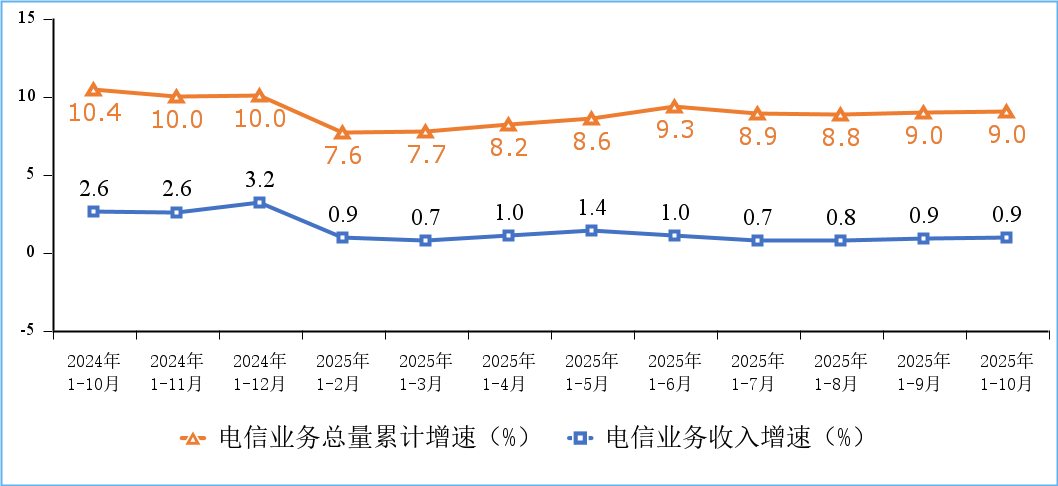
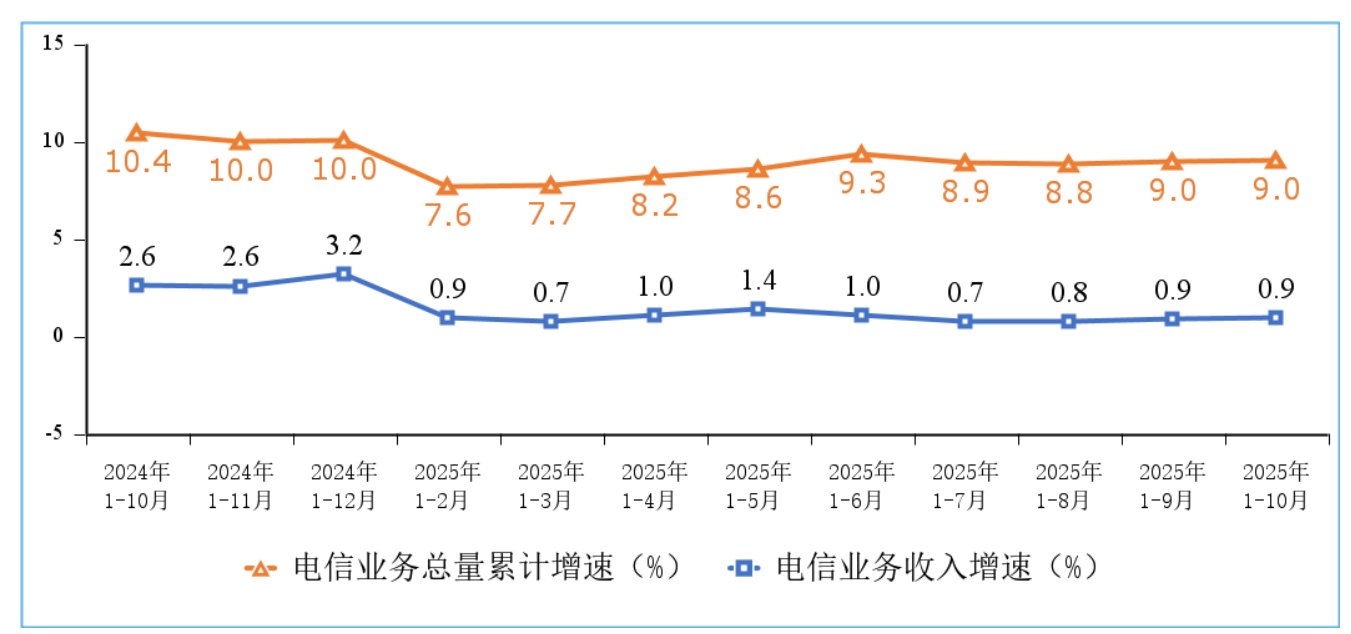
Overall Performance - The telecommunications industry has shown stable growth in business revenue, with a total revenue of 14,670 billion yuan for the first ten months of 2025, representing a year-on-year increase of 0.9%. When adjusted for last year's prices, the total business volume grew by 9% [2]. User Development - The number of fixed internet broadband users reached 697 million by the end of October, with a net increase of 27.01 million users compared to the end of last year. Users with access speeds of 100 Mbps and above accounted for 95.1% of total users, while those with speeds of 1,000 Mbps and above reached 238 million, marking a net increase of 31.13 million users and a 3.3 percentage point increase from the end of last year [4]. - The total number of mobile phone users reached 1.83 billion, with a net increase of 40.15 million users. The number of 5G mobile phone users reached 1.184 billion, with a net increase of 17 million users, accounting for 64.7% of mobile phone users [7]. - The number of mobile IoT terminal users grew rapidly to 2.89 billion, with a net increase of 23.4 million users. The number of internet TV users reached 41.2 million, with a net increase of 4.737 million users [9]. Telecommunications Usage - Mobile internet traffic maintained a rapid growth rate, with a total of 3,232 billion GB of mobile internet traffic for the first ten months, representing a year-on-year increase of 16.8%. The average monthly mobile internet access traffic per user reached 22.21 GB, a year-on-year increase of 15.7% [10]. - The total duration of mobile phone outgoing calls was 17 trillion minutes, a decrease of 5.2% year-on-year, while the duration of fixed-line outgoing calls was 56.04 billion minutes, down 14.1% year-on-year. The volume of mobile SMS services increased by 18.8%, but revenue from mobile SMS services decreased by 1.2% [10]. Communication Capability - The number of internet broadband access ports reached 1.243 billion by the end of October, with a net increase of 40.89 million ports. Fiber-to-the-home (FTTH/O) ports accounted for 96.7% of total broadband access ports, reaching 1.202 billion [11]. - The total number of 5G base stations reached 4.758 million, with a net increase of 507,000 stations, accounting for 37% of total mobile base stations, an increase of 0.4 percentage points from the previous three quarters [12]. Regional Development - The penetration rates for fixed broadband users with speeds of 1,000 Mbps and above in the eastern, central, western, and northeastern regions were 34.1%, 33.5%, 36.2%, and 27.8%, respectively, showing increases of 2.9, 2.3, 4.5, and 4.2 percentage points from the end of last year. The penetration rates for 5G mobile phone users in these regions were 64.3%, 65.4%, 64.6%, and 65.3%, with increases of 7.6, 8.2, 8.3, and 9 percentage points, respectively [13]. - The mobile internet access traffic growth rates in the eastern, central, western, and northeastern regions were 17.3%, 16.1%, 15.2%, and 25.1%, respectively, with total traffic reaching 1,357 billion GB, 761.1 billion GB, 921 billion GB, and 193.4 billion GB [13].
工信部:截至10月末 5G基站总数达475.8万个
智通财经网· 2025-11-26 02:28
Overall Performance - The telecommunications industry has shown stable growth in the first ten months of the year, with total telecom business revenue reaching 1.467 trillion yuan, a year-on-year increase of 0.9% [2] - The total telecom business volume, adjusted for last year's prices, has grown by 9% year-on-year [2] User Development - The number of fixed internet broadband users reached 697 million, with a net increase of 27.01 million users since the end of last year [4] - Users with internet access speeds of 1000 Mbps or higher reached 238 million, a net increase of 31.13 million users, representing 34.1% of total users, up 3.3 percentage points from the end of last year [4] - The total number of mobile phone users reached 1.83 billion, with a net increase of 40.15 million users, while 5G mobile phone users reached 1.184 billion, a net increase of 17 million users, accounting for 64.7% of mobile phone users [4][6] Business Usage - Mobile internet traffic has seen a significant increase, with a total of 3.232 trillion GB of mobile internet traffic recorded, a year-on-year growth of 16.8% [7] - The average monthly mobile internet access traffic per user reached 22.21 GB, an increase of 15.7% year-on-year [7] - The duration of mobile phone calls has decreased by 5.2%, while fixed-line call durations have decreased by 14.1% [7] Communication Capacity - The number of internet broadband access ports reached 1.243 billion, with a net increase of 40.89 million ports since the end of last year [8] - Fiber-to-the-home (FTTH/O) ports reached 1.202 billion, accounting for 96.7% of total broadband access ports [8] Regional Development - The penetration rates for fixed broadband users with speeds of 1000 Mbps or higher in different regions have increased, with the East, Central, West, and Northeast regions showing improvements of 2.9, 2.3, 4.5, and 4.2 percentage points respectively [10] - The penetration rates for 5G mobile phone users in these regions have also increased, with improvements of 7.6, 8.2, 8.3, and 9 percentage points respectively [10] - Mobile internet access traffic growth rates in various regions have maintained double-digit growth, with the Northeast region showing the highest growth at 25.1% [10]
十大关键词解码“十四五”中国移动通信行业发展成绩单
Zhong Guo Xin Wen Wang· 2025-11-21 12:58
Core Insights - The forum highlighted the significant achievements and forward-looking strategies of China's mobile communication industry during the 14th Five-Year Plan period, emphasizing ten key terms that reflect the industry's development [1][2] Group 1: Key Developments in 5G - China has accelerated its 5G development, achieving its construction goals ahead of schedule, with 4.705 million 5G base stations built and 1.167 billion 5G mobile phone users by September 2025 [1] - The global market share for 5G base stations and mobile phones exceeds 50%, while the market share for 5G modules surpasses 80% [1] Group 2: Application and Ecosystem Growth - The country has established the world's most extensive 5G application ecosystem, with over 138,000 5G application cases covering 86 out of 97 major categories of the national economy [1] - More than 20,000 "5G + Industrial Internet" construction projects have been initiated, and 1,260 5G factories have been cultivated, indicating a shift of industry applications from the periphery to core processes [1] Group 3: Connectivity and IoT Expansion - The initiative has achieved "gigabit access in every county, 5G access in every town, and broadband access in every village," with over 90% of administrative villages covered by 5G networks [2] - By August 2022, the number of IoT terminal users reached 1.698 billion, surpassing mobile phone users for the first time, marking a new phase of "Internet of Everything" [2] Group 4: AI Integration and 6G Development - The integration of mobile communication and AI is driving network upgrades and industry transformation, with new scenarios and models emerging, such as "smart native," "5G-A × AI," and "AI+" [2] - China has initiated 6G research and development, completing the first phase of technology trials with over 300 key technology reserves [2]
两部门:推进5G、移动物联网等工业园区网络基础设施部署
Zhong Zheng Wang· 2025-09-22 12:33
Core Viewpoint - The Ministry of Industry and Information Technology and the National Development and Reform Commission have issued guidelines for the high-quality development of industrial parks, emphasizing the digital transformation of enterprises and the enhancement of new information infrastructure [1] Group 1: Digital Transformation - The guidelines encourage enterprises in industrial parks to undertake digital upgrades of outdated equipment and promote the application of smart manufacturing equipment and systems [1] - There is a focus on exploring "chain transformation" for the overall digital transformation of the industrial and supply chains, guiding leading enterprises to develop universal digital transformation tools and solutions [1] - Support is provided for small and medium-sized enterprises to accelerate the application of "small, fast, light, and precise" digital solutions, fostering the creation of new digital products, applications, and services in the manufacturing sector [1] Group 2: Infrastructure Development - The guidelines advocate for the advancement of new information infrastructure, including the deployment of 5G, gigabit optical networks, IPv6, and mobile IoT within industrial parks [1] - There is a push for the industrial internet to be integrated into parks, along with the support for the construction or effective utilization of data storage and computing infrastructure [1] - Encouragement is given to parks with conditions to develop facilities for new technologies such as artificial intelligence and cloud computing, enhancing the application level of open-source operating systems [1]
两部门:推进5G、千兆光网、IPv6、移动物联网等园区网络基础设施部署
智通财经网· 2025-09-22 11:25
Core Viewpoint - The article discusses the "Guidelines for High-Quality Development of Industrial Parks" issued by the Ministry of Industry and Information Technology and the National Development and Reform Commission, emphasizing the importance of enhancing new information infrastructure and promoting digital transformation in industrial parks [1][3]. Overall Requirements - The guidelines aim to support the high-quality development of industrial parks by focusing on industrial characteristics, optimizing spatial governance, and promoting green development [4]. Development Orientation - Strengthening the positioning of industrial parks by identifying key industries and avoiding homogeneous competition is essential [4]. - Encouraging the clustering of industrial chains and enhancing collaboration among enterprises is highlighted [5]. - Upgrading traditional industries and fostering new and future industries through technological innovation is a priority [5]. Space Governance - The guidelines advocate for efficient land use and optimizing spatial layouts to support industrial development [6][7]. - Establishing a gradient cultivation mechanism for enterprises to support the growth of small and medium-sized enterprises alongside larger ones is emphasized [7]. Technological Innovation Capability - The guidelines encourage the establishment of high-level innovation platforms and collaboration between enterprises and research institutions to enhance technological innovation [8]. Digital Integration - Promoting the construction and application of new information infrastructure, including 5G and industrial internet, is a key focus [9]. - Encouraging digital transformation among enterprises and the development of smart manufacturing solutions is also highlighted [10]. Green and Safe Development - The guidelines stress the importance of building green facilities and promoting low-carbon development among enterprises [11][12]. - Ensuring production safety and enhancing safety management systems within industrial parks is crucial [12]. Open Cooperation - The guidelines promote industrial transfer and cooperation between parks, encouraging cross-regional collaboration and international partnerships [13]. Implementation Organization - The Ministry of Industry and Information Technology and the National Development and Reform Commission will guide local governments in implementing these guidelines and sharing best practices [14].