
通胀数据失真

Search documents
华尔街点评11月CPI:数据偏差明显,美联储不大可能因此政策转向
Sou Hu Cai Jing· 2025-12-19 07:37
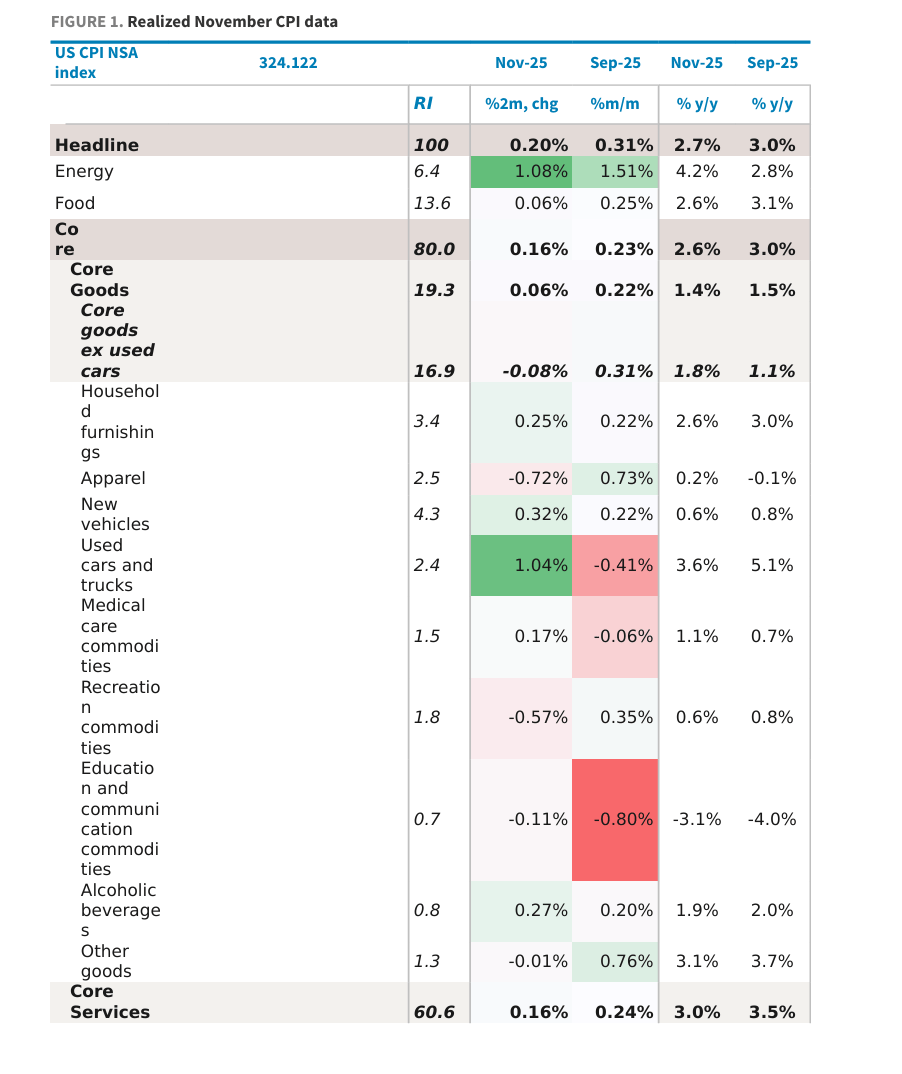
Core Insights - The November CPI data indicates a further cooling of inflation, but major Wall Street banks warn that the data is significantly affected by technical distortions and statistical biases, making it difficult to accurately reflect price trends [1][3] - Institutions like Barclays and Morgan Stanley believe that this "noisy" report is insufficient to prompt the Federal Reserve to change its policy stance in the short term [1][3] CPI Data Summary - The November core CPI recorded a growth of only 0.16% (based on the two-month change from September to November), with a year-on-year growth rate dropping to 2.6%, significantly below the market expectation of 3.0% [1][2] - The average monthly increase in core CPI for October and November was only 0.08%, far lower than the previously expected 0.28% [1][2] Data Collection Issues - The report's biggest controversy lies in the technical interference during data collection and processing, with Morgan Stanley describing it as a "noisy" dataset [4] - Barclays identified two core factors leading to the downward bias: the timing of price collection during the "Black Friday" promotional period and the handling of missing rental data [4][5] - Price collection was limited to the latter half of November, which typically sees lower prices for imported goods due to promotions, potentially leading to an underestimation of core CPI by 10-15 basis points [4][5] Housing and Services Inflation Concerns - The significant drop in housing and service sector inflation is seen as a key factor in lowering overall data, but the authenticity of this trend is questioned [6][8] - Barclays reported that rental prices only increased by 0.13% and Owner's Equivalent Rent (OER) by 0.27% over the two months, suggesting an average monthly rental increase of just 6 basis points, which analysts find highly suspicious [8] Policy Implications - Despite the inflation data appearing to provide a rationale for rate cuts, Wall Street analysts caution against overinterpretation [9] - Barclays maintains that the threshold for the Federal Open Market Committee (FOMC) to change policy remains high, with decision-makers focusing on upcoming December employment and inflation data for clearer economic signals [3][9] - Barclays continues to predict two rate cuts in March and June 2026, with rates expected to remain stable until the end of 2027 [9]


美国通胀:“不担心”的三个理由
Minsheng Securities· 2025-08-11 11:04
Group 1: Inflation Analysis - The report highlights concerns about inflation in the U.S. due to recent tariff increases, with tariffs reaching the highest level since 1933 at 18.6%[23] - Historical comparisons suggest that current inflationary pressures may resemble those seen during the 1970s oil crisis, where supply chain disruptions led to significant price increases[10] - The impact of tariffs is twofold: direct price increases and supply chain disruptions, which can lead to different inflationary outcomes[10] Group 2: Current Economic Indicators - Current inflation data tracking has become more challenging due to government layoffs and data collection issues, leading to a reliance on estimates for over one-third of inflation data[39] - Key inflation indicators show a mixed trend, with energy prices and used car prices expected to decline, while other core goods may see price increases due to tariffs[29] - The report emphasizes the importance of structural changes in inflation, noting that the breadth of price increases is rising across various sectors[32] Group 3: Risks and Concerns - There are significant risks associated with aggressive tariff policies, including potential stagflation or recession if inflation continues to rise without adequate demand control[42] - Geopolitical tensions and unexpected tariff expansions could lead to greater volatility in asset prices and a slowdown in global economic growth[42] - The accuracy of inflation data may be compromised by political influences and estimation methods, raising concerns about the reliability of reported figures[39]