酒系金融

Search documents
茅台10亿入股贵州农商联合银行,“酒系金融”版图再扩张
Xin Lang Cai Jing· 2025-12-17 13:09
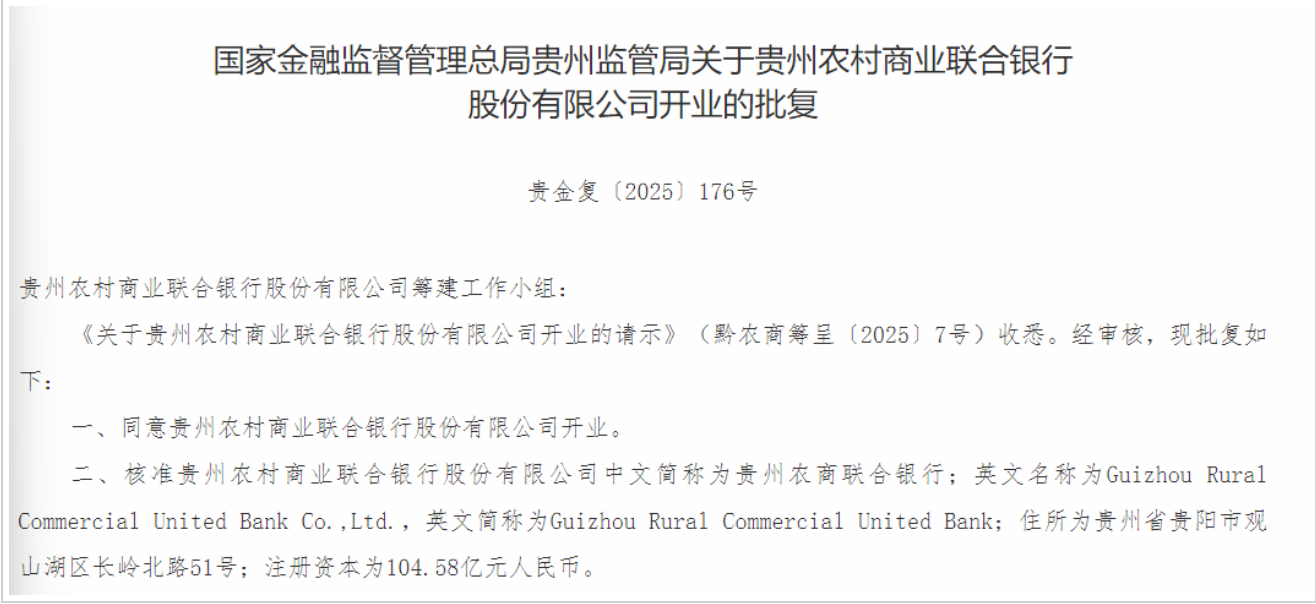
Core Viewpoint - The establishment of Guizhou Rural Commercial Bank, with a registered capital of 10.458 billion yuan, marks a significant development in the financial landscape of Guizhou, particularly with the involvement of Kweichow Moutai Group as a major shareholder, indicating a trend of collaboration between the liquor industry and financial institutions [1][3][4]. Group 1: Guizhou Rural Commercial Bank Overview - Guizhou Rural Commercial Bank has a registered capital of 10.458 billion yuan and is positioned as a key player in the banking sector of Guizhou, inheriting all debts and assets from the former Guizhou Rural Credit Cooperative Union [1][3]. - The bank's ownership structure features a dominant presence of state-owned capital, with Guizhou Financial Holding Group holding 65.844% and Guizhou Provincial Finance Department holding 15.032% [3][4]. - The bank will primarily serve as a management and service platform for 84 county-level rural commercial banks, focusing on fund clearing and settlement within the rural banking system [4][5]. Group 2: Kweichow Moutai Group's Financial Strategy - Kweichow Moutai Group has invested 1 billion yuan for a 9.562% stake in Guizhou Rural Commercial Bank, marking its fourth investment in the banking sector, following previous stakes in Guizhou Bank and Guiyang Bank [3][5]. - The group's financial strategy has evolved over time, with significant investments in various financial institutions, including a 12% stake in Guizhou Bank and a 1.45% stake in Guiyang Bank, showcasing a broadening financial footprint [5][6]. - Moutai's financial ambitions are part of a long-term strategy to leverage its cash flow for stable investments while contributing to the economic development of Guizhou [7][8]. Group 3: Industry Trends and Challenges - The collaboration between liquor companies and banks is becoming more pronounced, with other liquor giants like Luzhou Laojiao and Wuliangye also investing in banking institutions, creating a unique "liquor bank" ecosystem [8][9]. - The financial sector offers liquor companies a means to utilize idle funds effectively, while banks can provide financing services to the liquor supply chain, enhancing the industry's influence [10][11]. - However, challenges persist, including rising non-performing loan rates in the banking sector and structural adjustments within the liquor industry, prompting companies to seek growth opportunities beyond their traditional markets [10][11].