白酒业

Search documents
上证指数ETF富国(510210)开盘涨0.21%,重仓股农业银行涨0.00%,中国石油跌3.09%
Xin Lang Cai Jing· 2026-03-25 01:32
Group 1 - The Shanghai Stock Index ETF (510210) opened at 0.977 yuan, with a gain of 0.21% on March 25 [1][2] - Major holdings of the ETF include Agricultural Bank (0.00%), China Petroleum (-3.09%), Kweichow Moutai (0.20%), Industrial Fulian (1.13%), Bank of China (-0.18%), Zijin Mining (4.04%), China Shenhua (-2.06%), China Life (0.28%), China Merchants Bank (0.20%), and Ping An Insurance (0.65%) [1][2] - The ETF's performance benchmark is the Shanghai Composite Index, managed by Fortune Fund Management Co., with fund managers Fang Min and Wang Baohe [2] Group 2 - Since its establishment on January 30, 2011, the ETF has achieved a return of 106.07%, while the return over the past month is -5.74% [2] - A MACD golden cross signal has formed, indicating a positive trend for certain stocks [3]




全国首单落地!数字人民币到了新level:让农民工工资秒到账、不截留
第一财经· 2026-02-11 02:11
Core Viewpoint - The article highlights the successful implementation of the first digital RMB smart contract for wage payments to migrant workers in Chengdu, showcasing a significant innovation in ensuring timely and full payment of wages, addressing long-standing issues in traditional payment methods [1][3]. Group 1: Digital RMB Smart Contract Implementation - The digital RMB smart contract allows for automatic wage payments, targeted fund disbursement, and full traceability, effectively addressing concerns related to wage payment for migrant workers [3][4]. - The initiative is a collaboration involving multiple parties and technological innovations, marking a breakthrough in applying digital RMB smart contracts in critical livelihood scenarios [3][4]. - The first application involved the issuance of over 1 million RMB in wages to 104 workers, with funds directly reaching their digital wallets, ensuring transparency and immediate payment [3][4]. Group 2: Advantages and Features - The "Anxin Zhu" platform developed by a local company provides accurate business data, enhancing the precision of wage payments and addressing issues like "separation of people and cards" in the traditional construction industry [4]. - The digital RMB smart contract system is characterized by standardization, automation, and traceability, which eliminates human intervention and supports cross-institutional interoperability [4][5]. Group 3: Broader Applications and Future Prospects - Beyond wage payments, digital RMB smart contracts have been piloted in areas such as prepaid fund management and supply chain finance, with a total of 486,400 contracts signed and a transaction amount of 316 million RMB as of January 2026 [5][6]. - In supply chain finance, these contracts ensure that credit funds are used specifically for production, reducing the risk of fund misuse [7]. - The digital RMB smart contract can operate on both blockchain and off-chain environments, allowing banks to customize product services based on their business scenarios [7][8].


大摩闭门会-市场巨震之后
2026-02-10 03:24
Summary of Conference Call Notes Company/Industry Involved - Focus on the Chinese economy, particularly fiscal and real estate policies, and their implications for various sectors including telecommunications, gaming, internet, and finance [1][2][3][4][5][6][7][8][9][10][11][12][13][14][15][16][17][18][19][20][21][22][23][24][25][26][27][28][29][30][31][32][33][34][35][36][37][38][39][40] Core Points and Arguments 1. **Contradictory Market Expectations**: There are conflicting expectations regarding China's fiscal and real estate policies, with concerns about potential tax increases versus hopes for significant real estate policy interventions [2][8][9][10][11][12][13][14][15][16][17][18][19][20][21][22][23][24][25][26][27][28][29][30][31][32][33][34][35][36][37][38][39][40] 2. **Fiscal Policy Outlook**: The fiscal policy for the year is expected to be moderate, with no significant tax increases anticipated for private enterprises, particularly in the gaming and internet sectors [3][4][5][6][7][8][9][10][11][12][13][14][15][16][17][18][19][20][21][22][23][24][25][26][27][28][29][30][31][32][33][34][35][36][37][38][39][40] 3. **Economic Growth and Deflation**: The current economic environment is characterized by weak domestic demand and deflationary pressures, which complicate fiscal policy decisions [5][6][7][8][9][10][11][12][13][14][15][16][17][18][19][20][21][22][23][24][25][26][27][28][29][30][31][32][33][34][35][36][37][38][39][40] 4. **Infrastructure Investment**: There is an expectation for increased infrastructure investment in the first half of the year, but overall fiscal stimulus may remain limited unless economic conditions worsen [5][6][7][8][9][10][11][12][13][14][15][16][17][18][19][20][21][22][23][24][25][26][27][28][29][30][31][32][33][34][35][36][37][38][39][40] 5. **Real Estate Policy**: Any potential real estate policy changes are likely to be marginal rather than aggressive, focusing on specific cities rather than broad measures [7][8][9][10][11][12][13][14][15][16][17][18][19][20][21][22][23][24][25][26][27][28][29][30][31][32][33][34][35][36][37][38][39][40] 6. **Global Economic Influences**: The recent appointment of Kevin Warsh to the Federal Reserve is expected to influence U.S. monetary policy, which may have implications for global liquidity and investment strategies [10][11][12][13][14][15][16][17][18][19][20][21][22][23][24][25][26][27][28][29][30][31][32][33][34][35][36][37][38][39][40] 7. **AI's Impact on Employment**: The rise of AI is anticipated to disrupt employment patterns, with varying effects across different sectors in the U.S. and China [11][12][13][14][15][16][17][18][19][20][21][22][23][24][25][26][27][28][29][30][31][32][33][34][35][36][37][38][39][40] 8. **Japan's Political Landscape**: The recent election results in Japan are expected to lead to more stable fiscal policies and increased government spending, particularly in defense and strategic industries [14][15][16][17][18][19][20][21][22][23][24][25][26][27][28][29][30][31][32][33][34][35][36][37][38][39][40] Other Important but Possibly Overlooked Content 1. **Market Sentiment**: Investor sentiment is currently cautious, reflecting concerns over fiscal tightening and potential tax increases, which could negatively impact private sector confidence [4][5][6][7][8][9][10][11][12][13][14][15][16][17][18][19][20][21][22][23][24][25][26][27][28][29][30][31][32][33][34][35][36][37][38][39][40] 2. **Long-term Investment Trends**: There is a growing trend of global investment funds reallocating towards Chinese assets, indicating a potential long-term positive outlook despite short-term volatility [17][18][19][20][21][22][23][24][25][26][27][28][29][30][31][32][33][34][35][36][37][38][39][40] 3. **Sector-Specific Adjustments**: Specific sectors such as telecommunications and renewable energy are experiencing tax adjustments that may not reflect broader fiscal policy trends [36][37][38][39][40]
A股晚间热点 | 十五五首个中央一号文件发布!发展农业新质生产力 专家解读来了
智通财经网· 2026-02-03 15:36
Group 1 - The first central document of the 15th Five-Year Plan emphasizes "normalized precise assistance" for rural revitalization, marking a shift from previous phases of targeted assistance to a more stable approach [1] - The document promotes the integration of artificial intelligence with agriculture, expanding applications for drones, IoT, and robotics [1] - It encourages rural consumption growth through support for electric vehicles, smart home appliances, and green building materials [1] Group 2 - Gold and silver prices rebounded sharply after significant declines, with gold recovering to show a year-to-date increase of 14% and silver rising by 21% [2] - The Shanghai Gold Exchange adjusted margin levels and price fluctuation limits for gold and silver futures due to high volatility [2] - Other precious metals like platinum and palladium also saw adjustments in trading margins and price limits [2] Group 3 - The People's Bank of China announced an 800 billion yuan reverse repurchase operation to maintain liquidity in the banking system [3] - The operation will be conducted with a fixed amount and interest rate, with a term of three months [3] - The central bank's liquidity measures included net withdrawals and injections across various lending tools [3] Group 4 - In January 2026, 4.92 million new A-share accounts were opened, a 213% increase year-on-year and 89% increase month-on-month [5] - This figure is the highest for any month in 2025 and ranks as the fifth highest in nearly a decade [5] - Current market conditions differ from the 2015 bull market, with lower valuation levels and a healthier funding structure [5] Group 5 - Guizhou Moutai's stock price rose over 3%, reflecting positive market response to its market-oriented transformation [7] - The iMoutai platform reported over 6 million new users and 15 million monthly active users in January 2026, indicating a significant shift towards consumer engagement [7] Group 6 - In January 2026, over 600 A-share companies were surveyed by institutions, with increased interest in the banking sector [9] - Factors such as low interest rates and consistent dividends are driving long-term investments in banks [9] - Other sectors of interest include robotics and digital economy initiatives [9][11]

策略周报:波动明显上升,适度回归稳健-20260201
HWABAO SECURITIES· 2026-02-01 13:18
Group 1 - The report indicates that market volatility has significantly increased, suggesting a return to a more stable investment approach as the market approaches the holiday season [4][14] - The bond market is showing signs of support, with the central bank's clear stance on maintaining liquidity, which is expected to help stabilize the market during the holiday period [3][13] - The report highlights that the 10-year government bond yield is anticipated to gradually decline to around 1.80%, emphasizing the importance of high-yield bond allocations [3][13] Group 2 - The equity market is experiencing increased volatility, with a shift towards more defensive sectors such as liquor and real estate, indicating a potential end to the current market rotation [4][14] - The report notes that the A-share market has shown a mixed performance, with the Shanghai Composite Index declining by 0.44% and the Wind All A Index down by 1.59% [11] - The report suggests that investors should consider reducing exposure to sectors lacking earnings support and increase holdings in high-dividend stocks to mitigate portfolio volatility [4][14] Group 3 - The report provides a review of significant events, including the announcement of the Federal Reserve's decision to maintain the federal funds rate between 3.50% and 3.75%, reflecting a cautious approach to economic conditions [10] - It also mentions that the profit of large-scale industrial enterprises in China increased by 0.6% year-on-year, indicating a stable economic environment [10] - The report emphasizes the importance of monitoring upcoming economic indicators, such as the European Central Bank's interest rate decision and U.S. non-farm payroll data [27]
离春节不到1个月,有人预测4类东西将涨价,早做准备不花冤枉钱
Sou Hu Cai Jing· 2026-01-26 15:35
Group 1 - Major companies are planning to raise prices after the Spring Festival, affecting various products from packaging to snacks and skincare items [1][3] - The paper industry is experiencing a collective price increase, with leading companies announcing a price hike of 200 yuan per ton for white cardboard starting from late February or early March 2026 [3][10] - The increase in paper prices is driven by rising operational costs and reduced supply, with major manufacturers like Jiu Long Paper and Lin Sheng Pulp Paper planning maintenance that will decrease market supply by approximately 120,000 tons [8][10] Group 2 - The price increase strategy is timed to coincide with the post-holiday market recovery, creating urgency for downstream customers to purchase before prices rise [12][14] - The cost of packaging materials is expected to rise, impacting the prices of consumer goods, particularly popular snacks like nuts, which have already seen price adjustments ranging from 0.2 to 10 yuan [16][20] - The beverage industry, particularly high-end liquor brands, is also expected to raise prices following the Spring Festival, as maintaining brand image is crucial for premium products [27][31] Group 3 - International beauty brands are anticipated to adjust prices in the post-Spring Festival period, with average increases typically ranging from 10% to 30% [37][38] - Brands like Estée Lauder and L'Oréal are likely to raise prices on numerous products, with significant price hikes reported for individual items [40][42] - The rationale behind these price increases includes rising raw material costs, increased operational expenses, and currency fluctuations, as companies face pressure to improve profit margins amid declining sales [42][43]


[回眸“十四五”·高质量发展这五年]喜看黔山焕新彩
Xin Lang Cai Jing· 2026-01-24 22:39
Economic Development - Guizhou focuses on "Four New" and "Four Modernizations" to enhance economic development and industrial upgrading, with industrial contribution to GDP increasing from 17.1% in 2020 to 36.1% by Q3 2025 [1] - The province aims for a 7.0% growth in industrial added value by 2025, with significant exports in electric vehicles, lithium batteries, and solar cells projected to rise by 85.8% in 2024 [1] Agricultural Modernization - Guizhou is developing modern mountain characteristic high-efficiency agriculture, with a total agricultural output value expected to reach 519.64 billion yuan in 2025, a 4.5% increase from the previous year [2] - The province leads the nation in the planting scale of various crops, including chili peppers and medicinal herbs, with 13 national modern agricultural industrial parks established [2] Tourism Development - The tourism sector is projected to see an 8.9% increase in visitor numbers and an 11.1% rise in total tourism expenditure by 2025, with a 46.6% increase in international tourists from January to October 2025 [2] - The opening of the Hongjiang Gorge Bridge on September 28, 2025, is expected to enhance regional tourism and serve as a world-class tourism landmark [2] Quality of Life - Guizhou's GDP is expected to reach 2.356 trillion yuan in 2025, with a per capita GDP surpassing 60,000 yuan, reflecting a 4.9% growth from the previous year [3] - The province aims to create over 600,000 new urban jobs annually, with disposable income for urban and rural residents projected to grow by 3.9% and 5.7% respectively by 2025 [3] Future Outlook - Guizhou plans to continue implementing the "Four New" mission and "Four Modernizations" strategy, aiming for accelerated development and a vibrant practice of Chinese-style modernization [4]
老登的哀嚎
Sou Hu Cai Jing· 2026-01-23 16:01
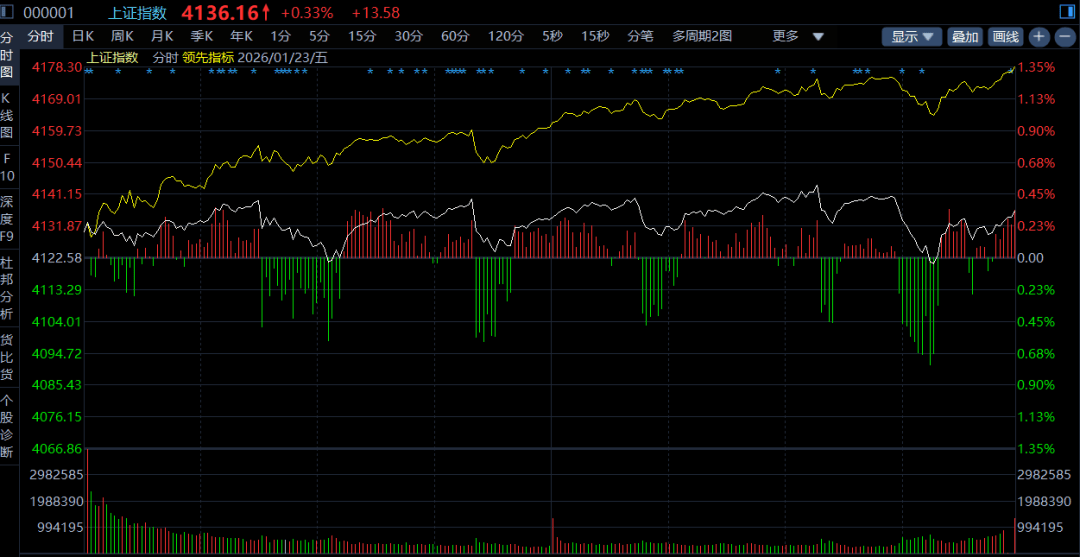
Core Viewpoint - The market is experiencing significant volatility due to the production team's systematic selling of broad-based ETFs, which is closely tied to the movements of the Shanghai Composite Index. This has created a pattern resembling an electrocardiogram, with repeated sell-offs and recoveries as the index fluctuates around a 0.45% threshold [1][3]. Group 1: Market Dynamics - The production team's selling strategy is causing some investors to react with caution, akin to conditioned reflexes, leading to a reluctance to buy when the index rises [3]. - Conversely, some investors are capitalizing on the situation by purchasing at lower prices after the production team's sell-offs, particularly in a strong market environment [3]. - The market has shown strong performance with a trading volume of 4 trillion, and the median index has risen by 0.90%, indicating robust activity despite the production team's interventions [3]. Group 2: Index Performance - Small-cap indices have performed well, while large-cap indices like the Shanghai 50 and CSI 300 have suffered, with the Shanghai 50 experiencing a nine-day decline [4]. - Notable stocks such as Moutai, China Yangtze Power, and China Mobile have been adversely affected, reflecting the broader struggles of the large-cap indices [4]. Group 3: Future Outlook - The production team has reportedly sold off about half of their ETF holdings, raising questions about the sustainability of their selling pressure in the coming weeks [5]. - Potential buyers of the sold ETFs include market makers and insurance companies, who may find value in the higher dividend yields of the depressed large-cap stocks [5]. - Three possible market scenarios are anticipated: continued index growth driven by small-cap stocks, a sideways consolidation leading up to the Lunar New Year, or a downward trend [6][7].
新华基金、宏利基金发布四季报更正公告,信披质量有待进一步提升
Sou Hu Cai Jing· 2026-01-23 03:48
Group 1 - The core issue highlighted is the recent correction announcements by Manulife Fund and Xinhua Fund regarding their Q4 2025 public fund reports, indicating lapses in data disclosure accuracy [2][3] - Manulife Fund's correction involved a mix-up between "active investment portfolio" and "index investment portfolio," leading to incorrect disclosures of stock investment details [4] - Xinhua Fund's error was a basic arithmetic mistake in the calculation of the total percentage of stock investments by industry, incorrectly reporting 93.91% instead of the correct 94.27% [7][11] Group 2 - The frequency of correction announcements in the public fund industry has been increasing, with 188 corrections in 2023 and 381 in 2024, indicating a systemic issue with data accuracy [13] - Errors in fund reports range from numerical mistakes to textual errors and omissions, raising concerns about the internal quality control processes of fund management companies [13] - The responsibility of custodians in verifying the accuracy of fund reports is questioned, especially when discrepancies arise despite their assurances of thorough review [18][19] Group 3 - The high custodial fees paid by Xinhua Fund and Manulife Fund, amounting to 41 million and 86 million respectively in 2024, are expected to correspond with a high level of diligence in report verification [19] - The recent corrections reflect a broader need for improvement in the quality of information disclosure within the rapidly growing public fund industry [19]

数字人民币十年蝶变:升级2.0,混合架构开辟全球数字货币新路径
第一财经· 2026-01-22 14:03
Core Viewpoint - The digital renminbi is transitioning from a cash-based model (M0) to a broader coverage including deposits (M1, M2), marking a significant upgrade from version 1.0 to 2.0, which is expected to be fully realized by 2026 [2][3]. Group 1: System Architecture and Operation Mechanism - The digital renminbi 2.0 retains the successful core elements of its pilot phase, particularly the "central bank-commercial institution" dual-layer operational system, which has gained global recognition as a standard for digital currencies [3]. - The People's Bank of China (PBOC) continues to lead the construction and operation of the digital renminbi system, focusing on three core needs: interconnectivity, standardized system construction, and risk prevention mechanisms [4]. - The central bank's digital renminbi system is responsible for lifecycle management, including issuance, exchange, and circulation, as well as providing essential business functions like wallet management and smart contract template management [5]. Group 2: Technological Innovations - The upgrade includes a digital solution based on "account system + currency string + smart contracts," enhancing the digitalization and intelligence of the renminbi's issuance and circulation processes [5]. - The digital renminbi achieves full traceability throughout its lifecycle, with real-time feedback to the central bank regarding transaction data, differing from traditional bank deposits [5]. - The digital renminbi's architecture is a hybrid model that combines centralized ledgers with blockchain technology, allowing for flexible application based on different transaction scenarios [10][11]. Group 3: Cross-Border Applications - The digital renminbi is exploring blockchain applications in various fields, including the establishment of a cross-border payment network through the mBridge initiative, which has processed 4,868 cross-border payment transactions amounting to approximately 477.8 billion yuan [14][15]. - The use of blockchain technology in cross-border payments addresses traditional system shortcomings, such as data privacy and security risks, by allowing local management of data by each participating central bank [15]. - Future expansions of the digital renminbi's cross-border use will focus on technological iterations to broaden access and reduce service costs, facilitating cross-border trade and investment [16].