量子-经典混合计算

Search documents
“QPU+GPU”异构计算或将重塑AI生态
Ke Ji Ri Bao· 2025-12-25 05:01
Core Insights - Turing Quantum and Moore Threads have formed a strategic partnership to develop a "QPU+GPU" heterogeneous computing platform aimed at accelerating quantum computing simulations and integrating quantum and classical computing capabilities to empower AI research [1][3][4] Group 1: Strategic Collaboration - The collaboration was announced at the first MUSA Developer Conference, highlighting the importance of combining quantum processing units (QPU) with graphics processing units (GPU) [1][3] - The partnership aims to leverage the strengths of both QPU and GPU, where QPU can handle complex tasks that classical computing struggles with, while GPU excels in large-scale numerical calculations and gradient optimization [1][3] Group 2: Technical Challenges - The integration of QPU and GPU faces significant challenges, particularly in communication bottlenecks and data transmission delays, as quantum states require data exchange to occur within microsecond levels [2][3] - A key objective of this integration is to utilize GPU's computational power to assist QPU in quantum error correction (QEC), which necessitates real-time decoding of error characteristics and rapid feedback of correction instructions [2][3] Group 3: Future Prospects - Turing Quantum plans to advance the core technology of quantum-classical hybrid systems through self-reliance in algorithms, architecture, and systems, aiming to create an open and controllable new computing ecosystem [4] - The "QPU+GPU" heterogeneous computing approach is expected to accelerate quantum computing into a fault-tolerant era and potentially establish new standards for AI infrastructure, positioning China favorably in the global computing power competition [4]

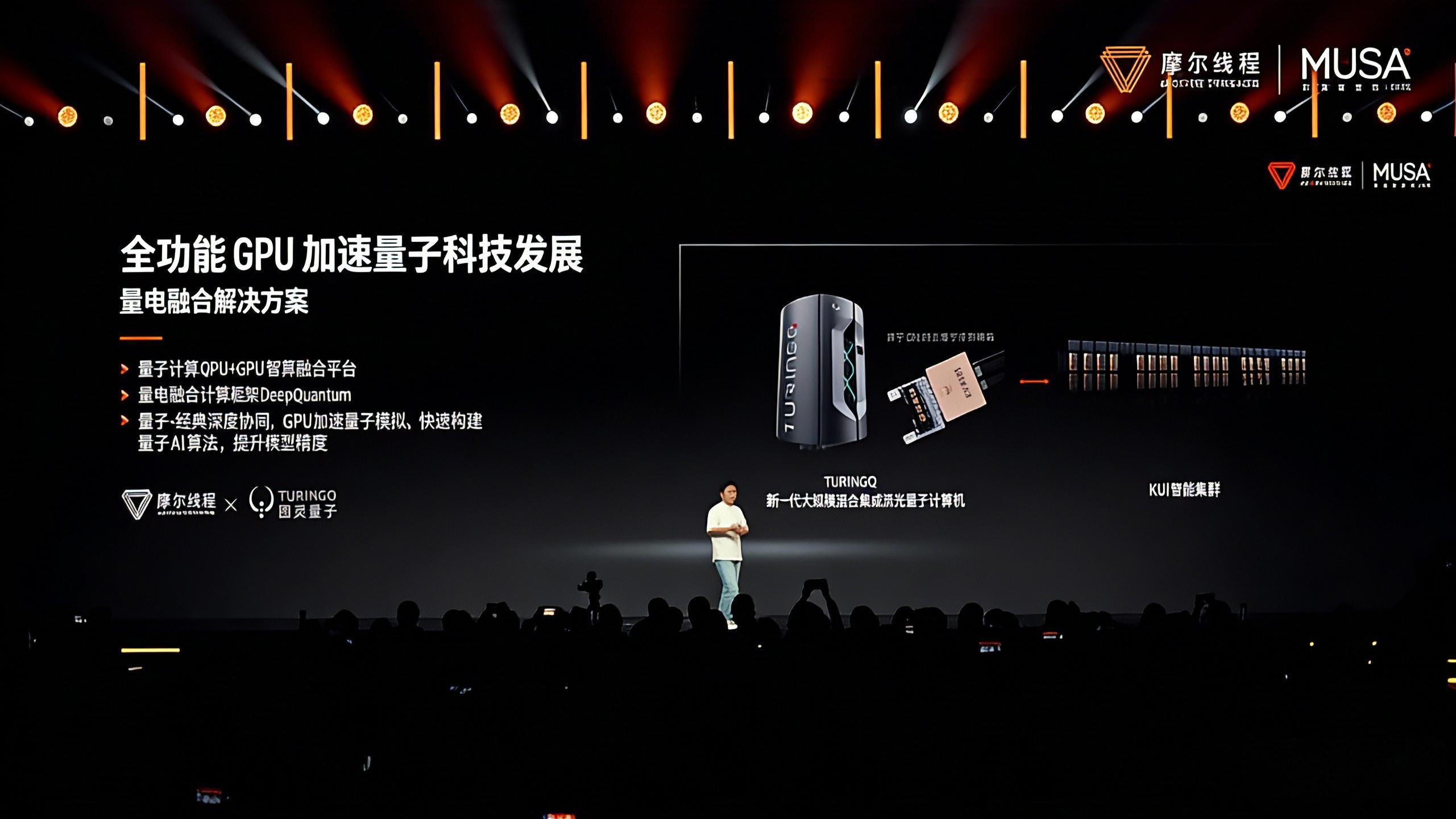
摩尔线程与图灵量子达成合作 推动量子经典混合技术应用
Zhong Guo Zheng Quan Bao· 2025-12-20 12:04
Core Insights - Turing Quantum and domestic GPU leader Moore Threads signed a strategic cooperation agreement to focus on quantum-classical hybrid computing [1] - The collaboration aims to accelerate the localization of core technologies and applications in quantum-classical hybrid computing, creating an open and controllable new computing ecosystem [1] Company Collaboration - The partnership will explore GPU-accelerated quantum computing simulation paths, optimizing model performance and computational efficiency for various fields including scientific computing, biomedicine, fintech, aerospace, materials chemistry, cryptanalysis, and communication networks [2] - Joint development of a hybrid computing architecture that integrates GPU and Quantum Processing Unit (QPU) to create a heterogeneous cloud computing collaboration platform across regions and fields [2] - Focus on overcoming core technologies to build large-scale fault-tolerant optical quantum computers, integrating cutting-edge technologies for a new generation of high-performance computing infrastructure [2] Technological Capabilities - Turing Quantum has developed fully autonomous photonic chips and quantum algorithms, leading the construction of China's first photonic chip pilot line, with comprehensive capabilities from chip design to system integration [1] - Moore Threads, as the first publicly listed GPU company in China, has established a complete product matrix covering AI, scientific computing, and graphics rendering [1]
研判2025!中国量子模拟器行业发展历程、相关政策及市场规模分析:从理论突破到市场增长,迈向前沿应用的新征程[图]
Chan Ye Xin Xi Wang· 2025-10-19 01:21
Core Insights - The quantum simulator industry in China is projected to reach a market size of approximately 1.506 billion yuan in 2024, reflecting a year-on-year growth of 15.23% [10][11] - Key challenges facing the quantum simulator sector include quantum noise accumulation and system scalability [10] - The development of modular architectures in quantum simulators, such as the nano-electronic quantum simulator by a US-UK joint team, enhances scalability from single units to large networks [10][11] Industry Overview - Quantum simulators are specialized computational tools based on quantum mechanics principles, primarily used to simulate the behavior of quantum systems [2] - They are categorized into digital quantum simulators and analog quantum simulators [2] Industry Development History - The concept of quantum simulation was established in 1982 by Richard Feynman, with significant milestones achieved in subsequent years, including the realization of the Fermi-Hubbard model by the University of Science and Technology of China in 2024 [4][5] - The development trajectory showcases a complete evolution from theoretical foundations to technological breakthroughs [4] Relevant Policies - Quantum technology has been included in China's "14th Five-Year Plan," emphasizing its importance as a core future industry [6] - The government has introduced various policies to support the research and industrialization of quantum technology, enhancing its global competitiveness [6] Industry Value Chain - The upstream of the quantum simulator industry includes essential components such as quantum chips, dilution refrigerators, and quantum light sources [8] - The midstream focuses on the manufacturing of quantum simulators and software development, while the downstream applications span finance, pharmaceuticals, logistics, and energy sectors [8] Market Size - The quantum simulator market in China is expected to grow significantly, with a projected size of 1.506 billion yuan in 2024, driven by advancements in quantum technology and government support [10][11] - Investment in quantum technology has surged, with 29 financing events recorded in the first eight months of 2025, marking a 93.33% increase year-on-year [10][11] Key Companies' Performance - The competitive landscape of the quantum simulator industry is characterized by leading hardware companies like GuoDun Quantum and Benyuan Quantum, which have established significant technological barriers [11] - GuoDun Quantum reported a revenue of 121 million yuan in the first half of 2025, a 74.54% increase year-on-year, with R&D investment also rising [11][12] Industry Development Trends 1. **Technological Integration and Hardware Breakthroughs**: The next five years will see deep integration of quantum simulators with AI and digital twin technologies, enhancing performance and reducing error rates [14] 2. **Deepening Application Scenarios**: Quantum simulators will penetrate core sectors such as manufacturing and finance, optimizing processes and improving returns [14] 3. **Accelerated Standardization**: China aims to lead in establishing international standards for quantum simulators, enhancing compatibility and competitiveness on a global scale [15]