银行息差压力

Search documents
100万元起步!工商银行三年期大额存单门槛提高,年利率为1.55%
Sou Hu Cai Jing· 2025-12-03 09:09
Core Viewpoint - The banking sector is experiencing significant pressure on net interest margins, leading to a reduction in the availability and attractiveness of long-term deposit products, particularly large-denomination certificates of deposit (CDs) [2][5][12]. Group 1: Large-Denomination Certificates of Deposit - Industrial and Commercial Bank of China (ICBC) is currently offering a three-year large-denomination CD with a minimum deposit of 1 million yuan and an interest rate of 1.55% [2][8]. - Previously, the minimum deposit for large-denomination CDs across banks was generally 200,000 yuan, indicating a shift in market conditions [2][8]. - Major state-owned banks have collectively removed five-year large-denomination CDs from their offerings, with only three-year products remaining, which have seen interest rates drop to between 1.5% and 1.75% [2][8]. Group 2: Market Adjustments and Trends - Several small and medium-sized banks have begun to adjust or eliminate their three-year and five-year fixed deposit products, reflecting a broader trend of long-term deposits "retreating" from the market [2][9]. - The first bank to publicly announce the cancellation of five-year fixed deposits was a rural bank in Inner Mongolia, which took effect on November 5 [2][9]. - At least seven private banks, including Meizhou Merchants Bank and Mybank, have also removed five-year fixed deposit products from their offerings [2][9]. Group 3: Interest Rate Trends and Financial Performance - As of the fourth quarter, multiple small and medium-sized banks have announced reductions in RMB deposit rates, with some cuts reaching as high as 80 basis points [3][9]. - According to the National Financial Regulatory Administration, the net interest margin for private banks decreased by 0.08 percentage points quarter-on-quarter, indicating a common challenge across the industry [5][11]. - Among 26 listed banks that reported third-quarter net interest margin data, 12 banks saw their margins stabilize or increase, while 14 banks continued to experience a downward trend [5][12]. - Everbright Securities predicts that the net interest margin will continue to decline in an "L" shape, with an expected annual contraction of approximately 15 basis points to 1.36% [6][12].



A股银行中报业绩观察:中期分红在路上,息差压力仍存
Mei Ri Jing Ji Xin Wen· 2025-08-24 12:21
Core Viewpoint - The performance of seven A-share listed banks in the first half of 2025 shows steady growth in total assets, operating income, and net profit attributable to shareholders, with a decrease in non-performing loan ratios, indicating ongoing risk improvement [1][2]. Group 1: Financial Performance - Seven banks reported positive growth in total assets compared to the beginning of the year, with Ningbo Bank leading at an 11.04% increase, the only bank exceeding 10% [2]. - All seven banks achieved year-on-year growth in operating income and net profit attributable to shareholders, with Shanghai Pudong Development Bank's total revenue surpassing 90 billion yuan, a 2.62% increase [2]. - Jiangyin Bank reported the highest revenue growth at 10.45%, while Changshu Bank followed closely with a 10.1% increase in revenue [3]. Group 2: Asset Quality - The non-performing loan ratios of Ningbo Bank, Hangzhou Bank, and Jiangyin Bank remained stable compared to the beginning of the year, while the other four banks showed varying degrees of improvement, with Qilu Bank experiencing the largest decline of 10 basis points [2]. Group 3: Dividend Expectations - Several banks have announced expectations for mid-year dividends, with the high dividend yield of bank stocks enhancing their investment value [1][4]. - The total cash dividends of A-share listed banks reached 646.025 billion yuan in 2024, reflecting a year-on-year increase of 5.33%, which has bolstered investor confidence [4]. Group 4: Market Trends - The banking sector has seen a significant upward trend, with the China Securities Banking Index rising by 52.7% since the beginning of 2024 [4]. - The average net interest margin for commercial banks was 1.42% in the first half of the year, down 10 basis points from the end of the previous year, indicating pressure on interest margins [5].
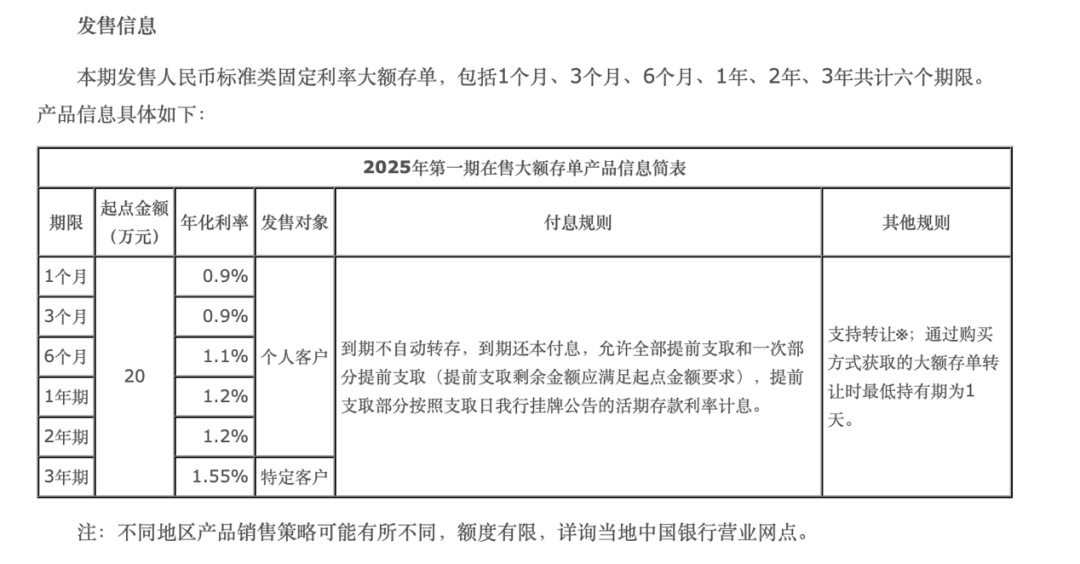
最新!跌破1%
Zhong Guo Ji Jin Bao· 2025-05-21 08:35
Core Viewpoint - A new round of interest rate cuts for large-denomination certificates of deposit (CDs) has begun, with some products' rates falling below 1% for the first time in recent years, indicating a significant shift in the banking sector's approach to deposit rates [1][9]. Summary by Category Interest Rate Changes - Major banks, including state-owned banks, have reduced the annualized interest rates for 1-month and 3-month large-denomination CDs to 0.9%, marking a historic low [1][3]. - The latest issuance by Bank of China shows a reduction of 25 basis points for 1-month, 3-month, 6-month, and 1-year products, while the 3-year product saw a reduction of 35 basis points [3][10]. - Other banks, such as Industrial and Agricultural Banks, have also lowered their rates to 0.9% for similar products [3][6]. Implications for the Banking Sector - The reduction in deposit rates is seen as a strategy to alleviate pressure on net interest margins, which have been declining [10][11]. - Analysts suggest that lowering deposit rates will help banks stabilize their net interest margins and reduce financing costs for the real economy [10][11]. Investor Guidance - Investors are advised to adjust their expectations regarding investment returns and consider a diversified asset allocation strategy in light of the declining interest rates [1][8][11]. - The trend of decreasing deposit rates is expected to continue, prompting investors to seek alternative investment options such as cash management products, money market funds, and government bonds [11].