存款利率下调

Search documents
多家中小银行,下调存款利率
新华网财经· 2026-03-29 02:33
Group 1 - The core viewpoint of the article highlights a trend of declining deposit interest rates among banks, particularly small and medium-sized banks, with many rates dropping to the "1" range [3][4]. - Starting from April 1, a specific bank will adjust its three-year and five-year fixed deposit rates to 1.8%, a decrease of 20 basis points from the current rates [2]. - Several banks have implemented differentiated adjustments in deposit rates, with some banks experiencing a "long-short inversion" phenomenon in their rates [5][6]. Group 2 - The downward trend in deposit rates is expected to continue due to multiple factors, including pressure on net interest margins, high funding costs, and intensified competition for deposits [8]. - Some banks are reverting previously elevated rates from promotional activities back to normal levels to manage net interest margins and long-term funding costs [8]. - Future expectations indicate that long-term deposit rates may continue to decline, while the proportion of short-term products is likely to increase, reflecting a consensus in the industry regarding the long-term decline in interest rates [8].


密集降息!中小银行长期存款利率迈入“1”字头
券商中国· 2026-03-24 03:17
Core Viewpoint - Since March, small and medium-sized banks in regions such as Xinjiang, Yunnan, and Shanghai have significantly reduced their fixed deposit interest rates, with cuts ranging from 5 to 80 basis points across various types of banks, including city commercial banks, rural commercial banks, village banks, and private banks [1][2]. Group 1: Interest Rate Adjustments - The adjustments cover all terms, with notable reductions in medium to long-term fixed deposit rates, which have generally fallen below "2" and into the "1" range [2][3]. - Some banks have lowered long-term deposit rates to below 1.5%, with significant cuts observed; for instance, Changji National Village Bank reduced its three-year and five-year rates from 2.2% to 1.4%, marking an 80 basis point drop [3][4]. - Short-term deposit rates have also decreased, with one-year and two-year rates down to 1.2% and 1.3%, respectively, while three-month and six-month rates have fallen below 1% [3][4]. Group 2: Frequency and Magnitude of Rate Cuts - Certain small and medium-sized banks have made multiple rate adjustments in a short period, indicating a high frequency of changes; for example, Nanjing Pukou Jingfa Village Bank issued three announcements within a month, with significant reductions in rates [4][5]. - The magnitude of the cuts is substantial, with some rates dropping by 50 to 80 basis points, leading to a narrowing gap between long-term and short-term rates, and even instances of rate inversion [5]. Group 3: Future Outlook on Rate Adjustments - Analysts suggest that there is still room for further reductions in deposit rates, driven by pressures on banks' net interest margins and the need to lower funding costs [7]. - The average cost of deposits for listed commercial banks is projected to decline, with significant reductions noted across various bank types, including state-owned and joint-stock banks [8]. - The trend indicates a potential for deposit rates to approach zero, particularly as some banks have already set their rates at or near this level [8]. Group 4: Diverging Trends - Despite the overall trend of rate cuts, a few banks have raised their deposit rates, such as Xin'an Rongxing Village Bank, which increased personal deposit rates from 1.44% to above 1.5% [6].

跌破“2”字头!民营银行中长期存款利率再下调
Guo Ji Jin Rong Bao· 2026-02-27 14:59
Core Viewpoint - The recent trend of declining deposit rates among private banks is a rational response to the macroeconomic downturn and loose monetary policy, aimed at controlling high-interest deposit risks and avoiding margin compression [1][3]. Group 1: Deposit Rate Adjustments - On February 25, Shanghai Huari Bank announced a reduction in its deposit rates by 5 basis points, with 2-year and 5-year products falling below 2% [2]. - Other private banks, such as Jiangxi Yumin Bank and Tianjin Jincheng Bank, have also adjusted their deposit rates, particularly for medium to long-term deposits [2]. - Jiangxi Yumin Bank's 2-year personal fixed deposit rate was lowered to 2.2%, while its 1-year and 2-year products have rates of 1.70% and 2.20%, respectively [2]. Group 2: Impact on Net Interest Margin - As of the end of Q4 2025, the net interest margin for commercial banks remained at a historical low of 1.42%, with private banks slightly narrowing their margins [4]. - The net interest margin for private banks was reported at 3.95% in Q1 2025, decreasing to 3.83% by Q4 2025, reflecting a decline of 0.27 percentage points from the end of 2024 [4]. - The loan market interest rate (LPR) has remained unchanged for nine months, with the 1-year LPR at 3% and the 5-year LPR at 3.5% [4]. Group 3: Future Strategies for Private Banks - Private banks need to balance profitability with serving the real economy, focusing on digital transformation and expanding inclusive finance and intermediary services [5]. - There is a need to optimize asset-liability structures and strengthen capital replenishment while exploring diversified income channels such as wealth management and ecosystem cooperation [6].
尼泊尔商业银行将平均存款利率下调至4.57%
Shang Wu Bu Wang Zhan· 2026-02-14 10:05
Core Insights - The average deposit interest rate in Nepal decreased by 0.12 percentage points to 4.56% from the previous month [1] - Global IME Bank reduced its personal fixed deposit rate by 0.75 percentage points [1] - Nepal Investment Mega Bank lowered its institutional fixed deposit rate by 0.5 percentage points [1]
揽储大战升温,中小银行竟加息“抢”钱
Xin Lang Cai Jing· 2026-02-12 10:14
Group 1 - The core viewpoint of the article highlights that as the Spring Festival approaches, small and medium-sized banks are increasing their deposit attraction efforts by raising interest rates on certain deposit products, although this is not a uniform trend across the industry [2][16] - Despite the upward adjustment in deposit rates by some banks, the overall trend in the banking sector is still towards lowering deposit rates due to macroeconomic adjustments and pressure on net interest margins [2][16] - As of the end of Q3 2025, the net interest margin for commercial banks was reported at 1.42%, remaining stable quarter-on-quarter but down by 0.1 percentage points year-on-year [2][16] Group 2 - Specific banks, such as Hunan Xinhang Rural Commercial Bank and others, have announced increases in deposit rates for various terms, with rates for 1-year, 2-year, and 3-year deposits reaching 1.30%, 1.40%, and 1.75% respectively [4][18] - Other banks, including Inner Mongolia Rural Commercial Bank and Shanxi Zhezhou Rural Commercial Bank, have also raised their deposit rates, with some offering limited-time promotional products [6][20] - The adjustments in deposit rates are characterized by "limited time, limited amount, and high thresholds," indicating a targeted marketing strategy to attract deposits during specific periods [7][21] Group 3 - Despite most banks having deposit rates in the "1% range," there are still products available with rates above 2%, primarily in the form of special term deposits or large certificates of deposit [8][22] - For instance, Guizhou Xifeng Rural Commercial Bank offers a 3-year deposit rate of 2.05% and a 5-year rate of 2.1%, with a low minimum deposit requirement [9][23] - Ningbo Tongshang Bank has introduced a limited-time 3-year large certificate of deposit with a rate of 2.1%, requiring a minimum deposit of 200,000 yuan [10][24] Group 4 - The phenomenon of "rate increases" before the Spring Festival reflects the tactical marketing strategies of small banks to address short-term liquidity needs and compete for quality deposits [12][26] - This behavior is seen as a localized and temporary market action rather than a reversal of the overall industry trend, with high-interest products remaining limited in scope and sustainability [12][26] - The People's Bank of China has indicated a continued implementation of moderately loose monetary policy to keep financing costs low, suggesting that deposit rates are likely to stabilize or decline in the future [13][27]

更多短期大额存单利率步入1%以下,“天量”存款到期后会搬家吗?
Xin Lang Cai Jing· 2026-01-20 12:45
Core Viewpoint - The issuance of large-denomination certificates of deposit (CDs) by local small and medium-sized banks has increased significantly since the beginning of the year, with many banks experiencing a decline in interest rates compared to last year, indicating a trend towards shorter-term products [1][2][3]. Group 1: Interest Rate Trends - Many banks have seen a decrease in the interest rates of their large-denomination CDs compared to last year, with specific examples showing declines of up to 43 basis points [1][2]. - Some banks are now offering short-term CDs with interest rates below 1%, diminishing the competitive edge they previously held over larger banks [3]. - The trend of declining interest rates is evident across various banks, with a significant portion of new issuances being for terms of one year or less, accounting for 68% of the total [2][3]. Group 2: Market Dynamics and Future Outlook - The total amount of fixed-term deposits maturing in 2026 is estimated to be around 50 trillion yuan, which is expected to increase by approximately 1 trillion yuan compared to 2025 [5][6]. - The decline in deposit rates is attributed to the central bank's efforts to lower financing costs for the real economy, leading to a continuous reduction in deposit rates since 2022 [3][4]. - The expectation is that the trend of declining interest rates for large-denomination CDs will continue, influenced by a need for a supportive monetary policy environment and moderate inflation levels [4][6]. Group 3: Investor Behavior and Preferences - Investors are likely to shift their funds from maturing high-interest deposits to low-risk financial products such as wealth management products and fixed-income funds due to the significant drop in deposit rates [6][7]. - Despite the potential for higher returns from wealth management products, the overall flow of funds out of fixed-term deposits is expected to remain limited in the short term due to the low risk appetite of depositors [6][7]. - Depositors are advised to balance safety and yield when choosing financial products, considering their cash flow needs and risk tolerance [7].
利率进入“0字头” 部分中小银行跟进调整大额存单
Mei Ri Shang Bao· 2026-01-14 03:01
Core Viewpoint - The deposit market is undergoing significant adjustments in 2026, with many banks launching large-denomination certificates of deposit (CDs) at declining interest rates, some even falling below 1% for short-term products, indicating a shift in the competitive landscape of deposit offerings [1][2][3]. Group 1: Interest Rate Trends - The interest rates for large-denomination CDs are generally low, mostly ranging between 1% and 2%, with some banks offering rates below 1% for three-month products [2][3]. - Major banks have already reduced the interest rates for three-month and shorter-term CDs to 0.9%, marking a significant shift as smaller banks follow suit with rates dropping to "0" [3]. - The trend shows a clear movement towards shorter-term products, with many banks focusing on one-year or shorter maturities, making five-year products increasingly rare [3]. Group 2: Market Dynamics - The decline in interest rates is attributed to banks' efforts to control liability costs amid operational pressures and regulatory guidance, aiming to maintain stable interest margins [3]. - The financial management authorities are actively discouraging irrational deposit competition, which has led to a reduction in high-interest deposit offerings [3]. - As new large-denomination CDs continue to be issued at lower rates, more depositors are turning to the secondary market for transferring existing CDs, indicating a shift in consumer behavior [4][5]. Group 3: Consumer Behavior and Investment Strategies - Consumers are increasingly seeking "second-hand" CDs, with a growing number of requests for purchasing or transferring existing CDs appearing on social media platforms [4]. - There is a notable demand for low-volatility, stable investment products with yields between 2.5% and 3.5%, prompting consumers to consider alternatives like bank wealth management products and insurance [5]. - The era of "easy money" from traditional savings is fading, driving a need for diversified asset allocation and enhanced financial literacy among investors [5].
部分银行短期大额存单利率进入“0字头”
Feng Huang Wang· 2026-01-09 06:54
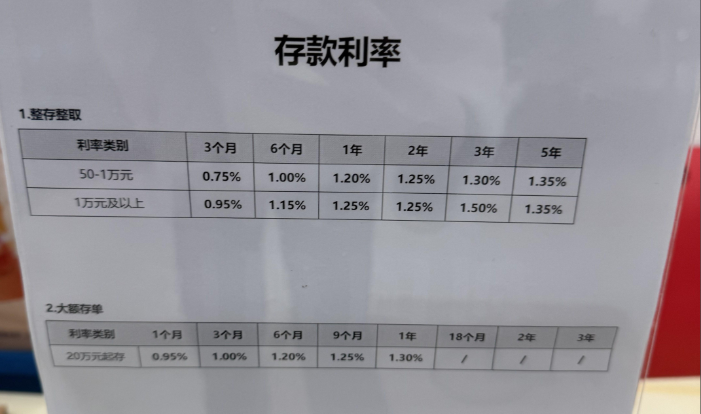
Core Viewpoint - Multiple banks in China have been actively launching large-denomination certificates of deposit (CDs) for the first issue of 2026, with over 30 banks announcing their issuance by January 7, 2023. The interest rates for some short-term CDs have dropped below 1%, approaching levels similar to regular fixed-term deposits [1]. Group 1: Bank Actions - As of January 7, 2023, more than 30 banks have released announcements for the first issue of large-denomination CDs for 2026 [1]. - Yunnan Tengchong Rural Commercial Bank plans to issue 0.1 billion yuan of large-denomination CDs with a three-month term and an interest rate of only 0.95% [1]. - At least three private banks have announced interest rate cuts starting in January 2026, indicating a faster pace of rate reductions in this sector [1]. Group 2: Interest Rate Trends - The interest rates for three-month short-term large-denomination CDs have fallen to below 1%, marking a significant decline [1]. - The interest rates for regular fixed-term deposits are now comparable to those of large-denomination CDs, reflecting a broader trend in the banking sector [1]. - The interest rates for large-denomination CDs starting from 200,000 yuan are as follows: 0.95% for 1 month, 1.00% for 3 months, and 1.20% for 6 months [2].
部分银行下调存款利率!
Zhong Guo Jing Ying Bao· 2026-01-08 00:31
Group 1 - Several small and medium-sized banks have recently lowered their deposit interest rates, with some banks reducing the one-year fixed deposit rate by up to 30 basis points (BP) [1][2] - For example, Puyang Zhongyuan Village Bank announced a reduction in various fixed deposit rates effective January 7, 2026, with three-month, six-month, and one-year rates decreasing by 30 BP to 1.05%, 1.25%, and 1.40% respectively [2] - Anhui Xin'an Bank and Qing'an Rural Commercial Bank also announced reductions in their deposit rates, with Qing'an reducing rates for various terms by 5 to 30 BP [2][3] Group 2 - The overall trend for deposit rates is downward, influenced by the current macroeconomic environment and the expectation of further monetary easing, including potential cuts in reserve requirements and interest rates [4][5] - The People's Bank of China has indicated a commitment to maintaining a moderately loose monetary policy to keep social financing costs low, which may lead to lower loan rates for residents and businesses [4] - Analysts predict that as loan rates decrease, deposit rates will also continue to decline, reflecting ongoing pressure on banks to manage their funding costs [5]
银行职员透露:2026年起,手里有定期存款的人,尽量做好这4个准备
Sou Hu Cai Jing· 2026-01-02 04:38
Core Viewpoint - The increasing enthusiasm of depositors to save money is driven by concerns over unemployment and health emergencies, as well as the perceived risks associated with higher-yield investment products like stocks and funds [1]. Group 1: Deposit Trends - In the first eleven months of 2025, residents' deposits increased by 120.6 billion yuan [1]. - The decline in deposit interest rates has been noted since 2023, with the three-year fixed deposit rate dropping from 3.25% to 1.75%, resulting in a decrease of 1,500 yuan in annual interest income for a 100,000 yuan deposit [6]. Group 2: Recommendations for Depositors - Depositors should consider moving funds to joint-stock banks, which typically offer higher interest rates than state-owned banks, while still being safer than village and commercial banks [6]. - For deposits exceeding 200,000 yuan, purchasing large-denomination certificates of deposit (CDs) is advisable, as they offer higher rates and transferability [6]. - A diversified asset allocation strategy is recommended to counteract the inability of deposit rates to outpace inflation, with examples provided for conservative investors [9]. Group 3: Liquidity and Safety - Maintaining liquidity is crucial; depositors are advised to avoid locking all funds in long-term deposits to prevent losses from early withdrawals due to emergencies [12]. - A suggested strategy includes keeping a portion of funds in short-term large-denomination CDs while locking the remainder in longer-term deposits [12]. Group 4: Bank Stability Concerns - The number of small bank failures is expected to rise, with recent examples including Baoshang Bank and Liao Yang Rural Commercial Bank [17]. - Depositors should ensure their banks display deposit insurance symbols, diversify their deposits across multiple banks, and understand the difference between deposits and investment products to ensure coverage in case of bank failures [17].