
银行治理结构优化

Search documents
东莞农商银行管理权移交市政府,治理结构优化获行业认可
Jing Ji Guan Cha Wang· 2026-02-21 02:36
Company Structure and Governance - On February 17, 2026, Dongguan Rural Commercial Bank announced that, with the approval of the Guangdong provincial government, its management rights would be transferred from the Guangdong Rural Credit Cooperative Union to the Dongguan municipal government, which will also assist in managing Puning Rural Commercial Bank. This adjustment aims to strengthen localized operations and enhance the ability to serve the local economy, and is expected to have no significant impact on daily operations [1] - On January 8, 2026, the bank was approved to amend its articles of association, eliminating the supervisory board and audit department, with the audit committee of the board taking over the supervisory functions and the establishment of employee directors. This adjustment aims to simplify governance levels and aligns with the regulatory trend of modernizing bank governance [1] Industry Position - On February 5, 2026, Dongguan Rural Commercial Bank ranked 37th in the "2025 China Banking Industry Competitiveness Top 100," rising 6 places from 2024, reflecting its asset scale (reaching 745.904 billion yuan by the end of 2024), profitability, and recognition of its digital transformation within the industry [2]
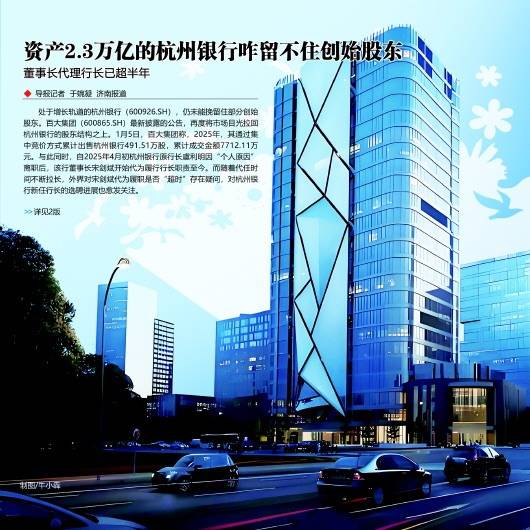
资产2.3万亿的杭州银行咋留不住创始股东 董事长代理行长已超半年
Sou Hu Cai Jing· 2026-01-13 01:42
Core Viewpoint - The article highlights the ongoing changes in the shareholder structure of Hangzhou Bank, particularly focusing on the divestment actions of Baida Group and the implications for the bank's governance and performance [3][6]. Shareholder Changes - Baida Group announced the sale of 4.9151 million shares of Hangzhou Bank in 2025, generating a total transaction amount of 77.1211 million yuan, which impacted the net profit attributable to the parent company by 5.9271 million yuan [3][6]. - As of January 5, 2026, Baida Group retained 4.3764 million shares of Hangzhou Bank [3]. - Baida Group has been reducing its stake in Hangzhou Bank since 2017, with a notable reduction of 7.838 million shares in 2022 and 4.3291 million shares in 2024 [5][6]. Historical Context - Baida Group has been a founding shareholder of Hangzhou Bank since its establishment in 1996, reflecting its long-standing connection to the bank [4]. - The bank was listed on the Shanghai Stock Exchange in 2016, marking a significant milestone in its growth [4]. Performance Metrics - For the first three quarters of 2025, Hangzhou Bank reported a revenue of 28.88 billion yuan, a year-on-year increase of 1.35%, and a net profit of 15.885 billion yuan, up 14.53% year-on-year [12]. - The bank's net interest income reached 20.093 billion yuan, growing by 9.96%, while net income from fees and commissions rose by 12.65% to 3.298 billion yuan [12]. - As of the end of Q3 2025, Hangzhou Bank's total assets amounted to 2.30 trillion yuan, reflecting an 8.67% increase from the previous year [12]. Governance and Management - Following the resignation of the former president in April 2025, the chairman, Song Jianbin, has been acting as the president for over eight months, raising concerns about the prolonged interim leadership [11][12]. - The bank has undergone significant governance changes, including the decision to abolish the supervisory board, with Wang Lixiong appointed as vice president [10][12].


五大国有银行同日官宣:不再设立!
Zhong Guo Jing Ying Bao· 2025-09-25 15:17
Core Viewpoint - The major state-owned banks in China have announced the abolition of their supervisory boards in response to new regulations set to take effect in July 2024, aiming to streamline governance structures and enhance decision-making efficiency [1][2]. Group 1: Regulatory Changes - Five major state-owned banks, including Agricultural Bank of China and Industrial and Commercial Bank of China, received approval from the National Financial Regulatory Administration to abolish their supervisory boards [1]. - This change is driven by the new Company Law of the People's Republic of China, which will be implemented on July 1, 2024, and a subsequent notification from the National Financial Regulatory Administration [1][2]. Group 2: Implications for Governance - The cancellation of supervisory boards is expected to simplify governance structures and reduce management costs, particularly benefiting smaller banks by concentrating management resources [2]. - Decision-making efficiency is anticipated to improve as the traditional "three meetings" model (shareholders' meeting, board meeting, supervisory board) becomes less cumbersome, allowing banks to respond more swiftly to market changes [2]. - The move aligns with international corporate governance trends, bringing Chinese banks closer to mainstream global practices and enhancing the modernization of corporate governance [2]. Group 3: Role of Audit Committees - The notification clarifies that financial institutions can establish audit committees within the board of directors to assume the supervisory functions previously held by supervisory boards [2][3]. - Audit committees, typically composed of independent directors with financial and auditing expertise, are expected to enhance the professionalism of oversight in areas such as risk management and financial compliance [3]. - The integration of supervisory functions into audit committees aims to eliminate overlapping responsibilities and optimize the allocation of supervisory resources [3].


