银行股权增持

Search documents
ECB poised to give conditional approval to Credit Agricole stake increase in Banco BPM
Reuters· 2026-01-11 10:08
Core Viewpoint - The European Central Bank (ECB) is nearing a conditional approval for Credit Agricole's request to increase its stake in Banco BPM, as reported by several Italian media outlets [1] Group 1: Company Developments - Credit Agricole is seeking to raise its stake in Banco BPM, indicating a strategic move to strengthen its position in the Italian banking sector [1] - The ECB's conditional clearance suggests that there may be specific requirements or stipulations that Credit Agricole must meet before the increase is fully approved [1] Group 2: Industry Implications - This potential stake increase reflects ongoing consolidation trends within the European banking industry, particularly in Italy, where banks are seeking to enhance their competitive positioning [1] - The ECB's involvement highlights the regulatory scrutiny that accompanies significant changes in ownership within the banking sector, emphasizing the importance of compliance with European financial regulations [1]


持股比例升至16%,大股东国发集团再度增持苏州银行
Huan Qiu Lao Hu Cai Jing· 2025-12-09 06:08
Core Viewpoint - Suzhou Bank's major shareholder, Guofa Group, has significantly increased its stake in the bank, reflecting confidence in the bank's future and aligning with the local government's strategy to optimize state-owned capital layout [2][3]. Group 1: Shareholding Changes - Guofa Group and its concerted parties have cumulatively increased their holdings in Suzhou Bank by approximately 44.71 million shares, accounting for 1.00% of the total share capital from July 1 to December 5 [1]. - After the increase, Guofa Group holds a total of 715 million shares, representing 16.00% of Suzhou Bank's total share capital [2]. - This is the second large-scale increase by Guofa Group in 2023, following an earlier acquisition of 118 million shares from January 14 to June 26, with a total investment of 856 million yuan [2]. Group 2: Corporate Governance and Management - The continuous increase in shareholding has altered Suzhou Bank's ownership structure, with Guofa Group becoming the controlling shareholder, and the Suzhou Municipal Finance Bureau emerging as the actual controller [3]. - In September, 12 members of Suzhou Bank's board and senior management collectively purchased approximately 600,000 shares, representing 0.0134% of the total share capital, at a total cost of 4.96 million yuan [3]. Group 3: Financial Performance - For the first three quarters of the year, Suzhou Bank reported a revenue of 9.48 billion yuan, a year-on-year increase of 2.02%, and a net profit attributable to shareholders of 4.48 billion yuan, up 7.12% year-on-year [3]. - As of September 30, Suzhou Bank's total assets reached 776.04 billion yuan, an increase of 11.87% from the beginning of the year, with total loans and deposits growing by 10.56% and 13.08%, respectively [4]. - The bank's non-performing loan ratio remained stable at 0.83%, with a provision coverage ratio of 420.59% as of the end of September [4].
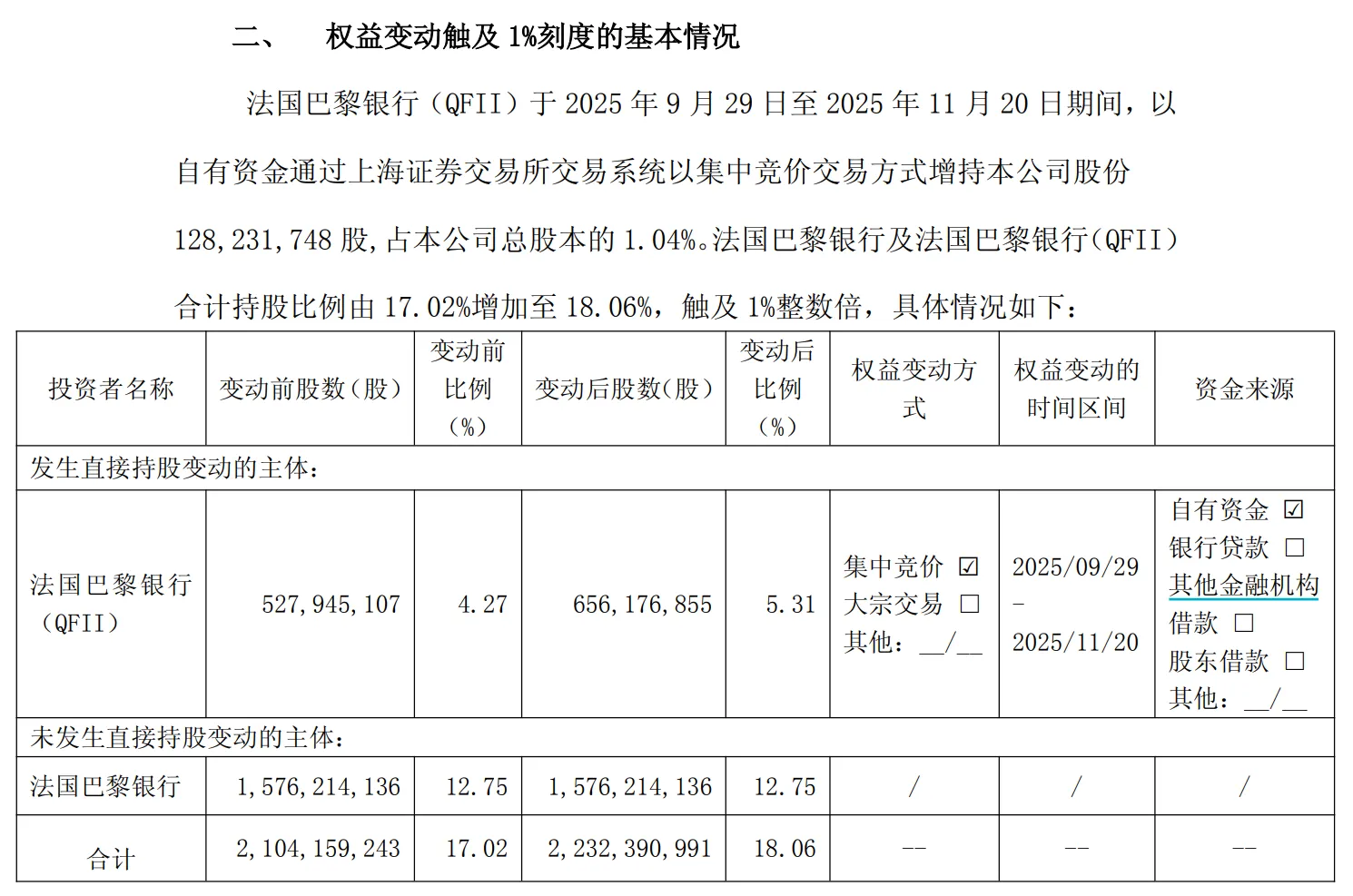
南京银行:股东法国巴黎银行(QFII)增持1.28亿股
Cai Jing Wang· 2025-11-21 14:19
Core Viewpoint - On November 21, Nanjing Bank (601009) announced that BNP Paribas (QFII) increased its shareholding in the bank by 128 million shares, representing 1.04% of the total share capital, reflecting confidence in the bank's future development and value growth [1]. Group 1 - BNP Paribas (QFII) increased its shareholding from 527,945,107 shares (4.27%) to 656,176,855 shares (5.31%) through centralized bidding on the Shanghai Stock Exchange [2][3]. - The total shareholding of BNP Paribas and BNP Paribas (QFII) rose from 2,104,159,243 shares (17.02%) to 2,232,390,991 shares (18.06%), reaching a 1% integer multiple [1][3].

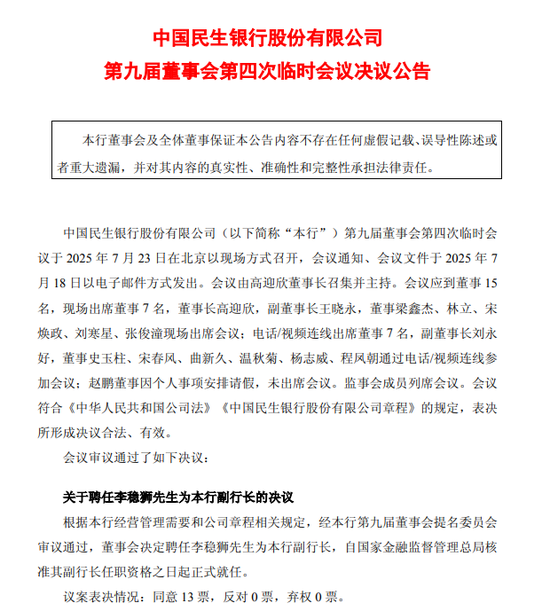
民生银行之变:“75后”李稳狮获聘副行长,深圳前首富林立获批董事资格
Xin Lang Cai Jing· 2025-07-29 00:49
Core Viewpoint - Recent management changes at Minsheng Bank include the appointment of Li Wenshi as vice president and the retirement of Shi Jie due to age [1][2][9] Group 1: Management Changes - Li Wenshi, born in 1977, has been appointed as vice president of Minsheng Bank, pending regulatory approval [1][2] - Shi Jie has retired from his position as vice president due to age, effective July 23, 2025 [7][9] - The current executive structure consists of one president and five vice presidents, with a notable presence of "post-70s" executives [1][9] Group 2: Li Wenshi's Background - Li Wenshi joined Minsheng Bank in 2004 and has held various positions, including branch manager and department head [7] - He has received multiple accolades, including being named a "contributor to Minsheng development" and a "financial service expert" [7] - His educational background includes a law degree from Shanxi University and an MBA from Tsinghua University [5] Group 3: Shi Jie's Contributions - Shi Jie, born in 1965, has served in various roles within Minsheng Bank since 2016 and has been recognized for his dedication and contributions [8][9] - His tenure included significant involvement in optimizing business structure and enhancing risk management capabilities [9] Group 4: Shareholding Changes - Lin Li has been approved as a director of Minsheng Bank, with his company, Liyue Group, increasing its shareholding to nearly 5% [10][11] - Liyue Group's shareholding has risen to 4.945%, just below the 5% threshold for mandatory disclosure [11] Group 5: Asset Management Strategy - Minsheng Bank has been actively working to resolve historical non-performing assets, with a focus on cash recovery strategies [14][15] - The bank reported a total asset of 7.78 trillion yuan, with a non-performing loan ratio of 1.46% and a provision coverage ratio of 144.27% [15]