销售费用高企

Search documents
离婚案致沃华医药实控人变更 公司销售费用仍然高企
Xin Jing Bao· 2025-11-06 11:55
Core Viewpoint - The actual controller of Wohua Pharmaceutical has changed due to a prolonged divorce property dispute, resulting in a lack of a single controlling party over the company [1][4]. Group 1: Control Change - The change in actual control stems from a divorce property dispute lasting 15 years between Zhao Bingxian and Lu Juan, with the core issue being the equity of Zhongzheng Wanrong [1]. - The Beijing Third Intermediate People's Court upheld the first-instance ruling to equally divide the shares of Zhongzheng Wanrong, leading to both parties holding 50% of the shares, thus resulting in no single controller for Wohua Pharmaceutical [1][4]. Group 2: Company Operations - Despite the change in control, Zhao Bingxian continues to serve as the chairman and legal representative of Zhongzheng Wanrong and Wohua Pharmaceutical, and the company's operations remain unaffected [2]. - Wohua Pharmaceutical has a history dating back to the Qing Dynasty and operates as a comprehensive traditional Chinese medicine enterprise with key products including Wohua Xinkeshu Tablets and Bone Health Capsules [3]. Group 3: Financial Performance - Wohua Pharmaceutical has experienced declining revenue and net profit from 2020 to 2024, with revenues of 10.06 billion, 9.43 billion, 10.15 billion, 9.1 billion, and 7.64 billion respectively, reflecting changes of 16.95%, -6.3%, 7.65%, -10.38%, and -16.02% [3][5]. - The decline in revenue is attributed to a drop in sales of core products, particularly Wohua Xinkeshu Tablets, which saw a price reduction of approximately 39% after entering a centralized procurement range [5]. - In 2025, Wohua Pharmaceutical's performance began to recover, with a reported revenue of 4.25 billion in the first half, a year-on-year increase of 7.64%, and a net profit of 446.76 million, up 303.16% [6]. Group 4: Sales Expenses - Sales expenses have consistently remained high, with figures of 4.71 billion, 4.22 billion, 5.21 billion, 4.92 billion, and 3.89 billion from 2020 to 2024, representing 46.82%, 44.75%, 51.34%, 54.07%, and 50.92% of revenue respectively [7]. - Even with a recovery in 2025, sales expenses reached 2.15 billion, accounting for 50.59% of revenue, indicating that over half of the revenue is allocated to sales efforts [7].


离婚案致沃华医药实控人变更,公司销售费用仍然高企
Bei Ke Cai Jing· 2025-11-06 11:49
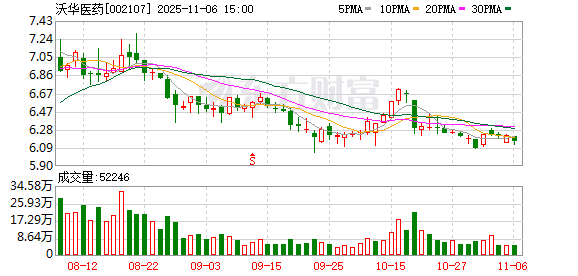
Core Viewpoint - The actual controller of Shandong Wohua Pharmaceutical Technology Co., Ltd. has changed due to a court ruling on a long-standing divorce property dispute, which may impact the company's operations and performance during a critical recovery phase [1][3]. Group 1: Control Change - The change in actual control of Wohua Pharmaceutical stems from a 15-year divorce property dispute between Zhao Bingxian and Lu Juan, which has now concluded with a court ruling [1][3]. - Zhao Bingxian previously held 80% of the shares in Zhongzheng Wanrong Investment Group, the controlling shareholder of Wohua Pharmaceutical, which owned 50.27% of the company [3]. - Following the court's decision, both Zhao and Lu now hold 50% of Zhongzheng Wanrong, resulting in no single party being able to control the company, thus leading to a state of no actual controller [3]. Group 2: Financial Performance - Wohua Pharmaceutical has experienced a decline in revenue and net profit from 2020 to 2024, with revenues of 1.006 billion, 943 million, 1.015 billion, 910 million, and 764 million respectively, reflecting changes of -16.95%, -6.3%, 7.65%, -10.38%, and -16.02% [5]. - The net profit has also decreased significantly, with figures of 179 million, 163 million, 107 million, 58.76 million, and 36.4 million, showing year-on-year changes of -86.72%, -8.66%, -34.28%, -45.27%, and -38.05% [5]. - The decline in core product sales, particularly the Wohua Xinkeshu Pian, which saw a price drop of approximately 39% after entering a centralized procurement range, has been a major factor in the revenue decline [5]. Group 3: Recent Recovery - Wohua Pharmaceutical's performance began to recover in 2025, with a reported revenue of 425 million in the first half, marking a 7.64% increase year-on-year, and a net profit of 44.68 million, up 303.16% [6]. - The third-quarter report for this year indicated revenues of approximately 625 million, an increase of 8.31%, and a net profit of about 63.99 million, up 179.34% [7]. - Despite the recovery, the company continues to face high sales expenses, which accounted for over 50% of revenue, with sales expenses of 471 million, 422 million, 521 million, 492 million, and 389 million from 2020 to 2024 [7].
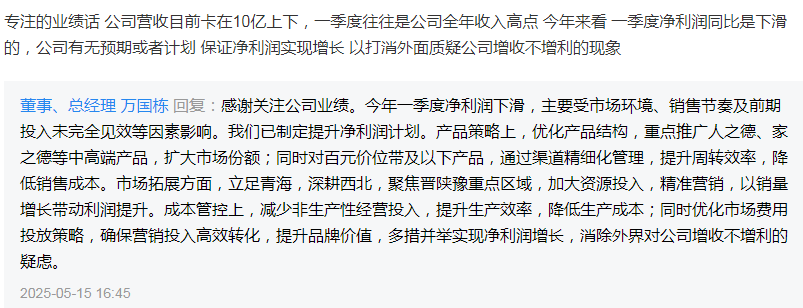
“增收不增利”“销售费用高企”“海外投资亏损”,面对三大质疑,天佑德酒回应了些什么?
Mei Ri Jing Ji Xin Wen· 2025-05-15 13:41
Core Viewpoint - Tianyoude Liquor has faced significant challenges in maintaining profitability, with net profit consistently below 100 million yuan over the past five years, and a notable decline of 52.96% in 2024 compared to the previous year, raising concerns among investors about the company's growth prospects [1][3][4]. Financial Performance - In 2024, Tianyoude Liquor's net profit decreased by 52.96%, while revenue only grew by 3.69%, indicating a troubling trend of "increasing revenue without increasing profit" [1][4]. - The company's first-quarter net profit for 2024 was 67.5 million yuan, marking a 37.69% year-on-year decline and the lowest quarterly profit in nearly five years [4][5]. Sales and Marketing Challenges - The company reported a 12.5% increase in sales expenses for 2024, totaling 324 million yuan, with advertising and marketing costs rising by 21.37% to 182 million yuan [6]. - Sales expenses accounted for 25.85% of revenue in 2024, ranking fifth among all listed liquor companies, yet the revenue growth did not align with this high expenditure [6]. International Expansion and Losses - Tianyoude Liquor's subsidiary, Oranos Group, has faced continuous losses, accumulating over 100 million yuan in losses over the past seven years, with a loss of 21.06 million yuan in 2024 alone [7][8]. - Despite the ongoing losses, the company remains committed to its U.S. market strategy, believing in the potential of the market and planning to continue investing in its U.S. subsidiary [7][8].