
长三角港口一体化

Search documents
起底长三角“亿吨港口”之变:从大港看大国经济发展韧性
Xin Hua Ri Bao· 2026-01-16 15:40
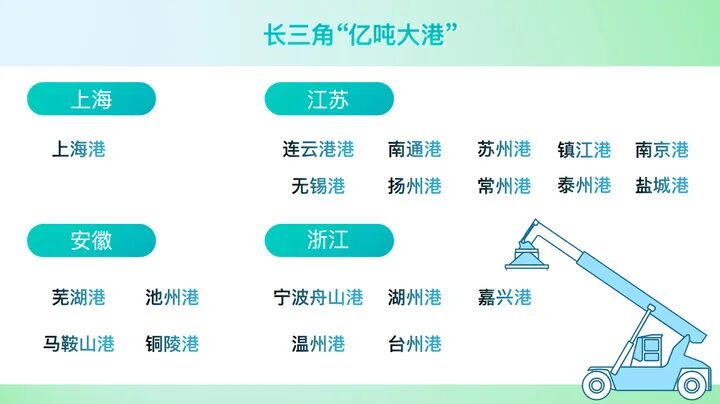
Core Insights - The article highlights the significant achievements of ports in the Yangtze River Delta, showcasing their role as economic indicators and their contributions to global trade [1][17] - The region has successfully unlocked the "Double Twenty" achievement, with 20 out of 63 major ports in China located in the Yangtze River Delta, accounting for nearly one-third of the total [1] Port Performance - Shanghai Port's container throughput exceeded 55.06 million TEUs in 2025, setting a new historical record [1] - Ningbo-Zhoushan Port achieved a cargo throughput of over 1.4 billion tons, maintaining its position as the world's largest port for 17 consecutive years [1] - Wenzhou Port and Taizhou Port both reached cargo throughput of over 100 million tons, marking their entry into the "billion-ton port" club [2] Historical Context - Wenzhou Port's development faced limitations for years until a comprehensive planning approval in 2008 led to significant growth, achieving a throughput of 50.43 million tons for the first time [3] - The goal of becoming a "billion-ton port" was set in 2010, and it took nearly 16 years to realize this ambition [3] Competitive Dynamics - The competition between Wenzhou Port and Taizhou Port is highlighted, with both ports strategically positioning themselves to enhance their capabilities and market presence [4][5] - Taizhou Port's throughput nearly doubled from 50.91 million tons in 2020 to significant levels by 2025, supported by substantial investments [4] Infrastructure and Investment - Taizhou Port invested over 7 billion yuan during the 14th Five-Year Plan period, adding 22 new berths and increasing its annual throughput capacity by approximately 24.5 million tons [4] - The article emphasizes the importance of infrastructure development in enhancing port capabilities and competitiveness [4] Regional Integration - The Yangtze River Delta ports are part of a coordinated development strategy, with a focus on collaboration and integration among ports in the region [14][15] - The establishment of the Shanghai Port Management Committee in 1997 marked the beginning of systematic planning for port integration in the region [14] Economic Impact - The ports serve as critical nodes connecting land and water, reflecting the vitality of foreign trade and the economy [11] - In 2025, China's foreign trade reached 45.47 trillion yuan, marking a 3.8% increase and reinforcing its position as the world's largest trading nation [17]

向海而兴,“洋太”破浪 如东洋口港“洋太”集装箱航线正式开通
Yang Zi Wan Bao Wang· 2025-09-28 04:39
Core Points - The "Yangtai" container shipping route has officially opened, connecting key ports in Jiangsu and enhancing regional logistics efficiency [1][2] - The route operates on a fixed weekly schedule, significantly reducing logistics costs and carbon emissions [1][2] Group 1: Route Details - The "Yangtai" route starts from Lianyungang, stops at Yancheng Dafeng Port and Rudong Yangkou Port, and ends at Taicang Port, covering approximately 159 kilometers with a one-way journey of about 12 hours [1] - This route fills the gap in container transportation at Yangkou Port, which has long lacked efficient shipping options despite its deep-water advantages [1] Group 2: Strategic Importance - The route is seen as a critical logistics artery linking the Yangtze River Economic Belt and the Coastal Economic Belt, marking a "zero breakthrough" for container business at Yangkou Port [1][2] - The development is expected to enhance the overall service capability of the port, particularly in container logistics, which has been a limitation for regional industry chains [2] Group 3: Economic Impact - The fixed schedule and reduced transit time provide certainty for businesses, aiding in production planning and contract fulfillment, which is crucial for cost reduction and efficiency [2] - The establishment of this route is anticipated to attract high-value industries sensitive to logistics costs, promoting local economic growth and creating a positive cycle of port-driven industrial development [2]
首批洋山港—吕四港“联动接卸”货物通关
Xin Hua Ri Bao· 2025-05-13 22:01
Core Insights - The "Linked Unloading" model has been successfully implemented, marking a significant innovation in customs supervision and enhancing the integration of ports in the Yangtze River Delta region [1][2] - This model allows for direct customs clearance at Lusi Port, reducing logistics costs and improving efficiency for businesses in the region [1][2] Group 1: Implementation and Benefits - The first batch of goods using the "Linked Unloading" model departed from Lusi Port to Yangshan Port, indicating the model's successful launch in Nantong [1] - The model eliminates traditional customs procedures, allowing goods to be directly transported from Lusi Port to Yangshan Port, thus saving logistics costs by 400 yuan per container and shortening delivery times [1][2] - In Q1 of this year, the customs supervision at Lusi Port managed 71,000 tons of import and export goods, a year-on-year increase of 36.8%, with container throughput reaching 49,000 TEUs, up 41.43% [1] Group 2: Future Developments - The customs authority plans to hold a promotional meeting to summarize pilot experiences and optimize regulatory processes for the "Linked Unloading" model [2] - There are ongoing efforts to enhance the "Smart Port" initiative, utilizing IoT technology for real-time tracking of goods and sharing regulatory data with Yangshan Port to improve logistics services [2]